Monday, May 25, 2020

From the trenches #4 Memorial Day 2020

From the trenches #4  Memorial Day 2020

As we start reopening, what have we learned about living with COVID-19 and how might we think about this? Just my view From the Trenches.
Stay-at-home orders and shuttering businesses are blunt tools. Its a strategy from the Pandemic Playbook, (yes, there really is one) employed when testing and contact tracing are not available. (Still not available… since January…) So stay-at-home effectively flattened the curve - sparing our hospitals from overwhelm, gave us time to learn about the coronavirus, sew masks, and get our testing and contact tracing programs in place. Blew dat last one “bigly” - as one might say. 

As businesses start to open and we creep from our homes; how do we assess which activities are high-risk and how or can we make them safer? What kind of information is useful and what should we pay attention to?

Look East (China, S. Korea, Singapore, Hong Kong). The East precede us in the pandemic waves. The first wave hit hard, they locked down to get things under control, started to reopen, and they are now experiencing flare-ups. Secondary to new infections, China recently locked-down another city and closed all movie theaters throughout the country after reopening just 600. We will experience flare-ups too. Watch the East; they are our crystal ball.
Unfortunately, coronavirus will not “go poof” and miraculously disappear. The virulent virus is still alive-and-well amongst us, and we’ve learned that hand-washing, physical distancing and mask wearing will help keep us safe.

Hand-washing (or sanitizing): Well known surgeon and medical author Atul Gawande weighs in on hand washing guidelines. “Behave as if you are the one with the virus,” he says. Yes, 20-seconds and about 10 times a day (if you are not working in a high-risk environment.) Wash before you go into a new place (to insure you are not the vector bringing virus in), wash or sanitize when you leave (in case you picked up virus there) and before you touch your car keys.
My FAVORITE hand-washing PSA from Viet Nam:
https://www.youtube.com/watch?v=Owcdxs_7dWw 

Little kids might also really like the Rock hand-washing with his daughter to Moana’s, You’re Welcome.
https://www.youtube.com/watch?v=cvHtcYHy4eI

Physical (social) distancing: notice that it really is PHYSICAL distancing, not social distancing. CA’s Governor Gavin Newsom has also changed his verbiage, swapping physical for social. During the Black Death or Bubonic Plague of the 14th century, doctors prodded patients with a long stick. While they did not know of bacterium spread by fleas, they did learn that keeping their distance increased personal safety. Why? Because their stick kept them beyond the range of jumping fleas. Later, the Pneumonic Plague was spread by respiratory droplets.
With nearly 100,000 dead over a 3-month period, this is hardly a hoax nor similar to our annual flu. Do you really want to tempt fate when simply keeping your distance might save your life? 
“I’m healthy,” you say, “I have a strong immune system.” …so did many of our dead.

Gang canny is a departing salutation from Scotland; it means go carefully. One of my patients recently shared it and methinks its apropos. Those in high-risk groups should go carefully. CDC still maintains those most at-risk for death are 65 years and older with a mortality rate of 1.3%. Next most at-risk for death are 50-64 years; mortality of 0.2%. (Flu mortality is ~ 0.1%) Experts believe the common and somewhat reversible diseases of diabetes and obesity - because of systemic inflammation, also put people at increased risk.
   
Can one golf safely? What about going to parks, rivers, and beaches. Yes, of course! Outside is safer than in; adding physical distancing and hand washing makes it infinitely safer.
Bowling? Movie theater? Churches? Gyms? Not until we figure out how to make them safer. They represent places where people gather or congregate (congregate spaces) with surfaces that are frequently shared and touched.

Masks: to wear or not to wear, that is the question. “The challenge is that our culture, our discussion in American life right now is about freedom versus safety, leave me alone versus keep me safe,” Atul Gawande said. “We overcame this in the healthcare sector by saying, ‘I want to come to work every day never wanting to infect anybody else.’ I never want to cause someone else to be in the morgue.” 
We have learned that coronavirus is primarily spread through droplets. We now know that up to 35% of infected people have NO symptoms and can spread the virus. We call them “asymptomatic spreaders”. A simple cloth mask will interrupt most of that. 
In our society, it is reflexive to cover a cough or sneeze, most frequently with one’s hand. And that is one way droplets move to surfaces: door knobs, elevator buttons, handrails, etc. A simple cloth mask will interrupt most of that.
“Don’t touch your face,” they say. Touching one’s face is unconscious and reflexive. A simple cloth mask will interrupt most of that. 
“I know I’m not sick, so why should I wear a mask?” Because we now know that up to 35% of infected people have NO symptoms and are capable of spreading the virus. That could be you. Wearing a simple cloth mask demonstrates that you care about those around you. Not wearing a mask also sends a message.

Outside vs Inside: Virus is dispersed into the air. Outside, the virus dissipates quickly, sunlight kills it, and inhaling a large concentration of virus becomes less likely. In an enclosed space, say a choir loft or doctor’s exam room, the concentration of virus builds up over time - making time in an enclosed space more risky.
Think of Easter egg dye in water. If you put 20-drops of red dye (represents virus) into a coffee cup filled with water (represents small, enclosed space), you will concentrate the dye and have red water (= lots of virus in small space). If you put 20-drops of red dye into a 5-gallon bucket of water, the dye dissipates and the water will look clear. And that is what makes outside safer than inside. 
Want to visit with friends? Do it outside. There has been plenty internet shaming of people having cocktails in their front yards with friends and family. But evidence shows - that’s the way to do it. My own cul-de-sac hosts 6 sets of grandparents visiting their grandkids in similar fashion. BYOF picnics: bring your own food and set up 6 feet apart.
Haircuts? Last week, a Springfield Missouri hairstylist, working sick X 8 days, exposed 91 known people - and they in turn, exposed hundreds. Haircutting is a recipe for close physical contact and lots of conversation. Wear masks. Minimize talking. Hold your mask to your face when the elastic around your head must be removed for haircutting. No talking when shampooing; a time when a gabbing hairstylist towering over an upturned face can literally be a viral shower. Make it even safer by having a dry cut outside.

Time: short vs long. Time = exposure. How long are you going to be exposed to others? A longer time increases the possibility of viral spread.
If someone jogs by - breathing heavy - holding one’s breath is a reasonable strategy while they jog away. What about singing or loud, slobbery talkers? Move away, add physical distance as all three activities are known to produce more droplets.
My own ukulele group KaBang! is back to in-person rehearsals - we are outside and spaced 6-8 feet apart.

What should we pay attention to?
I remember asking one of my ED physician mentors about using a drug “off label,” that is - using it for an unapproved, often unproven purpose. Kinda like using a drug for Lupus to prevent coronavirus… . What my mentor said has been with me for 20-years. He said, “I never presume that I am smarter than the team of experts who read all the studies and created the guideline.” All that to say - follow the science from vetted sources. 

Watch local stats: Keep tabs on the number of local confirmed infections and deaths. If numbers increase; up your game. Stay-at-home, decrease activities involving others, use more caution. Instead of continuing to open up, reverse direction and start closing down - like China is doing right now. We KNOW these starts and stops are coming. For us to survive a virus for which there is no vaccine and no natural immunity, ignore science at your own peril.

Where do we get good information? Find your local stats.
  1. Sacramento Coronavirus Stats (website below). California currently has 2405 cases/1M (million) = 2.4 cases/1000. These are cautious-open-up stats. If cases rise - pull back in your activities and lifestyle. Don’t wait for Gov Newsom’s announcement.
  2. Watch for the impact that opening up on Memorial Day weekend has on our area. New cases will increase in 7-14 days if we have not been sufficiently careful.                 

US Coronavirus Stats

Navigating the website:
See upper right corner dialogue box: Case Overview.   
At the bottom middle of that box, go to:   more locations and statistics.  
Choose: United States then look for California, then Sacramento. It currently reads 2405 cases/1M (million) = 2.4 cases/1000    

Sacramento Epidemiology maps - search by zip code
https://sac-epidemiology.maps.arcgis.com/apps/webappviewer/index.html?id=ad477bb955dc49e78d0a19b78bbd09dd   

3) CDC Coronavirus (COVID-19) site: While I personally think the CDC has been sidelined, muzzled, and their website scrubbed, I am not confident that they would actually publish false data. So while their website is not as  thorough and complete as in years of yore, I still believe that the information posted is accurate. Methinks you can use them as a reliable source of accurate data.
https://www.cdc.gov/coronavirus/2019-ncov/index.html

On 5/25, CDC did post their long awaited detailed plan for opening businesses, churches, schools, etc.

4) Other useful articles: 
                  
From Camping To Dining Out: Here's How Experts Rate The Risks Of 14 Summer Activities

The Coronavirus in America: The Year Ahead

Social Distancing is not Enough: The Atlantic 5/22/2020
https://www.theatlantic.com/ideas/archive/2020/05/how-will-we-ever-be-safe-inside/611953/

Atul Gawande on Handwashing

Much love and aloha to you all and Gang canny = go carefully. ~ Lorin

ps - feel free to share my blog.

Thursday, March 26, 2020

From the Trenches

From the Trenches
  1. I want to share with you how seriously people in the medical field take this virus. I have several friends who work in the Emergency Dept. (ED). When they return home after a shift, they strip down to underwear in the garage. Clothes go into the washer or into a clothes hamper. Shoes do not enter the house.
    Some dip the soles of their shoes into a light bath of Clorox and water. Why? Because we know that live virus can live on paper and clothing for some hours. If you leave them for a day, any attached virus will be dead. I do not work in an ED. Nonetheless, we have been instructed to do the same with our clothing each day. My shoes are shed at the door and I switch into house slippers.
  2. What advice do I have for those of you not hanging out
    with sick people everyday? Your home is your fortress; keep virus out. Have some hand sanitizer in your pocket and clean your hands before touching your car keys or door knob. 
  3. Leave your shoes at the doorway and switch to house shoes. Then of course, all the other stuff: social distancing, hand washing, cough/sneeze into your elbow (its a dance move called the Dab), etc. Do get outside and walk everyday - for at least 20 minutes. Check on someone who is elderly and/or lives alone - offer to grocery shop and deliver their groceries to their front door. They are precisely the people we want to keep out of the grocery store!
  4. China was on complete lockdown for 2 months and they have just recently experienced several days of no new cases. So they are turning the corner. Do NOT be lulled into hopefulness that everything will return to normal in a few weeks because Trump says so. Notice that the medical experts are no longer at his side when he pontificates.
  5. I’ve included this article by Dr. Larry Brilliant, an unconventional epidemiologist who speaks of past outbreaks and oversaw the eradication of all polio on earth in the 90’s. Of course, it has reemerged in the US secondary to anti-vaccers. He’s been there, done that. The first part of the article is stuff in which you are now well-schooled. Pay attention to the last part of the article, “How will we know when we’re through this?” There is also a link to his Ted Talk of 14-years ago, where he describes the next pandemic. Now that we’re here, his talk is prescient. Given that, I urge you to listen to doctors and politicians willing to heed their counsel.

Hand Sanitizer Recipe:

Leave your shoes OUTSIDE:
https://www.dailymail.co.uk/femail/article-8153619/Infectious-disease-specialists-warn-COVID-19-survive-soles-shoes-five-days.html?ITO=applenews


Stay safe y’all. Lotsa Aloha and virtual hugs ~ Lorin

Sunday, February 9, 2020

Happy 2020!

Hau’oli Makahiki Hou, Gung Hee Fat Choy, and Happy New Year! 

Sm shark moving thru feeder fish
December was so full of ukulele gigs that thoughts of getting my annual letter done swirled away in a whirl of activity. I hope your Holidays were grand and the New Year joyous. 
My 2019 in recap:
I journeyed to India with friends in February and spent my 63rd birthday in the Maldives. What an interesting trip. India is both puzzling and unique. The food was fantastic and, unlike in northern Europe, vegetarian food was more common than not. Pictures do not do the Taj Mahal justice. Gandhi’s grave is gorgeous. Shopping for Indian clothes is an event! (We westerners have NO idea…)
But India is not for those with respiratory illness. Seven of the world’s ten most air-polluted cities reside in India. I returned sick, on steroids, and with an appointment to meet my new Pulmonologist. (YIKES). Sadly, I will not return to India in my lifetime; I doubt they can clean their air sufficiently in the next three decades.
The Maldives are predicted to be the first island nation to submerge secondary to climate change - so we put it on our list. Each island desalinizes its own water and generates its power. The island sandbar we visited, Coco Bodu Hithi, could not have been six inches above sea level. 

I attended yoga school for 1-week during the summer. THAT WAS FUN. I’ve been working toward a “full lotus” position for many years and at the end of the week, I felt particularly flexible.

In early October (brrr), I coerced my hiking buddy Bill to fly out from Tampa and volunteer with me in Yosemite. We worked on various projects in Yosemite Valley until fire broke out about 10-miles west of the main (middle) park entrance. Smoke poured into the Valley, carried by the prevailing winds. Some volunteers left; I foolishly stayed. They moved our work to Tuolumne Meadows (LOVE meadow restoration projects) but we returned to the Valley each night to sleep. And while air quality improved steadily, I returned home to another protracted course of steroid and antibiotic therapy for asthma. This second, severe asthma exacerbation (finally) confirmed that when air quality drops, I must skedaddle. (duh!) 

Part of our Chun Clan
Of course, I returned home to Honolulu for New Years. Mom requires lots of help now for bathing and dressing. She has profound hearing loss and that affects her interest in participating. Her memory is declining, as it is wont to do when hearing loss affects one’s ability to even process words. She toddles with her cane around the public spaces of her building and attends some of their bigger events like movies and performances. I’ll return in April for her 95th birthday.
Aunt San and Aunt Corny are doing well. Still living independently in their home, attending Sunday night, Ohana (family) dinners, and shopping weekly in Chinatown with devoted nieces. (The Energizer bunny’s got nothing on this family.)

My band, KaBang (Kaneko, Bacon, & Yang, get it? KaBang!) played a few paying gigs this year. We added a bass player, Wade. So now we are KaBang and the Boy. We rehearse weekly, though sometimes less so as we are avid travelers. 
See and hear us perform at the winter kanikapila here:

How’s work? Work is fabulous. I work with a wonderful group of doctors, nurses, medical assistants, clerks, housekeepers, etc. My office mate Royal, is an exceptional nurse practitioner whom I call Dr. Gee (he knows everything). I am a mere 14-months from retirement and look forward to it more with each passing day.

My 2019 recommended reads: 
Hillbilly Elegy: A Memoir of a Family and Culture in Crisis. A hillbilly makes it to Harvard and takes a look back at the barriers in Appalachia that keep people stuck.
Strangers in Their Own Land: Anger and Mourning on the American Right.  Do you know an angry, white, disenfranchised person? Most of the world’s denizens would trade places with any American in a hot nano-second. I’ve often wondered what angry, white men are angry about. This book lends some insight into their world - one so different from my own.
Warmth or Other Suns: The Epic Story of America’s Great Migration. I didn’t know there was a great migration in the US; did you? This book follows several families who flee north and west from the Jim Crow South. It is a heart wrenching and moving recount of US history, not taught in schools.
The Bully Pulpit: Theodore Roosevelt, William Howard Taft and the Golden Age of Journalism. Teddy Roosevelt is the father of our National Parks; to him we owe a great debt. And he was a bully, overly confident, braggadocio, and egotistical. Despite his failings, he accomplished grand works because the gracious workhorse Taft, was at his side. These men exchanged beautifully supportive, affectionate, even sweet letters - all archived in the presidential library. This is a worthy, Pulitzer-Prize-winning tomb for those who love history.
The National Parks: America’s Best Idea. You’ve seen the Ken Burns documentary (and if you have not: STOP, do not pass go, do not collect $200 until you see the documentary!) The book contains a few more juicy details. If you are, as I, a lover of our National Parks. The movie and book bring them to life in living color when you cannot be immersed in their holy environs.
Michael Crichton from Andromeda Strain to Sphere. I believe I read or re-read every MC novel this year. He was one of our most riveting authors and died much too young. I love his body of work - you have seen many on the big screen. As usual, the books are better!

What’s on tap for 2020? 
I have reservations for the Spring Gathering in Yosemite Valley at the end of March. My volunteering friends say it is a wonderful event that updates volunteers on the progress of our multi-year projects and our focus for the coming season. I plan to camp in my van though winter may linger. 
Camel rides in Dubai

Planning a possible fall trip to the UK. I believe that Brexit offers a uniquely beneficial, financial opportunity to visit the UK, as I expect the pound to plummet. We’ll see if I’m right. Tentative itinerary: 1 week in London, a day or two in Liverpool for proper homage to the Beatles, then on to Scotland and Ireland. 
My traveling companion is John, of course. John and I became the best of friends on the first day of Nurse Practitioner training. I call him my adopted little brother; he is family. We find we travel well together, sharing small spaces w/o struggle. Lucky us. We’ve been all over the world together and this year will be no exception.


I do hope that you and yours are well and thriving. I would love to hear from you.
I’m a firm believer in blooming where you’re planted. Git yer flower on!

Much love and aloha ~ Lorin


Saturday, December 29, 2018

Hau’oli Makahiki Hou! 2019 New Year Letter

Hau’oli Makahiki Hou! Happy New Year to you and yours. 
     To enlarge, double click picture. Click X upper right corner to return to blog.

LB and the Duke @ Bishop Museum
I pray thee well and hope the new year finds you in good health and spirits. Barring that, I wish you vitality at every stage and any age. As I age myself, I find that “health” resembles moving target more than bull’s eye. I’ve turned my focus to vitality - the state of active, energetic, life with chi - which seems more a state of mind than body, such that vitality can be had from a hospital bed or dialysis chair. Such are the machinations of my mind in 2018.

I began the year by taking BAM (Baconz Adventure Mobile) to Redwoods National Park on the northern California Coast. The weekend was stormy, the rain incessant. I backed into my campsite, opened the sliding door, reached into the refrigerator, popped a beer, put up my feet, and watched the rain thinking, normally I’d be setting up my tent in this mess. Glorious!
En route to my volunteer week in Yosemite, I overnighted in Fresno to visit friend and fellow hiker, Leslie. Yosemite was engulfed in smoke and fire, the north-south corridor through the park was closed to all but firefighters. We drove to the Mariposa Sequoia Grove adjacent to the southern park border, newly opened after a four-year restoration project - the very grove protected by Lincoln’s pen, the very grove in which I had labored the previous summer. I gave Leslie the tour, highlighting the work that had been done to restore the wetlands and meadows within the grove. Work that would hopefully ensure the longevity and survival of the grove. During the two years that I volunteered in all three of Yosemite’s sequoia groves, I learned so much about sequoias and it was immensely satisfying to see the fruits of our labor.
The next day, I drove a circuitous route into Yosemite and to my volunteer week in
Budd Creek Sunset, Tuolumne Mdw by S Dunleavy
Tuolumne Meadows - where a multi-year restoration project was in year three. “I’m checking in for my work week,” I told the ranger at the campground kiosk. His eyes rose to take in BAM, “I thought you were moving in,” he laughed before directing me to our Yosemite Conservancy campsite. Meadow restoration is sooo interesting and the siren’s song to return to Tuolumne in 2019 is strong. Go to Volunteering in our National Parks 8/8/2018 to read more about meadow restoration and my volunteer workweek of 2018 at http://lorinzmuze.blogspot.com

As you know, California’s fires get bigger, hotter, and more destructive. Years of drought have left buku (beaucoup, like uber-plenty) dead fuel on the ground that can ignite a maelstrom from a flicked cigarette, a downed power line, sparks from the rim of a flat tire, a dragging haul chain or mower blade. 
My internal fire-bell began clanging in the wake of the Santa Rosa and Redding fires - cities not too dissimilar from my own. I finally made lists and packed “go-bags;” one for me and one for the cats. I had many discussions with my neighbors - we live against an oak-studded greenbelt after all. “Be not lulled into complacency,” I said, “Because the knock on the door seldom comes with more than minutes to evacuate.” When a “red-flag alert” was called for Sacramento County during the recent Paradise fire, I packed BAM for evacuation. For more on my own fire readiness and national recommendations for disaster, see my blog dated 8/4/2018 entitled Ready or Not - GO! at http://lorinzmuze.blogspot.com
NP Ranger Betty Reid Soskin
Sarah (ex mom-in-law) and I recently spent an afternoon at the Rosie the Riveter/World War II Home Front National Historical Park, located at the former Kaiser Richmond Shipyard #2. We went to hear Ranger Betty Reid Soskin speak. At 97 years, she is the oldest, serving ranger in the NPS. Employed as a clerk in the shipyards during WWII, she speaks of racial segregation and opportunities provided to all by Kaiser. A self-described “absolutely ordinary extraordinary person,” she says she took every opportunity to better herself and her situation. Now she keeps a vigorous speaking schedule and her lectures at the park are RSVP only. I found her inspirational and insightful.

Methinks: Leia, Alanna, Cora, Ayla
About the fam: Mom will turn 94 in April. She is definitely slowing and her deafness can be frustrating as well as isolating. Gina has spent most of 2018 in Newport Beach, CA helping Lael with new triplet daughters. Born in March, they are starting to take their first steps - triple-trouble for keeping them in sight! My nieces and nephews seem to be doing well. Collin will soon finish a 5-year electrician apprenticeship. Great-nephew Davin is 15; great-nieces Jaydalyn just turned 6 and Alanna will be 3 in a few days.
About me: I am 2 years and 3 months from retirement - yes, I’ve begun the countdown. I continue working in an adult medicine clinic and recently noticed that I am feeling much more comfortable in that role. Initially, I was so uncomfortable. It took me many months to realize that my career has been spent in a hospital, where I could order a test to justify the discharge of a patient and make myself feel more sure and comfortable. That is not how it works in a clinic. I am responsible for a thorough assessment that paints the picture for stable or not, urgent or emergent, discharge home or send to the ED - you get the picture. So while I have always enjoyed my work, this job is increasingly enjoyable as I feel less stress over mistakenly sending a very sick person home. I continue to do some insulin management for my docs: pre-op tune-ups, patients on chemo, dialysis or immunosuppression meds secondary to transplant. Their drugs make blood sugar management extremely challenging. It takes time, thought, careful calculation, and continues to be one of the most interesting tasks I perform. My docs are super appreciative.
I also continue to lecture to the graduating UCSF NPs on inpatient-outpatient diabetes care. To that end, I was bestowed with the title: Associate Clinical Professor at UCSF. No pay but... I’ll take it! 
KaBang! Kimi, me, Malia
The most fun thing I’ve done this year was put together a girl-band called KaBang! (a mashup of Kaneko, Bacon, and Yang). We met through various ukulele groups and are now performing as a trio. Suuppah fun man! Hear us sing Soft Green Seas for Mace’s 61st birthday here: https://www.facebook.com/lorinz.muze/videos/10213452230643275/?t=15

I’ve included some of my more interesting reads of 2018: I’d recommend them all. Fascism: A Warning (2018) by former Sec. of State Madeleine Albright. To label her a highly intelligent and worldly writer is an understatement. Becoming (2018) by Michelle Obama inspires one’s humanity and goodness. Fear (2018) by Bob Woodward. If half of it is true (it is - meeting transcripts were obtained through FOIA requests) …OMG it IS insanity in the White House - of the undiagnosed and under-medicated variety. The Life-Changing Magic of Tidying Up-The Japanese Art of Decluttering and Organizing (2015) by Marie Kondo. Sigh, my house is a work in progress… The Hero with a Thousand Faces (1949), in this book Joseph Campbell, discusses the journey of the archetypal hero found in all world mythologies and religions. I found this a fascinating juxtaposition to my Christian upbringing. The Plot Against America, (2004) a prescient novel by Philip Roth in which “America First” nationalists and Nazi’s win the Presidential election of 1940, thereby allowing closeted racism to reemerge. Did I say prescient? I am currently reading What the Buddha Taught (2017) by Wapola Sri Rahula. It is considered one of the best introductions to Buddhism - a philosophy that resonates in me. Oh, and if you saw and loved the movie, Notorious RBG - the book is waaay good! A tireless warrior for women, I for one, keep Justice Ruth Bader Ginsberg in my prayers.

Kittens: Koa and Kea
What’s on tap for 2019? I travel to India for 3-weeks starting 2/16. Traveling with workmates who speak the language, visit often, and invited me,  and honorary baby-brother and best travel buddy John, to tag along. So most of my 2018 vacation days have been hoarded for this trip.
I plan to be home in April for Mom’s 94th. I hope to get picked for a fall workweek in Yosemite. I’d love to attend a week-long yoga teacher-training this summer but will have to see if the dates work with the vacation schedules of my fellow NPs. I hope to take ukulele lessons from an excellent teacher originally from Oahu.
The rhythm of my life moves at a very predictable pace. I work and in the evenings I either attend ukulele rehearsal or yoga. It’s uncomplicated and follows my simple recipe: meaningful work, significant relationships, exercise, art: music and writing. These are the five components that dominate my calendar and are colored in green. If my calendar is lacking in green - I know I will soon feel out-of-sorts and work to put more green in my calendar.
How you? I would love to hear. 
Do Aloha, Be Aloha, do-be-do-be-do-Aloha ~ Lorin


Saturday, September 8, 2018

Volunteering in our National Parks

Volunteering in our National Parks

To enlarge, double click picture. Click X upper right corner to return to blog.

I just returned from my volunteer workweek in Yosemite National Park. It's my third summer of volunteering and I’m hooked. My last two years were spent in all three of Yosemite’s sequoia groves; working up-close-and-personal with the world's largest trees.

Last year was spent in Yosemite’s largest sequoia grove, the Mariposa Grove, during its restoration and while it was closed to the public. Can you imagine wandering quietly amongst nature’s giants? The very storied trees protected by Lincoln’s pen? The same that shaded Teddy Roosevelt and his guide, John Muir? From whom did they need protection? From foolish, white men felling them for toothpicks!
Wawona Pt - zenith of Mariposa Grove
The Mariposa Grove re-opened to the public in June, after a 3-year, intensive restoration. The Park’s Ranger-botanists noticed few young sequoias in the grove. Further studies revealed that young’uns are a thirsty brood and that the surrounding hardscape directed water away from the grove.
All hardscape was removed. No longer shall hardtop misdirect water. No longer shall the tram run atop their shallow root systems. The land was re-contoured to mimic the contour of old, as seen in old photos, to improve hydrology in the grove and reestablish a meadow. No longer shall water be directed away from thirsty, young’uns. Ground penetrating radar was used to minimize root damage when placing posts for the new, elevated boardwalk. No longer shall human feet trample and damage their roots. Jute netting was laid upon the soil and native, hydrophilic plants from nearby storm drains were transplanted. No longer shall their toes struggle in barren soil. Flow of the year-round stream was redirected back into the meadow. All new surfaces are porous, allowing every, precious drop of water to permeate soils in the grove.
Only rangers and volunteers worked during our last day in the grove. At day’s end, after receiving permission, half of us hiked the four miles through the vacant grove to the Wawona Hotel. Really, can you even imagine wandering quietly amongst nature’s giants? I re-photographed the botanical icons without homo sapiens loitering at their base. Wonder why I return annually to volunteer in the park?

This year, I visited the Mariposa Grove the day before I was to report for duty. For those who know the grove, all familiar landmarks, aside from the trees themselves, are gone. It’s a little disorienting. While working there I learned of an Indian grinding-stone, literally 30 feet from a parking lot. I visited the stone and thought of those who came before, of their hardship and tenacity. My eyes swept over the forest, imagining bark dwellings and the ancients who ground acorns in the hole at my feet.

The Yosemite Conservancy (YC) is the non-profit, fund-raising, and volunteer companion to Yosemite’s National Park Service (NPS). They partner in project-planning, fund and personnel matching. I volunteer through YC. 
YC sponsored nine summer-2018 projects in Yosemite NP. Many were cancelled due to fire. Everything between Yosemite Valley the Mariposa Grove was closed to the public; to give firefighters full run of the roads. Smoke obstructed views and poor air quality drove people from the high-country, which remained open. I received daily emails from the volunteer office during the weeks of the fire and was notified that my workweek would be held as scheduled, just 9-days before my report date.

Budd Creek Sunset, TM by Steve Dunleavy
I was slated for work in Tuolumne Meadows - reportedly the largest meadow in the country. Tuolumne Meadows (pron. “tÅ«-wä-lÅ«m’-ny”) is a granite-dome-studded, sub-alpine meadow along the Tuolumne River in the eastern section of Yosemite National Park. Its approximate elevation is 8,619 feet (2,627 m). The meadow vegetation is supported by shallow groundwater. The water comes from 1,000 mm (39 inches) of precipitation annually, predominately in the form of snow. Water arises from snowmelt and hill-slope aquifers, and flows through the Tuolumne River, Budd’s, Delaney, and Unicorn Creeks. In spring, as soon as the snow melts, it is not uncommon to see large areas of the meadows flooded, practically transformed into lakes.1

Our report time was 2pm on Sunday 8/18, at Tuolumne Meadows, group campsite-G. When I arrived, the commercial kitchen was already set-up beneath several canopies, two long picnic tables had already been abutted together, covered in NPS-green tablecloths (identical to DOD green for you military-types), and shaded by canopies. Other tables had been moved to ring the fire-pit. Team members were busy erecting tents and ferrying gear from their vehicles. I pulled BAM (Baconz Adventure Mobile) into a nearby spot and with nothing to unpack and no tent to set, helped in setting up our dish/hand washing stations.
The team gathered for pupus (Hawn for hors d’oeuvres), introductions were made, greetings delivered, and we learned of our tasks for the week. Every year I am struck with the preponderance of teachers and nurses on the team. This year’s team included 4 RNs, 1 PA (physician’s assistant), and 2 teachers. Notably, a soft-spoken, bearded fellow turned out to be Newberry award-winning author, Paul Fleischman. Boy does he have a way with words. His father, Sid Fleischman, also an award-winning, children’s author, wrote By the Great Horn Spoon!, a book about the gold rush, still used in California’s 4th-grade curriculum. It was later made into the movie, The Adventures of Bullwhip Griffin. Word spread amongst the rangers and crew and I was asked repeatedly, “Who’s the author?” 
“I LOVED that book!” our ranger Allie shouted when she learned the connection. 
Not to be outdone, Paul has himself penned approximately 50 children’s books. “I used to think book awards were frivolous and doled out without thought. But having received one, I can see they are given only after careful deliberations,” he said with a wry smile.
One night over dinner, I asked Paul to write a book explaining the roots of daylight-savings-time and the arguments for keeping it. “It’ll be an adult best-seller,” I insisted to nodding heads. But I digress…

2018 marks the third year of the Tuolumne Meadows Restoration Project and there are three areas currently under restoration.
Day 1 - Weed Warriors
Bull Thistle - Cirsium Vulgare
Bull thistle is an aggressive, invasive species battled throughout Yosemite. Typically it is found in the lower elevations but ONE was found in Tuolumne Meadows to much consternation. I’ve seen them 6-feet tall with thorns that pierce the best of garden gloves. We knock them over, removing the taproot from soil, and collect the florets and deadheads into heavy garbage bags for incineration.

Our first day involved weed-warrioring in the meadow.
Long ago, there was a road (now footpath) that heads straight across the meadow from the Tuolumne Mdws (TM) store to Parsons Lodge @ Soda Springs. 
Parsons Memorial Lodge
The Parsons Memorial Lodge is a quaint and beautiful building erected in 1915 by the Sierra Club at the northern end of Tuolumne Meadows. It was one of the earliest stone-built structures in a national park. Of interest, it was designed by architect Bernard Maybeck, whose homes are well-known and equally well-priced in the bay area.

Nicknamed the Soda-Store project - the road was apparently built by scooping mud and meadow from each side and piling it up in the middle. That left trenches on both sides of the road, as deep as eight feet in some places, causing major disruption to the hydrology of the meadow. 
In the first stages of the project, they filled the trenches and leveled the road to level the meadow. They had "clean dirt" stockpiled in the valley but it was used for another project. So they acquired other dirt, which was not so clean, thereby introducing invasive species into the meadow. The tainted, fill-dirt was only used in the first 6-8 feet on either side of the crushed-granite footpath that runs into the meadow. So, Day-1 was spent "weed-warrioring" along the path. The first half was rich in weeds, the second half - not so much. Teams of volunteers will be after these invasive species for several more years.
“My neighbors are going to die laughing when they hear I spent my first day weeding in the meadow,” I exclaimed, for I am well-known for my avid weeding.
We lunched at the riverbank, under shade trees. I noticed something circular - winking and blinking at me from the middle of the river. I removed my boots, rolled up my pants, and waded out to retrieve a pop-top (soda can pull-tab). I held it high in triumph and ignited the argument for leaving it - or not. 
Anything older than 50-years is considered an “artifacts” and is left for historic value. A pop-top was garbage then and now - but does its age make it an artifact? I slipped it into my pocket while some rangers instructed me to put it back and others debated its age and value as an artifact. Had we been able to consult Dr. Google - we might have been able to establish the date when cans no longer had removable pop-tops. But there is almost no cell-service and no wifi in TM, more on that later. So the debate raged on - even into the dinner hour.
In agreeing to work for the NPS, I sign an agreement “to follow the instructions of the rangers.” But the rangers themselves were not unified in their consideration of this ancient piece of refuse. I waded to shore and placed the pop-top in the easily-retrievable shallows.
Pause in thimk (an expression used by my math prof. as "an aside”): Dr. Google says, “These problems were both addressed by the invention of the "push-tab". Used primarily on Coors Beer cans in the mid-1970s, the push-tab was a raised circular scored area used in place of the pull-tab. It needed no ring to pull up.” So pop-tops are indeed 50 years old BUT does that make them artifacts?

Tourists walking the trail to Parsons Lodge stopped to ask about our labors. As we explained - many thanked us “for our service”. Can I just say that as a post-Vietnam vet, this expression seems a little odd, whether it refers to my military service or weeding? But it IS nice to be acknowledged for one’s service so perhaps I need to get over it.
Then one person asked quite earnestly, “Why do we care if invasive species move into the meadow? It’s all plants, it’s all green; what difference does it make?” Our ranger Molly explained that Yosemite is interested in preserving biodiversity and that keeping the meadow plant species pure supports all the other creatures that live in TM. You know the butterfly effect? The phenomenon whereby a minute, localized change in a complex system can have large effects elsewhere? No butterflies - which is in and of itself, another tragic story.

At the end of our workdays, we head for hot showers before returning to camp. Showers are usually located at the ranger’s community showers. TM campgrounds have no electricity: no lights, no showers and certainly no hot water.
Each evening, we stopped at the TM store for a 6-12 pack of beer for our 15 person crew. We gathered around the fire pit, awaiting our pupus, and discussed the day. On that night, the new Yosemite Conservancy Volunteer Program Mgr, Mark Marschall was in camp. Mark is in his first season as Volunteer Program Mgr and replaced the beloved, long-time, and supremely capable Susie. Mark brings 40-years of park ranger-ing experience to the job; he is knowledgeable and capable, with tremendous people-skills.
I broached the soda can pop-top. “I heard about that,” he said, “It was refuse then and its refuse now.” THAT gave me license to return to the river and retrieve it! 
We built a fire and spent the evening talking about Yosemite, the Conservancy, their vision, the projects, the challenges, stewardship/ownership, how/why we serve. My heart was full when I crawled into my sleeping bag.

Days 2 and 4 - Trail Restoration:
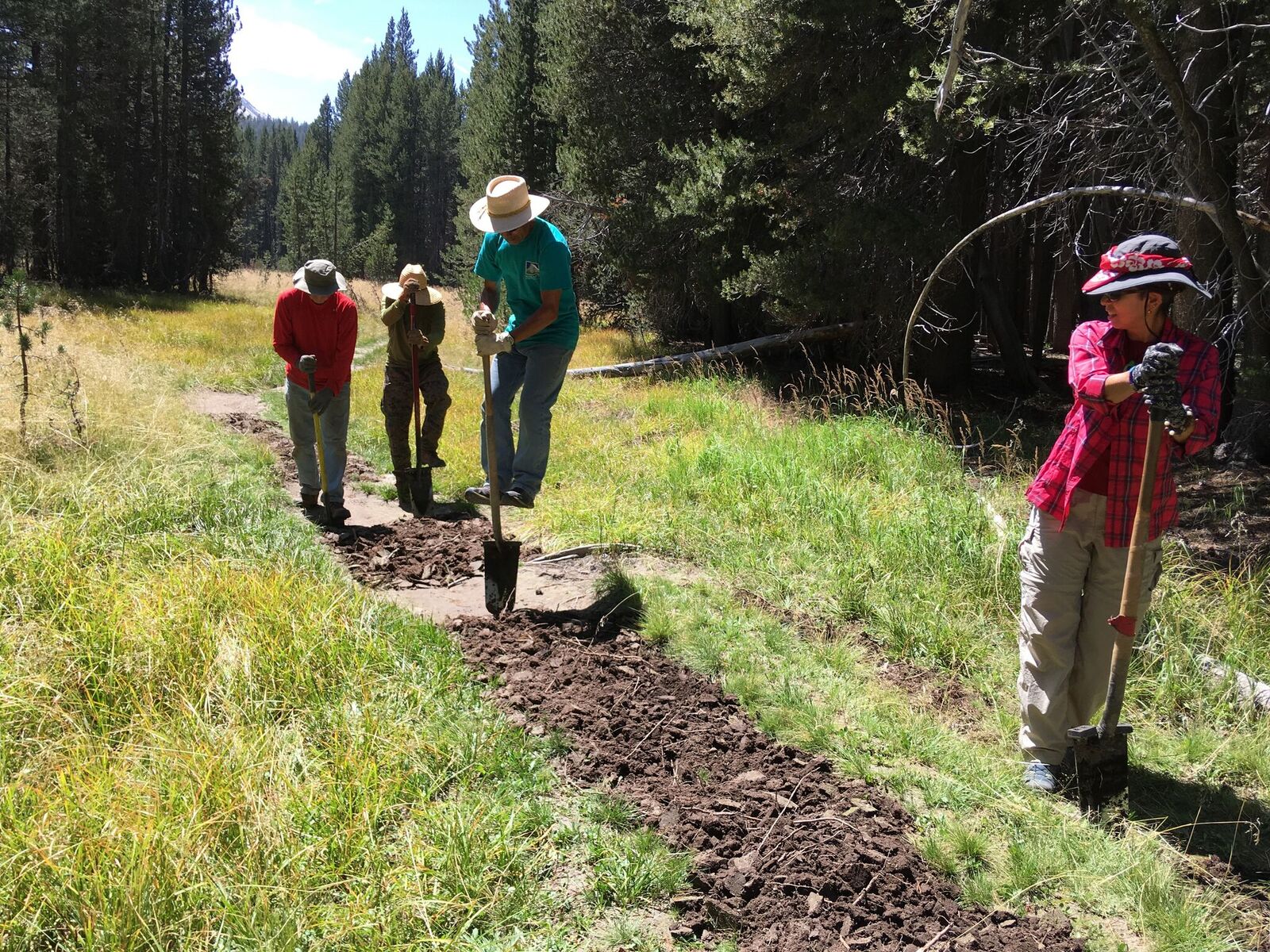
Geoff jumping onto de-compacting shovel
Throughout the park, trails have been moved off the meadows and into the forests. Surely you have seen how deeply rutted and compacted foot trails can become. Ultimately, rutted trails channel water rather than allowing it to dissipate over the meadow, thereby disrupting the “hydrology of the meadow.”
Two TM trails are under restoration. The first is a trail that runs perpendicular to the Soda-Store footpath. The second is a trail at TM’s western edge, skirting the base of Pothole Dome.

Our jobs included: soil de-compaction, soil reclamation, lobing, planting, duffing, and watering. When complete, the meadow will be replanted, making the old trail invisible.
De-compaction: De-compacting shovels look like huge trowels with foot pedals. We literally balanced on the shovel, stepping up onto the pedals, using our body weight to drive it deep into the soil. The soil is loosened and compaction reversed. I often jumped on my shovel up to five times to drive it deep. The bigger guys? One time.
Soil reclamation
Soil reclamation: Not wanting to bring in soil from elsewhere, deep holes were dug into the meadow, logs were put into the holes (which over time will compost into dirt), and the displaced dirt was used for surface planting.
Lobing: a section (or lobe) of meadow is removed from the trail’s edge. These lobes are about 12” deep and 18” in width and length. The lobe is turned and planted in the middle of the trail “in a mosaic fashion”, thereby disrupting and camouflaging the straight lines of the old path edges.
Placing "lobes"
Reclaimed dirt was used as fill between newly planted lobes. Lastly, it is duffed and watered. 
Duffing: we raked the wild grasses of the meadow to collect organic material (duff) to cover the newly planted lobes. 
Watering: a solar-powered-pump pumped water hundreds of feet from the river to our location and the new lobes received a thorough watering. We walked along parts of the trail that were restored 3 years ago; it is nearly invisible.

Day 3: Day Off to explore the park. 
Cathedral Peaks
The Chin’s and I hiked up the Cathedral Lakes trail. I remembered it as a trail with expansive views of Cathedral Peaks, Tressider Peak, Echo Peaks, and the Cockscomb. This trail had none of that, it was deeply buried in the forest and I walked miles before realizing that the trail had been relocated out of the meadow. At upper Cathedral Lake, we veered off-trail, up and over the shoulder of Cathedral Peaks. Two climbing teams were several pitches from summiting and we sat to watch them. Their voices echoed off the rock and bounced down the valley.
Budd's Lake - best photo of the week
Our ultimate destination was Budd’s Lake a high mountain lake with chilly, clear water. A gill net stretched across the lake. Lakes that were once stocked for fishermen are being restored to a more natural state, including the reintroduction of endangered frogs. As fish and frogs do not coexist in a small lake, the fish are being eradicated.

Day 5: Seed Collection
YC TM 3 Team
On our last day, we collected seeds from several meadows near Tioga Pass. We spent an hour or two stripping seeds from a particular plant. They were combined, geo-marked, and labeled. Later, they will be cleaned, dried, and chilled to keep them in a dormant state.
Tioga Road is being re-paved and improved, to include a wifi cable in the utility corridor of the road. As the road project is completed, the collected seeds will be used to re-seed the new road edges in their exact “collection location”. The NPS has a "seed shack" in El Portal where they store 3-years of dried, cleaned, labelled, and chilled seeds. When El Portal was evacuated for fire in July, the seeds were high priority evacuees.

Tioga Road Project:
Water collects in the storm drains and is dumped into TM via large culverts. The prevailing plan is to install many, wide, box-culverts that will spill water into the meadow in a more natural way. Again, this is about restoring the hydrology of the meadow. Conifers are encroaching into TM, as they are wont to do when meadows dry. When the meadow is wetter, conifers will naturally die off. Then projects will include restoring those parts of the meadow that are now eroded waterways created by the current round culverts beneath the road.

Mark Marschall - New YC Volunteer Program Coordinator
We spent several mornings and evenings with Mark because he camped with us. He asked many questions, our opinions on everything from the application process to how the workweeks were run. Six of thirteen in our group were brand new, on their first workweek. Obviously, YC wants to broaden their base without alienating their old-timers. Mark was delightful. He is very open, has terrific listening and people skills. He was willing to hear anything. Any non-English speaker overhearing our conversations would have thought his name was HeyMark. My gut says he is a wonderful and apt replacement for Susie.

New/Future Projects:
Shared bikes are coming to the Valley! The first 90-minutes will be free - to transport people to meals and stores without their cars. This is apparently Simon’s (works for YC) idea and baby that he will shepherd into reality next summer.
I thought we should work on the group campsite at Wawona - which has not ONE level campsite. It needs restoration too, maybe gravel paths to each campsite and replanting between campsites.

We had new cooks this year - Dawn and Kearey run Willowcreek Catering out of Oakhurst. They are highly skilled chefs and fishermen, bringing back fresh fish to supplement our meals. They live in an intentional community and have rental cabins and campsites available. Their cabins will soon be available through AirBnB. Located 15-miles from the southeast corner of Yosemite Park - ’tis a good jumping-off spot for exploration there.

In my evaluation to the NPS I wrote, “Lastly - thank you for being the guardians of our most valued national treasures. You have been the shining example of "what's possible" as emerging countries divvy up their lands. How Europe wishes they had a "do over" for public, national parks. Thank you for fighting the noble, honorable battle to protect our National Parks. I love and honor you for it and I stand with you in fighting the good fight.”

Many of you know I have become a “legacy member” of the Yosemite Conservancy. What does that mean? It means that Yosemite NP is a beneficiary to my estate - should there be anything left when I slide into home plate. I invite you to think about donating to causes greater than you and your family, to the National Parks - created, as inscribed on Yellowstone’s Roosevelt Arch, "For the Benefit and Enjoyment of the People”.

Footnotes:
1 Wikipedia