Volunteering in our National Parks
To enlarge, double click picture. Click X upper right corner to return to blog.
I just returned from my volunteer workweek in Yosemite National Park. It's my third summer of volunteering and I’m hooked. My last two years were spent in all three of Yosemite’s sequoia groves; working up-close-and-personal with the world's largest trees.
Last year was spent in Yosemite’s largest sequoia grove, the Mariposa Grove, during its restoration and while it was closed to the public. Can you imagine wandering quietly amongst nature’s giants? The very storied trees protected by Lincoln’s pen? The same that shaded Teddy Roosevelt and his guide, John Muir? From whom did they need protection? From foolish, white men felling them for toothpicks!
 |
| Wawona Pt - zenith of Mariposa Grove |
The Mariposa Grove re-opened to the public in June, after a 3-year, intensive restoration. The Park’s Ranger-botanists noticed few young sequoias in the grove. Further studies revealed that young’uns are a thirsty brood and that the surrounding hardscape directed water away from the grove.
All hardscape was removed. No longer shall hardtop misdirect water. No longer shall the tram run atop their shallow root systems. The land was re-contoured to mimic the contour of old, as seen in old photos, to improve hydrology in the grove and reestablish a meadow. No longer shall water be directed away from thirsty, young’uns. Ground penetrating radar was used to minimize root damage when placing posts for the new, elevated boardwalk. No longer shall human feet trample and damage their roots. Jute netting was laid upon the soil and native, hydrophilic plants from nearby storm drains were transplanted. No longer shall their toes struggle in barren soil. Flow of the year-round stream was redirected back into the meadow. All new surfaces are porous, allowing every, precious drop of water to permeate soils in the grove.
Only rangers and volunteers worked during our last day in the grove. At day’s end, after receiving permission, half of us hiked the four miles through the vacant grove to the Wawona Hotel. Really, can you even imagine wandering quietly amongst nature’s giants? I re-photographed the botanical icons without homo sapiens loitering at their base. Wonder why I return annually to volunteer in the park?
This year, I visited the Mariposa Grove the day before I was to report for duty. For those who know the grove, all familiar landmarks, aside from the trees themselves, are gone. It’s a little disorienting. While working there I learned of an Indian grinding-stone, literally 30 feet from a parking lot. I visited the stone and thought of those who came before, of their hardship and tenacity. My eyes swept over the forest, imagining bark dwellings and the ancients who ground acorns in the hole at my feet.
The Yosemite Conservancy (YC) is the non-profit, fund-raising, and volunteer companion to Yosemite’s National Park Service (NPS). They partner in project-planning, fund and personnel matching. I volunteer through YC.
YC sponsored nine summer-2018 projects in Yosemite NP. Many were cancelled due to fire. Everything between Yosemite Valley the Mariposa Grove was closed to the public; to give firefighters full run of the roads. Smoke obstructed views and poor air quality drove people from the high-country, which remained open. I received daily emails from the volunteer office during the weeks of the fire and was notified that my workweek would be held as scheduled, just 9-days before my report date.
 |
Budd Creek Sunset, TM by Steve Dunleavy
|
I was slated for work in Tuolumne Meadows - reportedly the largest meadow in the country. Tuolumne Meadows (pron. “tū-wä-lūm’-ny”) is a granite-dome-studded, sub-alpine meadow along the Tuolumne River in the eastern section of Yosemite National Park. Its approximate elevation is 8,619 feet (2,627 m). The meadow vegetation is supported by shallow groundwater. The water comes from 1,000 mm (39 inches) of precipitation annually, predominately in the form of snow. Water arises from snowmelt and hill-slope aquifers, and flows through the Tuolumne River, Budd’s, Delaney, and Unicorn Creeks. In spring, as soon as the snow melts, it is not uncommon to see large areas of the meadows flooded, practically transformed into lakes.1
Our report time was 2pm on Sunday 8/18, at Tuolumne Meadows, group campsite-G. When I arrived, the commercial kitchen was already set-up beneath several canopies, two long picnic tables had already been abutted together, covered in NPS-green tablecloths (identical to DOD green for you military-types), and shaded by canopies. Other tables had been moved to ring the fire-pit. Team members were busy erecting tents and ferrying gear from their vehicles. I pulled BAM (Baconz Adventure Mobile) into a nearby spot and with nothing to unpack and no tent to set, helped in setting up our dish/hand washing stations.
The team gathered for pupus (Hawn for hors d’oeuvres), introductions were made, greetings delivered, and we learned of our tasks for the week. Every year I am struck with the preponderance of teachers and nurses on the team. This year’s team included 4 RNs, 1 PA (physician’s assistant), and 2 teachers. Notably, a soft-spoken, bearded fellow turned out to be Newberry award-winning author, Paul Fleischman. Boy does he have a way with words. His father, Sid Fleischman, also an award-winning, children’s author, wrote By the Great Horn Spoon!, a book about the gold rush, still used in California’s 4th-grade curriculum. It was later made into the movie, The Adventures of Bullwhip Griffin. Word spread amongst the rangers and crew and I was asked repeatedly, “Who’s the author?”
“I LOVED that book!” our ranger Allie shouted when she learned the connection.
Not to be outdone, Paul has himself penned approximately 50 children’s books. “I used to think book awards were frivolous and doled out without thought. But having received one, I can see they are given only after careful deliberations,” he said with a wry smile.
One night over dinner, I asked Paul to write a book explaining the roots of daylight-savings-time and the arguments for keeping it. “It’ll be an adult best-seller,” I insisted to nodding heads. But I digress…
2018 marks the third year of the Tuolumne Meadows Restoration Project and there are three areas currently under restoration.
Day 1 - Weed Warriors
 |
| Bull Thistle - Cirsium Vulgare |
Bull thistle is an aggressive, invasive species battled throughout Yosemite. Typically it is found in the lower elevations but ONE was found in Tuolumne Meadows to much consternation. I’ve seen them 6-feet tall with thorns that pierce the best of garden gloves. We knock them over, removing the taproot from soil, and collect the florets and deadheads into heavy garbage bags for incineration.
Our first day involved weed-warrioring in the meadow.
Long ago, there was a road (now footpath) that heads straight across the meadow from the Tuolumne Mdws (TM) store to Parsons Lodge @ Soda Springs.
 |
| Parsons Memorial Lodge |
The Parsons Memorial Lodge is a quaint and beautiful building erected in 1915 by the Sierra Club at the northern end of Tuolumne Meadows. It was one of the earliest stone-built structures in a national park. Of interest, it was designed by architect Bernard Maybeck, whose homes are well-known and equally well-priced in the bay area.
Nicknamed the Soda-Store project - the road was apparently built by scooping mud and meadow from each side and piling it up in the middle. That left trenches on both sides of the road, as deep as eight feet in some places, causing major disruption to the hydrology of the meadow.
In the first stages of the project, they filled the trenches and leveled the road to level the meadow. They had "clean dirt" stockpiled in the valley but it was used for another project. So they acquired other dirt, which was not so clean, thereby introducing invasive species into the meadow. The tainted, fill-dirt was only used in the first 6-8 feet on either side of the crushed-granite footpath that runs into the meadow. So, Day-1 was spent "weed-warrioring" along the path. The first half was rich in weeds, the second half - not so much. Teams of volunteers will be after these invasive species for several more years.
“My neighbors are going to die laughing when they hear I spent my first day weeding in the meadow,” I exclaimed, for I am well-known for my avid weeding.
We lunched at the riverbank, under shade trees. I noticed something circular - winking and blinking at me from the middle of the river. I removed my boots, rolled up my pants, and waded out to retrieve a pop-top (soda can pull-tab). I held it high in triumph and ignited the argument for leaving it - or not.
Anything older than 50-years is considered an “artifacts” and is left for historic value. A pop-top was garbage then and now - but does its age make it an artifact? I slipped it into my pocket while some rangers instructed me to put it back and others debated its age and value as an artifact. Had we been able to consult Dr. Google - we might have been able to establish the date when cans no longer had removable pop-tops. But there is almost no cell-service and no wifi in TM, more on that later. So the debate raged on - even into the dinner hour.
In agreeing to work for the NPS, I sign an agreement “to follow the instructions of the rangers.” But the rangers themselves were not unified in their consideration of this ancient piece of refuse. I waded to shore and placed the pop-top in the easily-retrievable shallows.
Pause in thimk (an expression used by my math prof. as "an aside”): Dr. Google says, “These problems were both addressed by the invention of the "push-tab". Used primarily on Coors Beer cans in the mid-1970s, the push-tab was a raised circular scored area used in place of the pull-tab. It needed no ring to pull up.” So pop-tops are indeed 50 years old BUT does that make them artifacts?
Tourists walking the trail to Parsons Lodge stopped to ask about our labors. As we explained - many thanked us “for our service”. Can I just say that as a post-Vietnam vet, this expression seems a little odd, whether it refers to my military service or weeding? But it IS nice to be acknowledged for one’s service so perhaps I need to get over it.
Then one person asked quite earnestly, “Why do we care if invasive species move into the meadow? It’s all plants, it’s all green; what difference does it make?” Our ranger Molly explained that Yosemite is interested in preserving biodiversity and that keeping the meadow plant species pure supports all the other creatures that live in TM. You know the butterfly effect? The phenomenon whereby a minute, localized change in a complex system can have large effects elsewhere? No butterflies - which is in and of itself, another tragic story.
At the end of our workdays, we head for hot showers before returning to camp. Showers are usually located at the ranger’s community showers. TM campgrounds have no electricity: no lights, no showers and certainly no hot water.
Each evening, we stopped at the TM store for a 6-12 pack of beer for our 15 person crew. We gathered around the fire pit, awaiting our pupus, and discussed the day. On that night, the new Yosemite Conservancy Volunteer Program Mgr, Mark Marschall was in camp. Mark is in his first season as Volunteer Program Mgr and replaced the beloved, long-time, and supremely capable Susie. Mark brings 40-years of park ranger-ing experience to the job; he is knowledgeable and capable, with tremendous people-skills.
I broached the soda can pop-top. “I heard about that,” he said, “It was refuse then and its refuse now.” THAT gave me license to return to the river and retrieve it!
We built a fire and spent the evening talking about Yosemite, the Conservancy, their vision, the projects, the challenges, stewardship/ownership, how/why we serve. My heart was full when I crawled into my sleeping bag.
Days 2 and 4 - Trail Restoration:
 |
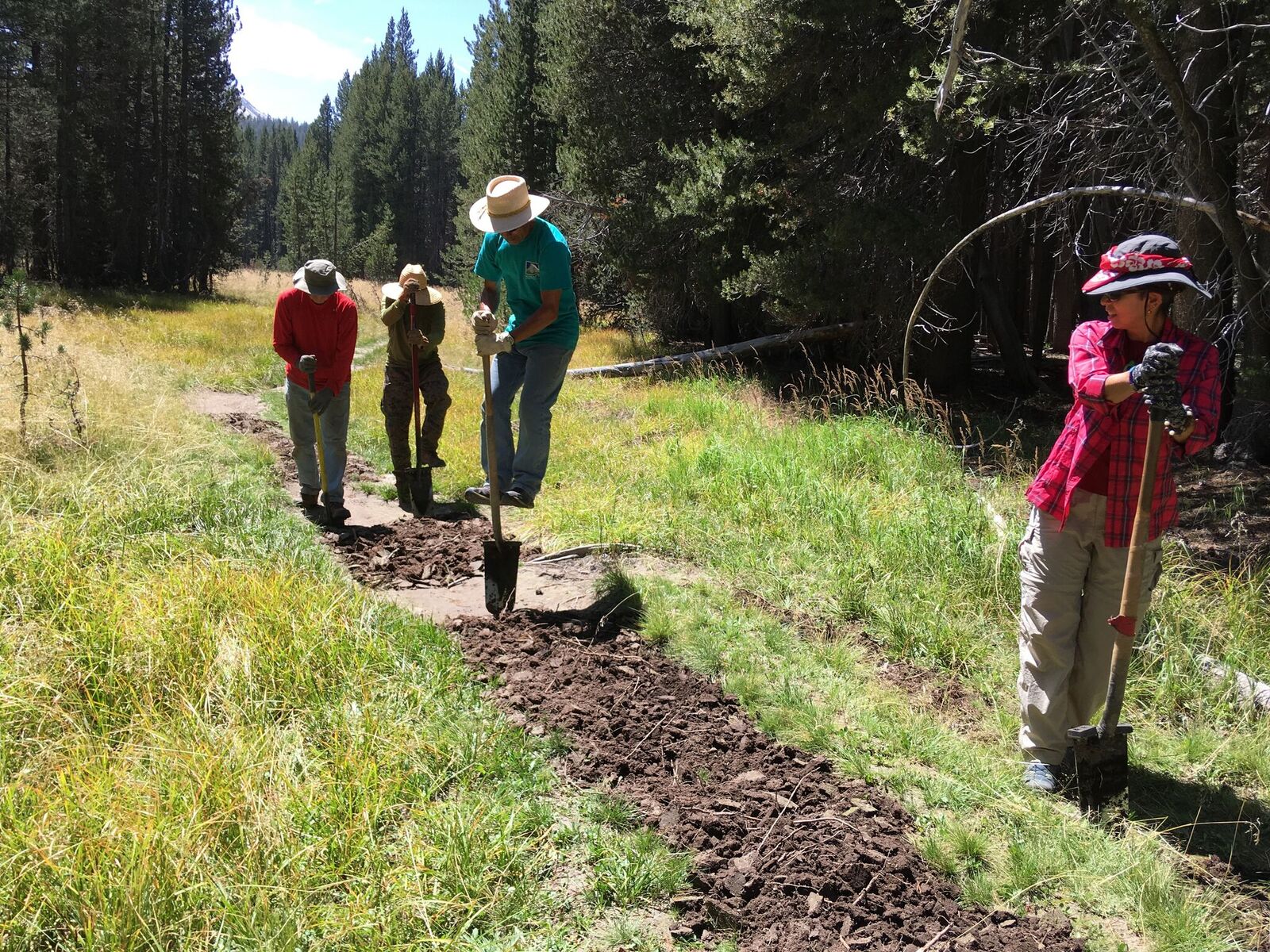
| Geoff jumping onto de-compacting shovel |
Throughout the park, trails have been moved off the meadows and into the forests. Surely you have seen how deeply rutted and compacted foot trails can become. Ultimately, rutted trails channel water rather than allowing it to dissipate over the meadow, thereby disrupting the “hydrology of the meadow.”
Two TM trails are under restoration. The first is a trail that runs perpendicular to the Soda-Store footpath. The second is a trail at TM’s western edge, skirting the base of Pothole Dome.
Our jobs included: soil de-compaction, soil reclamation, lobing, planting, duffing, and watering. When complete, the meadow will be replanted, making the old trail invisible.
De-compaction: De-compacting shovels look like huge trowels with foot pedals. We literally balanced on the shovel, stepping up onto the pedals, using our body weight to drive it deep into the soil. The soil is loosened and compaction reversed. I often jumped on my shovel up to five times to drive it deep. The bigger guys? One time.
 |
| Soil reclamation |
Soil reclamation: Not wanting to bring in soil from elsewhere, deep holes were dug into the meadow, logs were put into the holes (which over time will compost into dirt), and the displaced dirt was used for surface planting.
Lobing: a section (or lobe) of meadow is removed from the trail’s edge. These lobes are about 12” deep and 18” in width and length. The lobe is turned and planted in the middle of the trail “in a mosaic fashion”, thereby disrupting and camouflaging the straight lines of the old path edges.
 |
| Placing "lobes" |
Reclaimed dirt was used as fill between newly planted lobes. Lastly, it is duffed and watered.
Duffing: we raked the wild grasses of the meadow to collect organic material (duff) to cover the newly planted lobes.
Watering: a solar-powered-pump pumped water hundreds of feet from the river to our location and the new lobes received a thorough watering. We walked along parts of the trail that were restored 3 years ago; it is nearly invisible.
Day 3: Day Off to explore the park.
 |
| Cathedral Peaks |
The Chin’s and I hiked up the Cathedral Lakes trail. I remembered it as a trail with expansive views of Cathedral Peaks, Tressider Peak, Echo Peaks, and the Cockscomb. This trail had none of that, it was deeply buried in the forest and I walked miles before realizing that the trail had been relocated out of the meadow. At upper Cathedral Lake, we veered off-trail, up and over the shoulder of Cathedral Peaks. Two climbing teams were several pitches from summiting and we sat to watch them. Their voices echoed off the rock and bounced down the valley.
 |
| Budd's Lake - best photo of the week |
Our ultimate destination was Budd’s Lake a high mountain lake with chilly, clear water. A gill net stretched across the lake. Lakes that were once stocked for fishermen are being restored to a more natural state, including the reintroduction of endangered frogs. As fish and frogs do not coexist in a small lake, the fish are being eradicated.
Day 5: Seed Collection
 |
| YC TM 3 Team |
On our last day, we collected seeds from several meadows near Tioga Pass. We spent an hour or two stripping seeds from a particular plant. They were combined, geo-marked, and labeled. Later, they will be cleaned, dried, and chilled to keep them in a dormant state.
Tioga Road is being re-paved and improved, to include a wifi cable in the utility corridor of the road. As the road project is completed, the collected seeds will be used to re-seed the new road edges in their exact “collection location”. The NPS has a "seed shack" in El Portal where they store 3-years of dried, cleaned, labelled, and chilled seeds. When El Portal was evacuated for fire in July, the seeds were high priority evacuees.
Tioga Road Project:
Water collects in the storm drains and is dumped into TM via large culverts. The prevailing plan is to install many, wide, box-culverts that will spill water into the meadow in a more natural way. Again, this is about restoring the hydrology of the meadow. Conifers are encroaching into TM, as they are wont to do when meadows dry. When the meadow is wetter, conifers will naturally die off. Then projects will include restoring those parts of the meadow that are now eroded waterways created by the current round culverts beneath the road.
Mark Marschall - New YC Volunteer Program Coordinator
We spent several mornings and evenings with Mark because he camped with us. He asked many questions, our opinions on everything from the application process to how the workweeks were run. Six of thirteen in our group were brand new, on their first workweek. Obviously, YC wants to broaden their base without alienating their old-timers. Mark was delightful. He is very open, has terrific listening and people skills. He was willing to hear anything. Any non-English speaker overhearing our conversations would have thought his name was HeyMark. My gut says he is a wonderful and apt replacement for Susie.
New/Future Projects:
Shared bikes are coming to the Valley! The first 90-minutes will be free - to transport people to meals and stores without their cars. This is apparently Simon’s (works for YC) idea and baby that he will shepherd into reality next summer.
I thought we should work on the group campsite at Wawona - which has not ONE level campsite. It needs restoration too, maybe gravel paths to each campsite and replanting between campsites.
We had new cooks this year - Dawn and Kearey run Willowcreek Catering out of Oakhurst. They are highly skilled chefs and fishermen, bringing back fresh fish to supplement our meals. They live in an intentional community and have rental cabins and campsites available. Their cabins will soon be available through AirBnB. Located 15-miles from the southeast corner of Yosemite Park - ’tis a good jumping-off spot for exploration there.
In my evaluation to the NPS I wrote, “Lastly - thank you for being the guardians of our most valued national treasures. You have been the shining example of "what's possible" as emerging countries divvy up their lands. How Europe wishes they had a "do over" for public, national parks. Thank you for fighting the noble, honorable battle to protect our National Parks. I love and honor you for it and I stand with you in fighting the good fight.”
Many of you know I have become a “legacy member” of the Yosemite Conservancy. What does that mean? It means that Yosemite NP is a beneficiary to my estate - should there be anything left when I slide into home plate. I invite you to think about donating to causes greater than you and your family, to the National Parks - created, as inscribed on Yellowstone’s Roosevelt Arch, "For the Benefit and Enjoyment of the People”.
Footnotes:
1 Wikipedia