Saturday, January 3, 2015

Swimming Upstream

To date, my blog A Skeptic Dissects z Nursing Strike has received 220+ hits - more than double my normal readership. I’ve received nine (mostly private) comments. Reticence, methinks, points to the caution people feel; I might offend someone. In numerous conversation, physician friends expressed their confusion and dismay with the strike. For some, there is a loss of respect - that nurses would strike for a day of ebola awareness.
They would be further dismayed to know the number of nurses unaware they struck for a day of ebola awareness and nurses who neither worked nor walked but took the days off. I do not require agreement to respect others - but I do seek integrity. I do honor those with courage to stand by their convictions.
However, I explained, if one expects others to march out-of-sync with the masses - first recognize that THAT is a great expectation indeed. And its antecedent would be critical thinking to justify (at least to self) ones oppositional position. Sadly, it is far easier to go with the flow.

It was in this vein that I began examining the repetitive, contrarian conversations of my own life. What follows are pivotal, non-conforming events in my life, the pressures of the cultural discourse and my reactions to them. 
My earliest of such memories was of being labeled a tomboy. I much preferred tree-climbing, touch-football and bike riding to playing with dolls. I’ve given up football. 

In society, there are inherited conversations that exert force. 
Inherited conversations: to get (a personal quality, interest, etc.) because of the influence or example of your parents or other relatives. Inherited conversations lurk in the background.
Discourse: dis·course noun \ˈdis-ˌkȯrs\
: the use of words to exchange thoughts and ideas
: a long talk or piece of writing about a subject (that might span the anthropocene - the epoch of man)

For example - girls of my era wore crinolines, lace and played with dolls. My concession to being female was to wear a bracelet - one I continue even today. I much preferred feminism to feminine, running track in high school and marathons in college. Girls of my era found good husbands, got married, and raised families. The joke was - girls went to college for their MRS degree. College, of course, spans those years when most marry so the MRS degree conflates several forces.

The discourses of a society are often invisible to us. We do not necessarily recognize them and seldom consciously agree to abide by them; they just ARE. Its the way things are; the water in which we swim. The American, societal discourse of athletic females without a man is: something’s wrong and she MUST be gay
Ever the rebel, I cared not that people thought me gay and continued on my merry way. It did occasionally give me pause, I found it entertaining, definitely stupid and irrelevant but then - that’s because I had nothing to hide. 
Societal discourse exerts pressure - let me reiterate, it is far easier to go with the flow. And thats why, 40 years later, coming out is still fraught with angst and gay marriage remains outlawed in fourteen states. (Florida capitulated just this week.) As the societal discourse of homosexuality becomes less condemning and more accepting, it allows for freedom of expression - hence the slow change of our laws allowing equality in marriage and spousal benefits.
I was very late to the marriage game and spent the preceding years intermittently unattached and celibate. “Are you gay?” my own family asked, articulating that which hung like low hanging fruit begging to be picked. Athletic female with no man - she MUST be gay.

And so I married. After ample time - say nine-months - a new set of inherited conversations, societal discourses and pressures emerged: Are you pregnant? When are you getting pregnant? Are you trying? Why aren’t you trying? Why aren’t you pregnant; is something wrong? (Note: had I delivered a baby within the requisite nine-months, like Medusa, a different set of inherited conversations would have reared its ugly head.)
Procreation is deeply imbedded in our biology and evolution. It provides for survival of the species and from an evolutionary viewpoint, I’ll concede that I have failed miserably. The pressure of this societal discourse is as ever-present as the tides, constantly pulling. 
If one fails to produce offspring in this era of choice, the common discourse is one of selfishness and egocentrism. I found myself compelled to say, “I was unable to conceive,” to escape criticism. Why do I have to explain? And why is unable better than unwanted? Bless them who choose to resist this societal tsunami in the face of no agreement.
Even now, people assume I have grown children and when they learn the contrary, a shadow crosses their face as they struggle with the anomaly. Procreation is an unrelenting task master that shadows me still.
There is no denying that I have days when I wish for a family. I watch my sister with her grandchildren, my niece marry, my friends welcome their first grandkids. These moments are fleeting but occur with more frequency during the holiday season - a time that is family-centric. 

You could have adopted; why didn’t you adopt? 
PAUSE IN THIMK: Am I the only one who finds this line of questioning extremely offensive? Perhaps I’ve heard it once too often. My reflexive reaction begins with an F and should not be spewed - however tempting. Please do not suggest that people should (have) fix(ed) infertility with adoption. Not now - not EVER. Adoption is a very personal and very different decision, not a solution. Trust me, we know adoption is available.
End Pause in Thimk - sorry for the di-grrr-ession.

You could have adopted; why didn’t you adopt?
Why didn’t you
What? Well… because I didn’t have to; I could have my own.
You could have had one less child and adopted one. Why didn’t you adopt?
Oooh - now THIS is interesting; donchya think? It challenges the standard discourse and instantly transports them into my moccasins. I apologize for gloating over the clever trap.

Ever present in this societal discourse is that something’s wrong that should be remedied. Please know that there is nothing wrong and nothing to fix. I am not broken and need no fixing - nor does my circumstance. I have moments of sadness sans familia; people have moments of sadness about their kids. When they do, I don’t advise divestiture of their children. Conversely, I neither welcome nor require instruction to marry someone with kids and grandkids. Should I choose to partner, 95% of the world has kids; do the math.

And so it came to pass that I divorced. Upon hearing the news, people automatically said, “I’m sorry.” Do you hear the common discourse in that? We assume that the end of a marriage is not good. Consider that - it isn’t always.
“Don’t be sorry,” I’d say, “Its the best thing I’ve done in the last 20 years.”
And after ample time - say one year - the discourse about being single emerged: Are you dating? When are you going to start dating? What about him? Why aren’t you dating? Are you in-relationship? What about him? Why aren’t you in-relationship? What about him? You’re too picky. How’s that guy you’re not dating? I guess its okay that you’re not dating. What about him? You should find someone now or you’ll be lonely when you’re old. (As an aside, do you think a man would appreciate being my hedge against the assumed loneliness of old age? Would he knowingly volunteer for that?) You better hurry; you’re not getting any younger. Why don't you want to date? What about him?

As gravity is to earth, so pair bonds are to mankind. So strong is this biologic, evolutionary discourse that we can hardly stand when one does not conform. I have found this conversation unrelenting at every turn. Notice that we do not ask the married-with-children to defend their lifestyle - however contentious or estranged.
I trust this conversation arises from concern for me but you would be shocked at its frequency, even after ten years, leaving me feeling defensive and pestered. Whose business is it anyway? The implication is that I am not whole, am making do, could not possibly be happy or thrive outside a pair bond.
But don’t you miss …? Apparently it is difficult to understand and more so for men. One of, if not THE greatest driver in a man’s life, is the desire for regular sex. The sanctioned avenue to regular sex is through pair bonding. I understand fully - and - I’m not a man.
I recently toured rental homes in Sun City - Lincoln. The talkative tenant paused packing to follow us through the house and jabber. His pallor and belly were vaguely suggestive of liver disease, a subtlety unnoticed by most methinks. 
“I thought that when I moved here, I’d have a line of casseroles to the curb,” he pointed out the front door, “And women wanting relationships. But, they’ve all had relationships. Now they want a beer and pizza and not much more. So either I’m a real jerk or women just don’t want relationships.” He sounded exasperated and confused. Yep, I get it. ‘Tis a brave new world Aldous.


The equally compelling corollary to Gotta find a woman is Gotta find a man. These automatic conversations for coupling are hardwired in our DNA and in them, my own fears of going-it-alone bubble to the surface. Yet, I remain unmoved toward partnership born of fear in lieu of want and love. I am not one to settle for.
Never in the history of womankind, can a woman survive - even thrive - without a man. Our safety, food acquisition and property are no longer solely dependent upon our man or clan. We can now have families and raise them without a partner or husband. Most don’t but it IS possible. We can hold title to property and maintain sole and separate funds. However, the societal discourse around uncoupled women is not kind. She must be gay. She couldn’t find a man. No man would have her. She’s too: tall, athletic, fat, old, angry, smart, strong, sour, dour, yada, yada, yada… as if women have no choice or voice in the matter.
Two friends of mine had children through artificial insemination and are raising families without a known father or man-of-the-house. They have terrific grandparental assistance, love and support. I’ll admit to my initial surprise and carefully avoid any implication of disapproval. I know that digs and off-handed remarks cast aspersions, undermine their decisions and are not supportive. 

This brings me back to my initial premise. That marching to one’s own drumbeat is a very tall order - be it refusing to strike with the masses or bearing children without a husband or coming-out or leaving a marriage, or remaining uncoupled, etc., etc., etc. Inherited conversations and cultural discourses pull for conformity and we are intolerant of them that differ. Further, we are blind to the discourse, like fish blind to the water in which they swim.
Part of the human condition is to look for “what’s wrong”. Throughout evolution, identifying what’s wrong and what’s different has provided a survival benefit. What’s wrong is a human discourse likely spanning the anthropocene. We are blind to the ways in which that lens colors our world. If you seek what’s wrong, you will assuredly find it.

This is why I write, so that you too can see the water in which we swim. Most of us are not childless, have not spent extended periods alone, uncoupled, or celibate in adulthood (actually - a surprising number of marriages are asexual but the societal discourse surrounding that is one of secrecy), will never divorce, bore no children out of wedlock, are not now and never will be gay. Yet we harbor judgements about all of it and our teasing, flippant remarks and advice convey the common discourse and judgements. It can leave people feeling like battered salmon swimming upstream. 
Do I sound defensive? I am - I’m tired of defending my lifestyle to my friends and family, people who are theoretically in my camp. Its exhausting and irritating. I have marched out-of-step and out-of-sync and I am likely to continue. It has been met with resistance and ridicule. I feel like that salmon. I cannot even imagine how my gay friends manage to move through life with such grace.
Obviously, I’ve made the people who tease and pester me wrong - for making me feel wrong - albeit my surety that their pestering rises from care and concern. I am made to feel wrong and I make them wrong for it. It’s all so mediocre and mundane. Can we rise above mediocre and mundane?
I’m sorry you don’t understand me. Your inability to understand does not require an explanation by me or you. Understanding is not required and makes no difference. This is a petition to attend the common, societal discourses and examination of our bias. 
My family would tell you (in a hot nanosecond) that I am equally judgmental and intolerant of those who abuse their bodies with food, substances and sedentism - and they are right. This prejudice is no longer invisible to me and I work to disabuse myself of my righteousness in the matter.


It is a constant struggle to hold on to what connects us. Especially when so many forces -- politics, media, religion -- flood in to demonize our differences, alienate one group of people from another, drown our compassion and leave our very humanity gasping for air. ~LZ Ganderson

Sunday, December 21, 2014

Kule Yule Tidings 2014

Melé Kalikimaka e Hau’oli Makahiki Hou! 

My hope is this Holiday Season finds you and yours in good health and spirits. As I write, mana pours from above onto parched westlands. The small creek behind my house has swelled beyond its banks and onto nearby roads. Funny how three years of drought can change ones perspective of minor, local flooding. Let it rain, let it snow, let it snow. 
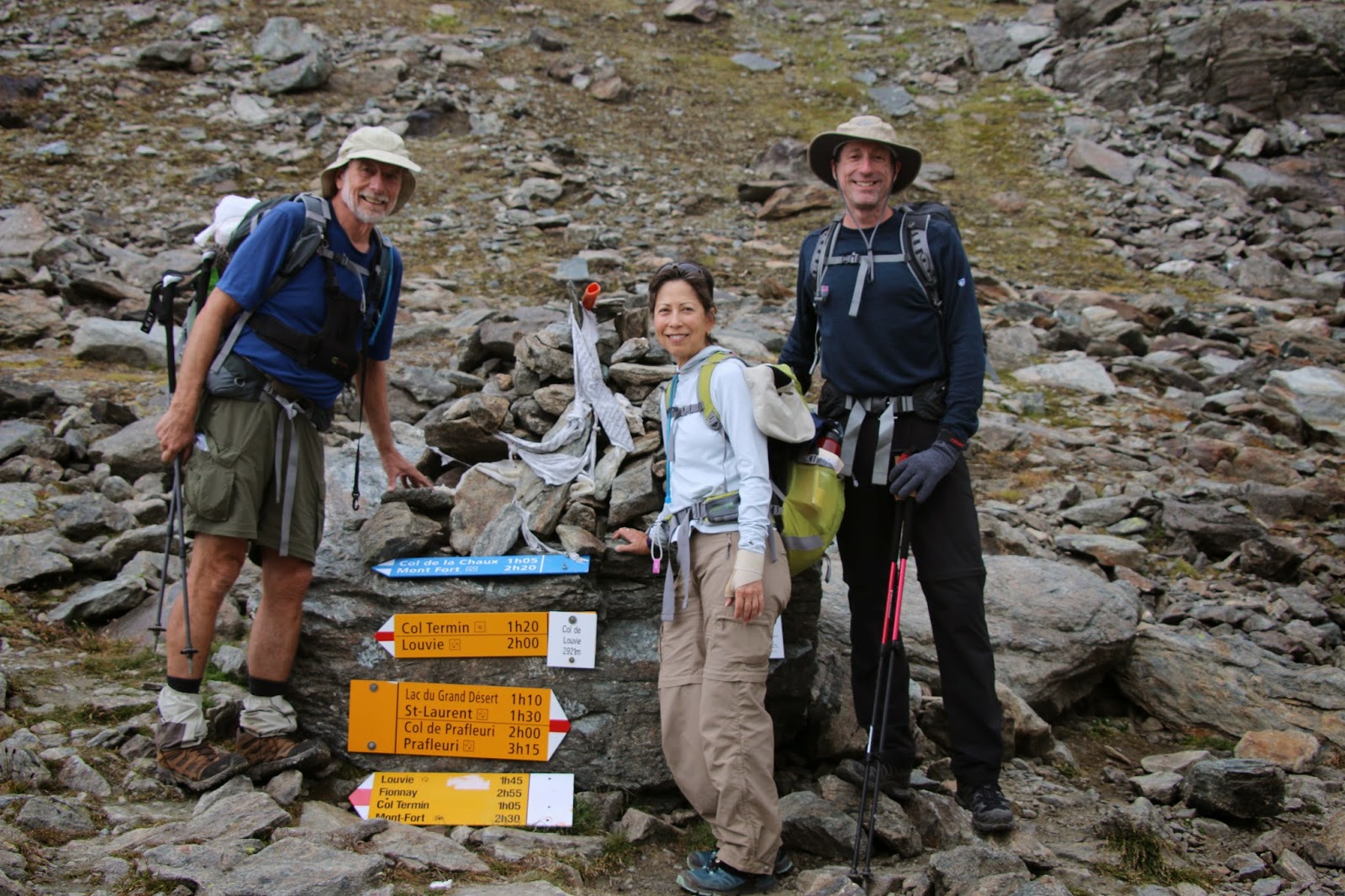
Bill, John & I - Switzerland
(Click the photo once to enlarge. Click X in upper right corner to return to text.)
LBz 2014: In recent years I’ve had an eye on my Bucket List, adding and reprioritizing. This year I checked off a big one. I spent 5.5, late-summer weeks in Europe hiking with friends. The trip was built around hikes in the Alps and fjords. Huts are sprinkled throughout the Alps along the Swiss Haute Route (haute = hut, pronounced “oat”). They provide hot dinners and breakfasts, cold showers and warm beds; reservations required. We learned the Swiss detest desecration of their land with cleared campsites and fire rings. The hut system allows hikers to travel lighter-faster-farther. To that end, the huts are 8-10 miles apart and shortly after breakfast, off you go toward your next hut. Its a fascinating and well marked trail system supported seasonally throughout many European countries.
We met many wonderful hikers and my pack weighed a fraction of what it did last year in the high Sierra. We’ve never done a “supported” hike before, we had  sherpa/guides, Swiss cheese and chocolate at every break - FUN! We will definitely do another such hike and I have my eye on the Inca Trail in 2016.
Prague @ night
Our route between hikes was sprinkled with old world cities and fishing villages turned Atlantic oil ports: Salzburg, Prague, Oslo, Stäväńger, Haugesund, Bergen, Stockholm, and Amsterdam. We visited UNESCO World Heritage sites in each location. Many of the old cities are tourist traps littered with trinket shops but if one can look beyond the kitsch, the architecture and stories are quite interesting. Prague has the esteemed reputation as a rare, old city spared annihilation during the bombing raids of WWII. Overrun first by the Nazis then the Soviets, they have returned palaces to them that can prove ownership. We toured the Lobkowicz Palace and viewed handwritten scores by Beethoven and Handel! We took guided walking  tours in Stockholm and Amsterdam and learned their secrets and hideaways. I wore a fitbit pedometer during the entire trip. Most days, we walked ten miles.
me @ Preikestolen - 2500' down
The fjords were fantastic, breathtaking and a must return destination. Back onto the Bucket List with Norway! Turns out Norway shares latitude and weather with Anchorage, AK (with which you may remember, I am quite familiar). One of our premiere hikes to Kjerabolten (pronounced Sheerabutn) was rained out with its peak literally in the clouds. Of our hike to Preikestolen - the  pictures say it all.
We toured the palace in Stockholm just days before the opening of parliament. When a parade of plumed horseman and empty carriages passed us, we raced to stand out front, to see the King and royal family depart.
“You saw the KING?” the hostess of our B&B asked with incredulity. “I haven’t even seen the King!” We proudly displayed the photo of her King waving in our  direction.
early Rembrandt self-portrait
The Rijksmuseum (Dutch Master’s museum) in Amsterdam is also back on the Bucket List. There we stood before Van Gogh and Rembrandt self-portraits, Rembrandt’s The Night Watch (which is enormous) and some of his early attempts at playing with light. I am a Vermeer fan and the Kitchen Maid was just exquisite. The museum provided iPhone-ish devices into which one entered a code to hear a brief history of these priceless works. Photos ALLOWED - without flash natch. Amsterdam has several such museums, each requiring at least one full day of exploration. We did visit Rembrandt Square where many of his characters are brought to life in full-scale bronze  sculptures.
The Kitchen Maid - Vermeer
I have two complaints about northern Europe: 1) it IS the land of milk, cheese and meat. They do not suffer vegetarians well. I spent almost 30 days eating Italian food because it was the only way to eat vegetarian. 2) Many of the old cities thrive on the backs of tourists with value added taxes as high as 25% but have made few, if any provisions, for these tourists to pee! I was so annoyed. Even pay toilets are an acceptable alternative to NO toilets.
Their citizens were wonderful. We had many trip-angels help us buy train tickets and head us in the right direction, write a list of things to do in their city, recommend restaurants, help us at the washrei (laundromat) and backrei (bakery).
“I don’t usually help tourists,” the young woman said after walking us to the train kiosk, helping us purchase tickets and sitting with us on the train to Oslo, “But you were so friendly on the plane.” 
“Keep helping tourists!” I called back, waving as we de-trained.
Stävävańger, Norway
“You’ve had a good experience in Norway?” the young man asked as he stuffed his clothes at the washrei. “We’ve been friendly and helpful?” 
“Yes, people have been very friendly and helpful,” I confirmed nodding.
“That’s good,” he nodded once with some finality, “Because we are known to be not so friendly.” He worked for a company that made machine parts for Atlantic oil drillers and spoke of family in Seattle.
We met Sierd Jongstra, a lovely Dutch oilman from Friesland, while prowling the harbor for nighttime pictures. In the end, we traded emails and I sent photos.
Talk to strangers - you will meet the most fascinating people!
Toward the end of our journey, a new Bucket List idea was seeded. That is, to live in Europe for several months post-retirement (which approaches more quickly than I can believe). Take my bicycle outfitted with baskets for food and goods - that way I can assemble my own raw, live, green foods. Live in northern Europe earlier when the weather is moderate and allows for quick excursions north, to the fjords for instance, when the weather forecast is clear. Then move to experience southern Europe and the Mediterranean. European extended holiday now added to the list in addition to visiting every US National Park.

post reconstruction
I finished two major home remodel items this year - the travertine floors and removal of my living room’s back wall. My home backs to a dedicated greenbelt/animal corridor and I envisioned opening it from the moment I stepped inside -  and now, the reality is beautiful and tranquil. My dear friend/gen contractor Wade did exceptional work and captured my vision, turning this small, tract-house into my home.
I finally wrapped my backyard oaks in lights - something I’ve been wanting to do for years. You’ll be happy to know I employed my climbing harness and rope to get 30-feet up. I think it took me longer to remember how to properly tie the figure-8 knot than it did to wrap the trees!
My cul-de-sac and street continue to hold biannual BBQs that promote cohesion and “neighborliness”. I love living on Gardner Court with the Courties!

I continue to work in the Neurology Memory Clinic at Kaiser. It is sad and necessary work to help families understand, then care for persons who’s brains are UN-learning - its counter-intuitive. I do find myself missing the worlds of diabetes and cardiac surgery where patients get better, go home and have an opportunity to reverse disease.
Yoga continues to reign as my preferred sport though tendonitis in my left wrist has curtailed some arm balancing and handstands. I find greater physical challenges by deepening the pose and spiritual connection in its meditative practice.
I continue to blog at http://lorinzmuze.blogspot.com though home construction, disruption and travel seriously slowed my pace in 2014. 

Lael & Darth 9/2014
In news of the family: While I was away, niece Lael married longtime sweetie Darth. Family reports the wedding was magical - and on the beach in Hawaii - natch. My great niece and nephew seem to grow before my eyes and I am thrilled to receive new pictures every few days over our shared iPhoto stream. If you haven’t connected your family in this way - you must! I feel so much more connected, even from 2000 miles away.
On a much sadder note, in a matter of weeks we lost both my Uncle Sonny and Aunt Gert. Theirs was the home in which we gathered every NY eve and day. Uncle Sonny would start strumming his guitar as we scurried for our ukuleles. He called out the chords, we followed and sang Hawaiian songs in kanikapila (Hawaiian jamming). Now and again an aunty or cousins would rise and dance the hula. At midnight, the racket began - strings of ten (or hundred) thousand firecrackers lit in rapid succession to ward off evil spirits in the new year. Wonder why I am always home at new years? I learned the true meaning of aloha in their home and theirs is a devastating loss for our clan. Knowing that he was ill, I flew home for four days in November and we three had a wonderful visit. I am thankful for the foresight and resources allowing those last acknowledging and loving moments with them both. Indelible is their imprint on our hearts.

What’s in store for 2015? 
Mom
Mom & her twin Milly turn 90 in April and we are planning a party for the girls. So my next trip to the islands will be in April.
The annual, national nurse practitioner conference is in New Orleans and I hope to combine that with visiting several friends in the east. Also planning a visit Cancun in September - a European hiking reunion of sorts. There we will tour the Mayan pyramids and lounge on the beach. I am researching the possibility of spending a week in Yosemite as a volunteer with the Yosemite Conservancy. Typically this involves trail restoration of some sort with park employees and other volunteers. It will involve sleeping in a tent at a remote location. Right up my alley! Its a great way to combine volunteerism and a park visit during the summer. They reportedly have many more applicants than spots so keep yer fingers-n-toes crossed for me!
That’s all folks! Would love to hear from you too. Sending you joy and Hau’oli Makahiki Hou!

LAUGH • PLAY • SING • DANCE • LOVE ~ lorin


Saturday, November 29, 2014

A Skeptic Dissects z Nursing Strike

This blog is an attempt to distill the communications and issues that lead to the two-day work stoppage across Northern California’s Kaiser Permanente (KP) facilities. In my mind, California Nurse’s Association (CNA) had not built a strong case for strike. Nonetheless, they received a clear mandate from my colleagues. Ever the skeptic, I saved every 2014 communication from both organizations, just knowing I would want to follow the breadcrumbs. 

“The union is a double-edged sword.” If I’ve said that once, I’ve said it a thousand times. I appreciate that my wages and benefits are the spoils of hard fought battles. That nurses can work twenty-plus years for a healthcare system and retire without medical benefits remains the norm. Excepting the state and feds, Kaiser was early to grant healthcare benefits to retirees. The union did that. We affectionately call our pay and pension package the golden handcuffs and I believe nurse retention spares Kaiser the largest expense in any healthcare budget - the hiring and training of nurses. The union did that - that however, is no mandate to heed every word like chiseled tablets from the mountain.

Context is decisive. My context for CNA is not a powerful one. Our last contract was ratified September 1, 2011. Contract negotiations were secreted between CNA and Kaiser arbiters. The rank and file were notified post-hoc and encouraged to ratify. It was a different time, profit margins were thin and Kaiser was anxious to settle the behemoth budgetary item. The contract was bounteous, included raises during a time of high, national unemployment and economic downturn. Generous beyond expectation, we were universally thankful and thrilled.
CNA’s chief arbiter visited each campus to explain the new contract and encourage ratification. I found one phrase unsettling. “They are… scared of us,” he said smugly to the rank and file, “Yeah, scared is a good word.” And not for the first time, I wondered about supporting such an organization. 
That same organization called for a one-day work stoppage twenty-two days into that brand-spanking-new contract to support other, non-KP RNs and KP optical techs in union contract negotiations. A union representative visited each site to encourage nurse participation. I entered the fray brandishing my newly-minted-copy of the Agreement between Kaiser Permanente, Kaiser Foundation Hospitals, the Permanente Medical Group, and CNA dated 9/1/2011 - 8/31/2014.
Page 116 Section I - No Strikes or Lockouts 4023 addressed the issue: There shall be no strikes, lockouts or other stoppages or interruption of work during the life of this Agreement. 
“How do you reconcile a call for a work stoppage with this new contract?” I asked pointedly, after reading the passage aloud.
“We have a past practice,” the union representative said.
“This contract says no strikes, lockouts or other stoppages or interruption of work during the life of this Agreement,” I reiterated. “It does not say except for past practice.” We were diametrically and equally opposed, entrenched and immovable. Some nurses, elated with the new contract, saw heeding CNA’s call-to-action as homage due. Honoring the contract and one’s word seemingly fell upon deaf ears. All told, 23,000 nurses from numerous healthcare systems heard and heeded the call - a CNA flex-of-muscle, described as “the largest-ever strike by nurses.”
That nurses would stage a work stoppage, in direct conflict with our new and very generous contract, and for issues unrelated to Kaiser RNs was unfathomable to me. That CNA would call for such an action was unconscionable. CNA became suspect and the minions who, without question, would do their bidding? I viewed as uninformed and ignorant. I penned a letter of dissent to Sac Bee’s Letters to the Editor that went unpublished. But context is decisive and subsequent calls-to-action by CNA are met with fervent skepticism and scrutiny.

Fast forward to 2014. The Kaiser-CNA contract was set to expire 8/31/2014. 
In April, Dr. Robbie Pearl, Kaiser’s CEO, was filmed at The Permanente Medical Groups shareholder meeting. “A big threat is that our nurses union has a contract coming up this year that will not get settled. There is no way it gets settled. And so we are looking at strikes inevitably coming up sometime in the latter part of 2014, heading into 2015.” https://www.youtube.com/watch?v=qWLkQJCR5X4
As early as May 2014, CNA emails to membership pointed to the 2014, 21.7 billion dollar profit while care units were short-staffed or shut down. 
With contract negotiations scheduled to begin 7/24, CNA encouraged RNs, on July 20th, to set aside 2% of each paycheck as a Patient Protection Fund and sought a written commitment to do so. A Patient Protection Fund  “for our patients and ourselves if Kaiser fails to work with us…” A strike fund, by any other name, is still a strike fund. Sadly, seemingly both sides were entrenched before negotiations had even begun. Score: 15-love, point-CNA for the pre-emptive strike.

As I walked toward my office on July 23rd, I was asked to sign a petition urging Kaiser to bargain in good faith.
“Isn’t that a given?” I asked. 
“No,” the nurse said, shaking her head.
“I don’t think the best strategy for negotiations is to go in with guns blazing,” I said moving on, “Sorry, I won’t sign that.” Score: love-all, penalty point-CNA for un-sportsman-like conduct.

The first day of bargaining was re-scheduled for July 31st, 2014. CNA reported that Kaiser failed to show, so they marched to Kaiser’s corporate offices in Oakland and read their opening statements in the lobby - which was covered by the national news. Kaiser had been working for weeks to obtain an agreement to meet at a neutral location, at which they waited on the appointed day. Apparently, CNA never agreed to that venue. To their detriment, Kaiser failed to widely broadcast their version. Score: 15-love, point-CNA, everyone loves a David beats Goliath tale.

CNA, framing their demands around patient care and safety, delivered 38 proposals to the bargaining table. As early as August 14th, CNA represented their proposals focused on “working conditions and changes for improved patient care and services” while Kaiser’s rebuttals allegedly cite “cost containment”. (Cost containment will seem ludicrous later with reports of Kaiser’s, record, $12,000,000 daily profit in 2014.) CNA showcased the death of a bay area toddler as proof that services were lacking.  Score: 30-love, point-CNA for strumming the heartstrings. It’s difficult for many to see issues beyond the death of a child.

On August 21st, CNA employed a time-tested-tactic, the old bait and switch. “No takeaways in light of record profits.” With that declaration, a two-pronged attack was launched and the battle subtilely shifted from patient care and safety only, to sharing in the loot. Leaflets addressed corporate profits and CEO salaries. ACE! Score: 40-love, point-CNA, for stirring stinky bait into the pot, muddying the waters and altering the debate.

PAUSE IN THIMK (this was a phrase my university math prof used to indicate a sidebar)
No margin; no mission. Where do new, digital mammogram machines come from? From the margin. Where do new hospitals come from? The margin. Where do newer, designer drugs like expensive insulin pens subsidized by pharmacy programs come from? Yep, you guessed it; from the margin. Where does my very substantial paycheck and pension come from? Righto - the margin. 
As one who has owned a small business, I understand the cost of business, a P&L statement and the margin. While current and historic evidence of income inequality and its deleterious effects on society is well documented, that discussion is for a future blog. Nonetheless, I view CEO pay and corporate profits as a separate issue, unrelated to my own W-2. During my 35 years of nursing, my wages have increased 7-8 fold. Kaiser nurses are well paid, possibly some of the highest paid nurses in the country (uh... = world). When one points to CEO and corporate greed, must one address the three fingers pointing back at self?
End Pause in Thimk

9/11 - CNA reported, “Kaiser informs us that they have no interest in the majority of our proposals.” Did Kaiser actually say this? Unlikely. Counter-proposals are part of the game and do not infer no interest - that's what a rejection is for. There is no record of Kaiser rejecting any of the proposals. Kaiser’s accounting of negotiations on 9/11 are collegial and collaborative. They propose extending the contract 60-days and adding numerous bargaining days. Score: 40-15, point-KP for bargaining in good faith.
As negotiations proceeded, nurses were encouraged to attend the bargaining sessions, to witness the process first hand. Carpools were organized across northern California and CNA filled the bargaining venue with chanting RNs. At one point, Kaiser’s negotiating team refused to continue and called for an arbiter to arbitrate the arbitrations on the grounds that they did not feel safe. Excuse me - is this a professional nurse's association or the Teamsters? Score: 30-all, point-KP for professional conduct, penalty point-CNA (and attendant nurses) for behaving like thugs.

On September 30th, CNA proffered its last proposal - one for Ebola preparedness including supplemental insurance in the event that Ebola is contracted at work.
October 8th - Kaiser’s response to the Ebola Proposal included creating a CNA/KP task force to incorporate best practice and ensure all voices/concerns are addressed. CNA scoffed and spun this into: “Kaiser is responding with a proposal with the lowest common denominator. Kaiser is using our patient’s lives as bargaining chips. Kaiser’s lack of preparedness matches how they treat us every day when they fail to prepare for admissions, discharges and sick calls. It is clear they are unwilling to embark on a sufficient Ebola preparedness plan in an effort to limit costs.” 
Here, CNA effectively taps into national nursing outrage that frontline nurses were inadequately protected at Texas Presbyterian, while proper personal protective equipment was available onsite. Undoubtedly, mistakes were made; mistakes for which Texas Pres has apologized and paid. But methinks Texas Pres was a long time ago and far, far away from where we are now. That was then; this is now. Score: 40-30, point-CNA for effectively personalizing the debate and tapping into the outrage required to mobilize the minions.
10/15 - Kaiser is “unwilling to spend any of the $12 Million in daily profits on ensuring adequate relief for nurses.” Score: point and Game-CNA for guerrilla warfare that effectively demonizes Kaiser at every opportunity, tossing in every bone and stirring the pot. Game Score: CNA-1, KP-0.

PAUSE IN THIMK
Burnout: the condition of someone who has become physically and emotionally tired/spent after doing a difficult job for a long time. One symptom of burnout is anger. 
I left the Emergency Department because I was becoming a person I didn’t like. I was angry: angry at patients, angry at home, angry at work, angry at friends, angry with my parents and family. I’ve spent years working on self, finding that which nurtures my soul - returning to myself. “You are more you,” a friend said. Exaaactly. I know many angry nurses; the workplace can be a cauldron, little kindling required to light the fire.
To combat burnout and boost mental health, Kaiser has an Employee Assistance (counseling) Program and an employee wellness program called LiveWellBeWell that is unmatched in the industry. There are processes to escalate concerns of workplace violence, sexual harassment, and unsafe practice, to name just a few. Programs are free too all but employees must actually participate (engage, document, submit) to receive the benefits.
This is not to say that cases of harassment and unsafe practice do not exist; only to say that there are options to anger and strikes.
End Pause in Thimk

Game 2
10/16 - “CNA told Kaiser that we are willing to settle our contract today providing there were NO TAKEAWAYS.”
Regarding the Ebola Proposal: “Kaiser’s refusal to agree to this proposal further solidifies that Kaiser is putting profits before the safety of nurses and our patients.” Note: Kaiser did not refuse but countered. I'm sure CNA knows the difference.
I view this communique as critical. First, while CNA claimed 39 proposals addressed patient care and safety - they are clearly willing to chuck the entire body of work for no takeaways in pay and pension. Really? Didn’t they just commit the exact offense they accused Kaiser of in the next line? Of putting profiteering before the safety of nurses and our patients?
Score: love-15, point-CNA for cleverly/effectively couching double-speak for political gain whipping the nurses into a frenzy.

10/20 - Petition to Authorize Bargaining Team to Call Strike if Necessary 
“We have been bargaining for several months and it is clear that Kaiser is not interested in putting its $12 million per day in profit towards the provision of safe patient care. …Kaiser has the resources to settle our contract …but obviously they have no intention of settling our contract without coming after our benefits.” 
Note: Not agreeing to no takeaways is not the same as proposing takeaways. At this point in the game, Kaiser has deferred financial discussions. Rather, they propose settling most of the 39, non-financial proposals before discussing pay and pension. But notice how CNA framed this as “they are coming after our benefits.”
They may come after our benefits but that has not been proposed. I will hardly strike over something I fear Kaiser might do. But fear is a powerful motivator. When my physician friends express confusion with the issues” its because issues are difficult to discern in the stewing cauldron stirred by CNA. This strike, best I can tell, was not about issues but emotions. Bubble, bubble, toil and trouble. Score: love-30, point-CNA for obvious reasons.

10/30 - Notice Issued for 2 Day Strike
CNA got their mandate from Northern California Kaiser nurses to strike, and in an am-a-a-a-zing coincidence, coordinated Kaiser’s work stoppage to precede a (yet to be declared) National Day of Action by nurses for Ebola preparedness. Ask yourself; does my employer need to be penalized with a day of strikes because their Ebola Policy changes with the evidence? Aren't you glad it does? Score: love-40, point-CNA for coincidental planetary alignment with the moon in the 7th house and Jupiter aligned with Mars. Does anyone feel even remotely manipulated? Think nurses - THINK!


From California to Maine, registered nurses plan to make their voices heard louder on Nov. 12 with a National Day of Action for Ebola Safety Standards.
This comes after hospitals across the country refuse to set proper safety protocols and training with optimal personal protective equipment.

To their detriment, Kaiser all too sparsely leaflets its nurses with position statements and their disappointment in the rhetoric and tactics of CNA. Their information is tempered, a welcome sprinkle on the flames fanned by the frequent CNA communiques. A sprinkle nonetheless - inadequate and infrequent. Kaiser needs a counter-terror blogger, one to call a-spade-a-spade; an impartial voice with an eye for half-truths and spin.
On Novemember 7th, Kaiser's Leadership responded with an email to employees: “The union’s use of Ebola as a rationale for a strike is not justified. We are very disappointed about the nurses union's decision to call for a strike. The reasons it is giving for striking are simply not supported by the facts. To date, CNA leadership has… continued to label KP publicly as unprepared, which is not true and is stoking unnecessary fear.” Score: 15-30, point-KP for stating the obvious - albeit ineffectual.
Buried at the bottom of that 11/7 email, I found this: If you have questions: We understand that you may be hearing conflicting or confusing information from different sources. Please visit For the Record (fortherecord.kp.org), our website that provides updates, answers to frequent questions, and KP’s perspective on bargaining and other important topics. WHAT???
Dear Bleader (blog reader), you know me to be a voracious reader and consumer of information. Trust me when I say, November 7th was the first I’d learned about a Kaiser website for bargaining information. Truth is, it is not solely dedicated to bargaining though bargaining dominates the website at this time. Shame on me and shame on KP. Score: love-30, penalty point-KP for failing Employee Communications 1.0.
November 13th: the day following the strike, Kaiser’s Leadership sent a conciliatory email: “We especially want to express appreciation for the many hundreds of nurses who chose to put their patients first and came to work. On behalf of our patients, we thank you for your dedication and commitment.”  
“With this unfortunate work stoppage behind us, we welcome back those nurses, engineers, and other employees who were not here during the strike. We know you will resume providing excellent care in your departments, your care teams, and at your patients’ bedsides.” Score: 15-30, point-KP for diplomacy and inclusivity.
November 20th: CNA claims victory and responsibility for improvements to the Cal OSHA Ebola policy announced November 14th. Score: 15-40, point-CNA for effectively using circumstance to their advantage.

I spoke of the strike with a non-Kaiser, nursing friend. “Wait a minute,” she cut me off, “Isn’t Kaiser a great place to work?”
Exaaactly.
I wonder - are we better off after a two-day work stoppage? I fear not. I am cautious in speaking with those who supported the strike. I am curious about their view - so different from my own - and  wonder about the decision-points leading to their willingness to strike. 
As the game continues, Kaiser is seemingly outmatched in propaganda and spin. I have spent hours sifting through data for this distillation. Few have the time or want for such a summary; few will read this blog. No matter as my blogs are typically (no exception here) the place to address that which niggles and gnaws and to observe the distillate.

I recently listened to an interview with Arie Kruglanski, an Israeli researcher, psychologist and terrorist expert. He points to the black-and-white, right-and-wrong, rigid versus nuanced thinking of extremism as juvenile, underdeveloped but providing a place for one to become part of a larger whole. He cautions that victims often become as extreme as their oppressors and cites his mother country as an example. Finally, he discussed decreased cognitive complexity as exemplified in one’s inability to digest many points of view and extremism and entrenchment as causal for literally dumbing-down.
I continue to be unmoved by CNA and have been known to call them rabid. It is for me to move forward carefully, that I am not equally rabid from the opposite side of the net and court. Life is not back-and-white, mostly methinks, we inhabit the vast fields of gray.

Rumi said it most eloquently - Out beyond ideas of wrongdoing and rightdoing there is a field. I’ll meet you there.

Sunday, July 27, 2014

On Death & Dying - Part 3

Please excuse my nearly two-month absence. I was managing another piece of home transformation: from tract home to tranquil retreat. (Sayonara fireplace - joi gin glass (literally “again see”). I continue to open and remove walls to bring the outdoors in  - allowing nature to nurture.
Before
After

Another hiatus is imminent as my European Holiday quickly approaches: hiking in the Alps and fjords. We intend to post the 10-best photos each day to facebook.

In Part 3, I will discuss how fear keeps us from having meaningful, reformative conversations in this country. How threats of Granny Death Panels and cost-saving rhetoric keep us stuck, outraged and unable to make common sense reform.

Death is the cessation of all biological functions that sustain a living organism. Plain, simple, easy-peasy. “The cessation of all biological functions that sustain a living organism.”
The nature of death and mortality has been a concern of all religious traditions and philosophical inquiries. Death - the final frontier, the great unknown. We surround it with meaning including judgements of good deaths versus bad deaths. We attach beliefs of resurrection, reincarnation or rebirth, or that consciousness permanently ceases to exist - known as eternal oblivion.
Our judgements and beliefs are entwined with cultural and generational perspectives. They color our world and act as filters such that we believe our perspectives as truth. Defending our perspective as truth keeps us stuck. Can we agree that gravity is a universal truth? Birth and death are universal truths - but everything between forceps and stone is subject to interpretation and perspective. I contend that your truth, while assuredly shared, is not a universal truth. If one can start the discussion of death from that place of non-judgement, without moral or ethical overtones, then a real conversation can be had that will honor all opinions and perspectives and allow people to find their path to death.

Lets examine some of these beliefs that keep us from meaningful dialogue.
Morality - Morals refer to an individual’s own principles regarding right and wrong.  Notice it is an individual’s own, not a dominant belief imposed upon others. 
Culturally, we have a strong moral code around suicide. This was never more evident than in the events surrounding The World Trade Center and 911. Did you know that more than 200 people fell or jumped from the burning towers? How do we know that? Because they were photographed and the people within the buildings were vaporized. But DNA identification could be made from the remains on the sidewalks below. 
Sometimes, a single image captures it all - such is the photograph by Richard Drew of The Falling Man. It ran in The New York Times on 9/12/2001 to such outrage and vehemence that the photo was buried for years. Our response to such a photo is visceral, it touches places we don’t want to go, so we push back.
The Falling Man documentary is a wrenching watch and an effort to identify the falling man. It first aired in the UK in 2006 and finally in the US 18-months later (interesting delay donchya think?). In their search, they interviewed many families. Despite describing the internal temperature of the upper floors as climbing to 2000 degrees Fahrenheit, families protested, “That is NOT my father/uncle/brother/son/cousin. My father/uncle/brother/son/cousin would never jump. He was a devout Catholic and he would NEVER do that.” 
One woman’s beautiful swan dive was filmed, making her easily identifiable by her family. She had been a member of her high school diving team. She was survived by a husband and two young children. “She had a choice,” her husband said. “If she jumped,” he shrugged in resignation, “She jumped.” Interviews captured family struggles with their views of suicide even in extreme circumstance.
The fall was said to take about ten seconds. It would vary according to body position and time to reach terminal velocity — around 125mph —  but if someone fell head down with their body straight, as if in a dive, it could be 200mph.
All deaths in the attacks except those of the hijackers were ruled to be homicides due to blunt trauma (as opposed to suicides). The New York City medical examiner's office said it does not classify the people who fell to their deaths on September 11 as "jumpers". These people were forced out by the smoke and flames or blown out.” ~Wikipedia
In his article entitled, The 911 victims America wants to forget: The 200 jumpers who flung themselves from the Twin Towers who have been ‘airbrushed from history’, Tom Leonard states, “Even now, nobody knows for certain who they were or exactly how many they numbered. Perhaps worst of all, surprisingly few even want to know. … some considered that to choose to die showed a lack of courage. And in this country of intense religious fervor, many believe that to be a jumper was to choose suicide rather than accept the fate of God - and suicide in whatever circumstances is considered shameful or indeed, a sin that will send you to Hell.”

“How can anyone know what one would do in a situation like that, having to choose how you go from this Earth” The notion that she jumped is consoling to surviving spouse Jack Gentul in some ways, in that she exercised an element of control over her death. “Jumping is something you can choose to do,” he said, “To be out of the smoke and the heat, to be out in the air, it must have felt like flying.”
Notice if in this reading you feel resistance, outrage or disgust. It is THAT, that keeps us from meaningful dialogue about death. 
What is my point? My point is: if we cannot find a place to stand like Jack Gentul, a place of compassion and generosity for the other, we cannot even begin to have meaningful conversations about death that will include other points-of-view, belief systems, and circumstance. And I contend, any conversation that includes choice must include assisted death for the terminally ill as separate and distinct from a conversation for suicide.

Ethics -  Ethics and morals both relate to “right” and “wrong” conduct. However, ethics refer to the series of rules provided to an individual by an external source, e.g. their profession or religion. 
I’ve just proposed (and perhaps demonstrated with the jumpers of 911) that right and wrong can be circumstantial and that each case must be examined on its own merit. 
Is it ethical for companies to withhold birth control and abortion services? Its legal but some would argue not ethical. Would we withhold testicular care because it could affect reproduction? Is abortion ethical? Its legal but many would argue, unethical.
Who remembers the British woman who died in Ireland several years ago because, after fetal demise, she could not get an “abortion”? She died of sepsis with a dead, rotting baby in her womb. But that was an unusual case, you say. Maybe; maybe not.
Is it ethical to hasten death by withholding food and fluids voluntarily? Its illegal in many states but conversely, is it ethical to force-feed the "decisionally competent" choosing to hasten death via starvation? What about prisoners? Do we force-feed prisoners on hunger-strikes? As a matter of fact - we do.
Where is that boundary between personal/patient autonomy and the right of personal choice versus the sanctity of life from a religious perspective, or the concept of “do no harm” from a medical perspective?
’Tis a very slippery slope indeed. 

Value - The overwhelming majority of Americans who die are elderly and covered by Medicare. The Congressional Budget Office reports that one-quarter of all Medicare spending occurs in the last year of life. Medicare spending in 2013 was $586 BILLION - yes - with a capital B. One-quarter of that equals $146.5 BILLION … spent in the last year of life. Clearly not a good value. If we do not address this black hole, the Baby Boomers will bankrupt the country.
In Harvard Business Review’s The Strategy that Will Fix Health Care, its authors propose that Providers must lead the way in making value the overarching goal. “At its core is maximizing value for patients: that is, achieving the best outcomes at the lowest cost.” They cite six components, the second of which is: Measuring Outcomes and Costs for Every Patient. “The only true measures of quality are the outcomes that matter to patients.” The metrics can be translated into reportable outcomes: amputations and blindness and dialysis and heart attacks and stroke and death. 
Research says patients are interested in survival, then recovery and sustainability of health. When healthcare systems track and report outcomes that matter, in a way that is meaningful to patients, patients will be empowered in their choices.
How does this overlay onto real life?
Three weeks ago, an acquaintance’s 80-something, year-old grandfather was found to have a mass in his brain that was likely cancerous. They scheduled a biopsy. 
“Why?” I asked.
“Because they need to find out if its cancerous,” he said.
“No they don’t,” I argued. “At his age, it will not change his treatment. If its benign, they will not cut his head open to remove it. If its cancerous, they will not cut his head open to remove it. Chemo and radiation therapies will be poorly tolerated at his age... and brain cancer? At that age? Com'on - the chances of survival are slim to none; the surgery alone could kill him. So really, why do the biopsy at all; why do they need to know? It won’t change anything. Let him live out his days.”
They did the biopsy - it was cancer. Then they said he was not a surgical candidate and he should go home to make his peace. Which he did - and he was dead within 14-days. So why did they do the biopsy? I knew from cross-country and without ever having laid eyes on the patient that he was not a surgical candidate, nor would the biopsy results change the treatment course. They MUST have known that before the biopsy. 
Why did they do the biopsy and how much did that cost?  I dunno - when I am at my most cynical and sarcastic, and in a fee-for-service world where doctors get paid by the procedure, I assert it was because someone had a mortgage payment due.
This is a perfect example of: $146.5 BILLION … spent in the last year of life on ultimately, futile care.

I have another one - I was discussing no-CPR orders on those of advanced years. 
“I disagree,” my cousin said, “If someone is in a restaurant and chokes on some food, you should try to save them.”
First - this points to confusion in terms. The Heimlich Maneuver for choking is NOT CPR.
In 1996, The New England Journal of Medicine published an analysis of three popular series: “ER,” “Chicago Hope” and “Rescue 911.” Two-thirds of those victims survived CPR and were discharged back into their active lives. So a misinformed American public thinks CPR is survivable and beneficial? Statistics show a different and grim reality.
From the American Heart Associations website: Nearly 383,000 out-of-hospital cardiac arrests occur annually. 88% occur at home; less than 8% survive. What they do not track or report is - the percentage of survivors that are viable. After 80, only 3.3% survive to hospital discharge - this from Dr. David John, former geriatrics chairman of the American College of Emergency Physicians. Of that 3.3%, some are not viable.
You wanna gamble on being some fraction of the 3.3% who survives AND is viable? That’s how people end up in the ICU on a ventilator while their family rings their hands and struggle with the guilt-laden task of unplugging Granny.
Let me reiterate: When healthcare systems track and report outcomes that matter, in ways that are meaningful to patients, they will be empowered in their choices. In an informed, rational world, the fully informed grandfather chooses for no biopsy and no CPR. But nothing surrounding death is rational unless one has time to discuss and digest the issues.

When we try to address these emotionally laden and highly personal issues, people like Sarah Palin talk about Granny Death Panels - a term coined during the 2009 legislative battle over the Affordable Care Act. She charged that language in the bill reimbursing doctors to counsel patients about living wills, advanced directives and end-of-life care options would ultimately judge them “worthy of medical care” … or not.
Fellow blowhards - oops-did I say that with my out-loud voice? Let me start over: Other prominent and highly respected Republicans including Newt Gingrich, Glenn Beck, Rush Limbaugh and Michelle Malkin took up the call and backed Palin's statements. One poll showed that after it spread, about 85% of respondents were familiar with the charge and of those, about 30% believed it true.
Is it any wonder that a meaningful, national dialogue regarding End-of-Life options and care is elusive?

Patients who live with an incurable and progressive disease often have to accept many losses. Their lives may be filled with pain, physical limitations, dependency on others, and a decreasing ability to engage in activities that once were a source of joy and satisfaction. Some people can accept such limitations with grace and good will, but for others, the inability to have a voice that is heard or to make a choice about dying that is respected is an intolerable affront to their personhood. Many in this group want to know that there are still options and choices available to them during this time. Only the person living with the terminal illness can know when the burdens of living outweigh the benefits.
For the most part, people do not fear death - what they fear, and wish to avoid, is unnecessary suffering during the dying process.” Michael White, JD in his testimony before the CA Assembly Comm. on Aging and Long-Term Care  2/19/2013.
The tension exists between beliefs that EoL choices should be founded mainly honoring the sanctity of life versus compassion for those who are suffering. Said another way, sanctity based on religious and moral principles versus compassion based on respect for personal autonomy.
If we concur with Harvard Business Review, that healthcare is moving toward “maximizing value for patients: that is achieving the best outcomes at the lowest cost”, consider that EoL care in this country is in for an e-ticket ride. We bundle and improve diabetes care (estimated to affect 50% of us) but neglect the conversations for change in EoL care (guaranteed to affect 100% of us). We are ill prepared for death because like anything, preparation requires attention and intention. The last year of life is the most expensive though reports clearly demonstrate that money makes no difference.
Perhaps we can take a page from the Hospice playbook and have conversations for how we want to live until we die. What's important to you right now? What are you hoping for? What are you afraid of? What is quality of life to you? If this were to happen; could you live with it? What about that? And that? 
Could we switch off the auto-pilot of life and have conversations to really know one another, what we value and brings precious meaning to our lives? Could we help bring that value and fulfill on such desires? What would life be like if your loved ones helped fulfill on your deepest desires? Well, that'd be a life worth living; wouldn't it? There are some who contend that being known is our greatest desire.

Notice that I have no answers, only questions. But I hope this series has given you pause and opened your eyes to those hidden forces that exert pressure on your choices in life and End-of-Life. My intention is that you start conversations in your family, honest, uncomfortable conversations about who and what are important to you and how you want to live until you die - then do it. Live how you want to live - until you die. Live out loud and true to your heart.

What are the elements that leave me feeling like I live with heart? I’ve distilled it down to five things: meaningful work, music, exercise, writing, and spending time with those I love. I work to put two or more of these elements into each day.
Confucius said: Wheresoever you go, go with all your heart. As a reminder, this phrase was painted on my wall, the one removed during the remodel. The men doing the work were so taken with it that unbidden, they cut it out and saved it. It speaks to me, it spoke to them. Let it speak to you. 


Wheresoever you go, go with all your heart. ~ Confucius