Saturday, January 18, 2014

Glass of Wine? - Rethinking Drinking


Americans Drink Too Much, my online medical journal simply stated. You’re telling me? I live in California where wine is poured like water.
“I am shocked at the number of elderly that drink daily,” I said during my recent trip home. “They come into the Memory Clinic concerned about their memory and they drink alcohol daily.”
“So? I drink daily,” someone said.
“Here’s the problem with that,” I said. “People develop a habit and then when they are 70, their liver is 70 and can’t detox the alcohol. Daily alcohol consumption can mimmic dementia. And drinkers have a higher incidence of dementia. My friend’s wife fell and broke her hip after several glasses of wine. That’s a preventable injury and subsequent surgery. Now she’s unstable and more prone to future falls - and she still drinks! A habit of daily drinking leads one-way.”
“That’s not true,” another defended. “What about all those European countries where people start drinking at an early age? And Germany, where they drink beer instead of water? They don’t have problems.”

Buddha said comparison is the source of all suffering and such comparisons are ludicrous in my mind. Nonetheless, I had to concede I had no knowledge of Europe’s alcohol problems excepting caricatures of Russians with Vodka and the brawling Irish. The topic is one of personal interest and angst - so it niggled and gnawed, begging to be plucked like the burr beneath the saddle.
After 35-years in nursing, (yes, University of Hawaii 1979), I realize my perspective is skewed. I have worked daily with the carnage of poor choices and unfortunate missteps. I know my lifestyle choices and judgements are shaped by the pool of human suffering in which I wallow.

Let’s start with defining the standard and the problem. Alcoholics Anonymous (AA) defines an alcoholic as one who cannot stop or one who drinks to physical, mental or social impairment.
The diagnostic medical criteria for alcohol dependence follows. A maladaptive pattern of alcohol use leading to impairment or distress as manifested by three (or more) of the following occurring at any time in the same 12-month period:
1) tolerance = need for increased amounts of alcohol to achieve intoxication or desired effect, diminished effect of alcohol with continued use.
2) withdrawal symptoms when alcohol is stopped or… the inability to stop.

A standard drink is defined as 12.0 oz of beer, 5.0 oz of wine, or 1.5 oz of liquor. A commonly cited standard developed by the National Institute on Alcohol Abuse and Alcoholism (NIAAA) recommends that healthy adult men aged 65 years or younger have no more than 4 drinks per day and no more than 14 drinks per week and healthy adult women and all adults older than 65 years have no more than 3 drinks per day and no more than 7 drinks per week. [2]
Contrarily, The Centers for Disease Control and Prevention, defines heavy drinking as consuming more than one drink per day for women and two drinks for men. Their definition of a standard drink is consistent with that stated above.
The way to use such recommendations is as a benchmark against which to measure one’s self. Adjust alcohol consumption down to the recommendation. Why? Because there is good data that you are cruisin’ for a bruisin’ if’n you don’t.

So what about Europe?
There are countries that drink socially and moderately and there are countries that ritually binge drink. Binge drinking or heavy episodic drinking or getting shit-faced is a modern epithet for drinking alcoholic beverages with the primary intention of becoming intoxicated by heavy consumption of alcohol over a short period of time. [1] 
An almost exclusively Y-chromosomal activity favored by the collegiate, binge drinking is the source of alcohol intoxication resulting in well publicized, frat-house deaths. (As an aside, the upcoming Superbowl Sunday will provide a magnificently sanctioned opportunity to view this arm-chair, sideline sport by those well beyond frat-house pubescence.)

The Organization for Economic Co-Operation and Development assesses per capita alcohol consumption around the globe, detailing consumption of alcohol in liters per year. The most current and complete data set is from 2009. All but one of the top 16 countries are European. The US is outside the top 20. Such measures are considered non-medical determinants of public health. [3]

Luxembourg 15.3 (down from 17.7)
France 12.3
Austria 12.2 (down from 12.9)
Czech Republic 12.1
Estonia 11.9
Germany 11.7 (down from 12.4)
Hungary 11.5 (down from 13.2)
Spain 11.4 (up from 10)
Ireland 11.0 (down from 13.4)
Slovak Republic 10.7 (down from 11.0)
Slovenia 10.5 (down from 12.2)
Australia 10.3
Poland 10.2 (up from 9.1)
Portugal 10.2 (down from 12.2.)
UK 10.2 (down from 11.4)
Denmark 10.1 (down from 12.7)
Russia 9.29 (2006 - no current data)
US 8.7 (up from 8.4)

So what about Europe?
The current downtrending of alcohol consumption across Europe may be attributed to economics (Eurozone crisis and failing economies) more than any movement to curb drinking. Notice that no third-world countries appear on the list. Economically challenged countries, whose citizens have limited discretionary funds, buy food and consequently have low rates of alcohol consumption.

Alcohol abuse is considered one of the biggest social problems in Germany, where beer is about the same price as water and public imbibing is common as well as legal. Their drinking age is 14 (if drinking beer or wine in the company of parents) - one of the youngest in the world. Further, German laws regulating alcohol use and sale are some of the least restrictive worldwide. Has the ease with which people can consume cheap alcohol created a harmful drinking culture?
Alcoholism is a significant problem in Germany, according to Peter Lang, head of drug prevention and abuse at the German Center for Health Education. "A common misperception, both in Germany and the US, is that if you only drink beer or wine, you cannot be an alcoholic," he said. "This seems to be an even more prevalent attitude here in Germany where one in five Germans has an alcohol problem.”
The deaths of 73,000 people aged 35 to 65 could be traced back to “alcohol-related health problems” annually, which is about one fifth of all deaths. For men, the figure is roughly one in four.

The reputation that the French drink in moderation appears misleading after a report revealed alcohol is responsible for around 49,000 deaths in France each year - that's 134 each day. The report was published by the European Journal of Public Health.
Catherine Hill, one of the authors of the report summed up the findings simply by saying "the French drink too much”. The stats, based on the year 2009,  revealed that three times as many French men died as a result of an alcohol related health problem than women.
Forget defending American libations with European impunity. Dat dawg don’t hunt.

“Alcohol consumption is the direct cause of nearly 80,000 deaths in the Americas each year, according to a new study.”
Published in the journal Addiction (January 2014), researchers looked at alcohol as the cause of death by examining death certificates, over a two-year period in 16 North and Latin American countries. Men accounted for 84% of alcohol-related deaths.
Maristela Monteiro, study author and a senior advisor on alcohol and substance abuse at the Pan American Health Organization, says people are drinking too much and "it's killing people before they should be dying. These deaths are all 100% preventable,” she says. 
“This is just the tip of the iceberg,” Monteiro said. “Of course there are many more alcohol-related deaths from injuries, traffic accidents, violence, and also chronic conditions – where alcohol has a role but is not the only cause. But the data does not cover that.  We’re only getting the most severe cases.”
Get that? The data does not capture deaths caused by trauma related to vehicular manslaughter or homicide or suicide or chronic conditions (liver failure, cerebral encephalopathy) where alcohol was a contributor but not the primary cause of death.
Excessive drinking is associated with a profound social harm, economic costs as well as increased disease burden.
“We know how to reduce mortality – with population-based policies, controlling availability and increasing price,” Monteiro said. “We need to prevent people from getting to that stage where you have alcohol dependence or you die.”

Alcohol flows through my bloodlines. My Chinese gung-gung (grandfather) is remembered by all as a happy drunk (but a drunk nonetheless) who slept when his guzzling exceeded his liver’s capacity to detoxify. His son, my Uncle, was similarly inclined, singing and strumming his ukulele until he slept and met his early demise, the cause of which rested in his tightly clutched bottle. 
Tales tell, when drunk, my paternal grandfather was meaner than a junk yard dog. My father hated his father - who was no father to his kids, the unfortunate byproducts of another favored activity. I never met one Bacon with a kind word for Grandpa Bacon. And as hungry as his children were, they do remember Pa was never without cigarettes and booze. Fact is, moonshine killed his eldest son at the age of five and his daughter, my aunt, died prematurely from liver failure related to cirrhosis and alcoholism.
I come from a family of alcoholics - both living and dead. Any wonder why I am a controlling shrew in this regard? My past colors my future and while I am no teetotaler, I am measured and careful. I resent being handed an alcoholic beverage without consent and I have been known to return an untouched glass of wine to the bottle.
While neither of my parents were alcoholics, they were raised with alcoholic fathers and learned accommodating, enabling (co-dependent) behaviors… and passed them down. We learn these behaviors at mother’s knee and carry them into adulthood. I was a safe, accommodating place for an alcoholic to land… and I suffered. I didn’t see it for years, sometimes still don’t. More recently, I have worked diligently and methodically to remove the alcoholics from my inner circle. I find I swiftly judge people based on drinking frequency and/or impairment.
At a recent Christmas party, I met a woman who became more verbose with the hour. Toward the end of the evening, with just five people remaining, when meaningful conversations were both possible and probable, this woman hijacked every sentence into a story about self, frequently rising from her chair to enact parts of her tale. After 60-minutes, when it was clear that we were naught but the audience for her monologue and that dialogue was unlikely, I excused myself. She invited me to join her for a future evening of dancing. I don’t think so. I don’t know how much she drank nor do I care. Tis a harsh reality that I am beyond welcoming another into the fold.

People do not decide their futures, they decide their habits and their habits decide their futures.  ~ Frederick M. Alexander 

Next steps:
If you drink daily, stop. I am not instructing you to stop drinking, I am instructing you to stop drinking DAILY. If you can’t stop - get help.
Men, if you drink more than two drinks/day or 14 drinks/week - cut back. If you can’t cut back - get help.
Women, if you drink more than one drink/day or 7 drinks/week - cut back. If you can’t cut back - get help. [4]

A healthy lifestyle is nothing more than a series of healthy habits practiced over time. Its different - not difficult.

Who I am is vitality at every age and any stage 
- for me, for us, for all of us. 
Ask me how.

[1] Renaud, SC. (2001). "Diet and stroke". J Nutr Health Aging 5 (3): 167–72. PMID 11458287.
[2]http://pubs.niaaa.nih.gov/publications/RethinkingDrinking/Rethinking_Drinking.pdf
[3] http://www.oecd-ilibrary.org/social-issues-migration-health/alcohol-consumption_alcoholcons-table-en
[4] http://www.aa.org/?Media=PlayFlash

Tuesday, December 17, 2013

YuleTidings 2013

Season’s Greetings, Mele Kalikimaka e Hau ‘oli Makahiki Hou!
I hope the Season finds you in high spirits and good health.

LBz year in review: Quite simply, I have been consumed with learning a new job, home projects and yoga.
Job first: our Memory Clinic is only one of two in all of Kaiser Permanente, Northern CA. Locally, UC Davis and Sutter also have memory programs and the field grows with demand. Ours is a multidisciplinary team including neurologist, nurse practitioners, social workers, pharmacists and medical assistants.
As the bearers of bad news, we often find ourselves convenient targets for anger and frustration - particularly surrounding the issue of driving. I remember my Uncle Bill selling his car with little fanfare, following his first accident. Wise man he, he had the good sense to know that in his early 80’s, driving perhaps required more dexterity and reflex than he possessed. 
But hey - we are not equanimous and sagacious Chinese men. We are American cowboys and we intend to ride our Mustangs into the sunset… or oncoming traffic, whichever comes first. Nor do we well suffer the indignation and sequestration of keys to said horseless carriage.  
Its… difficult and a daily opportunity to bring equanimity to our Memory Team. I can more quickly identify those situations that raise my hackles. “Its not about me/us,” I say, “Don’t take it personally.” Our team Neurologist Dr. Wong, is terminally joyful and a constant source of inspiration in this regard. Remember the idiom: like water off a duck’s back? Like that.

Of Kaiser Permanente: I recently attended a presentation to educate all employees about the ACA (Affordable Care Act) and our positioning in the ACA marketplace. We celebrated what we do well and looked at areas for improvement. 
I was shocked to learn that outside polling reveals non-Kaiser members view our care as substandard and doctors as mediocre. They falsely believe they cannot choose a Primary Care Doctor and that care will be fragmented and disjointed because they will see a different doctor at every visit. This could not be further from the truth.  
Conversely, our members (including employees) consistently rank KP the best place to work and receive care. Medicare concurs, ranking us tops in providing care for seniors. It is no mistake that Kaiser Permanente, Mayo and Cleveland Clinics are models for a new healthcare system. 
The Leapfrog Group, a national, employer-based organization that recognizes breakthrough improvements in safety, quality and affordability in healthcare named my workplace, Kaiser's Roseville Medical Center, “Top Hospital” for an unprecedented fourth year in a row. We are one of just 90 hospitals nation-wide to receive this recognition. 
So why does our poor public persona persist? Its a good question and one we are challenged to tackle. You know, Kaiser Permanente is the water I swim in - wearing rose-colored goggles, no less. I’d be very interested in the opinions/perceptions of those who drink no Kool-Aid. 

(Tap the pictures to expand.)
Home projects: For the last decade, I have straddled two healthcare systems and worked two, part-time jobs with split days off. Now I work a single, full-time job with two, consecutive days off. I find I have the energy to tackle home projects: painting, cleaning, sorting and discarding. 
I’ve had a vision of replacing my carpets with travertine tile. In October, my friend and gen. contractor Wade replaced 2/3 of my flooring with a “mosaic pattern” of travertine. The seemingly random puzzle of stone is, in actuality, a nine-foot-repeating-square. Its more beautiful than anticipated and lends a look of unexpected elegance. The acoustics are completely changed; like singing in the shower, egging me on - pity my neighbors.
After completing the floors (the remaining stone sits stacked on my lanai), the next big home improvement project will replace the back wall of my house with glass - inviting the outside in. I live against a greenbelt and wildlife preserve. Opening my home to the preserve will alter the space like nothing else. Can I just say - it feels sooo good to have my home become an expression of self.

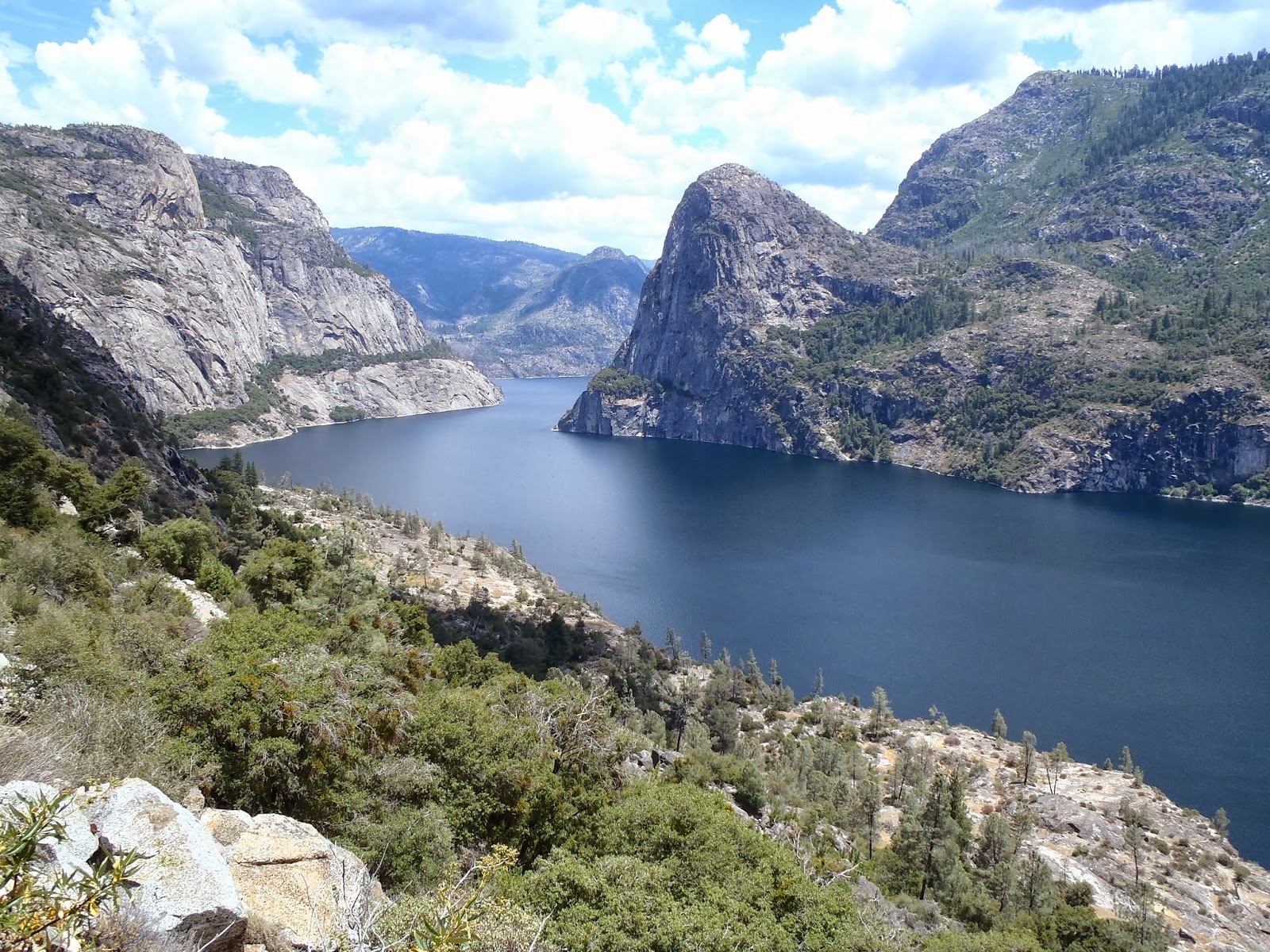
Summer’s backpacking trip: This year, we hiked the Pacific Crest Trail (PCT) from Sonora Pass south into Hetch Hetchy Reservoir (Yosemite), just weeks ahead of the Yosemite Rim fire - California’s third largest wildfire ever. The trail was hot and dry, full of kindling, making for heavier packs as we carried more water.
Hetch Hetchy
A “fire ban” prohibited all fires excepting camp stoves but that did not stop some from starting and stoking camp fires. (Not unlike hunters that similarly started the Yosemite Rim fire weeks later.) We left the PCT to follow the water as it dropped directly south into Hetch Hetchy and were treated to stunning vistas of granite and water and deserted campsites on pristine lakes. Worth every aching muscle - eh Moose?
I am already registered for 2014’s trip of a lifetime. I am hiking the Haute (pronounced “oat”) Route through the French and Swiss Alps - from Mont Blanc to the Matterhorn. This is a bucket list trip for me and I am sooo excited. The actual hike is eleven days at altitude. Then I’ll to fly to Norway for the last of their hiking season in the fjords. I’ll be in Europe five-ish weeks. Lotsa walking, no tours - my kind of trip. I did find a Norwegian base camp  with intriguing/inviting tree-yurts. I’m opting instead for a hotel in Stävän’ger. No falling from tree-yurts!

"Crow"
Handstand
"Running Man"
Yoga: I’ve been practicing yoga regularly for 20-months - gaining strength. Leap (and the net will appear) Yoga is three-blocks from home. I practice 6+ hours/week and most Sundays for 3-hours. The practice at Leap is lightly spiritual. 
There, I’ve learned to arrive on my mat, letting go of the day. Sufficiently strong, I no longer struggle through the poses. That allows for appreciating yoga as a moving meditation - bringing focus, stillness, equanimity and peace. There, I have found a community striving to live in the present with kindness and acceptance - a like minded community of many vegetarians with many tattoos. (No pressure to tat-up but I do feel conspicuously un-inked.) There, I am confronted with my aversion to touch and people in my space - and another lotus blossom petal falls. (The yogic equivalent of peeling an onion.) Its all a practice. “Practice makes  practice,” they say.
Jadalyn & Papa Nick
Davin's Honu (sea turtle) & friends

Ohana (family): Nephew Nicholas and wife Lindsey birthed baby girl Jadalyn last December and I am excited to attend her first birthday party. Great nephew Davin is quite the artist, a bent nurtured by his Popo (grandmother), my sister Gina. Niece Lael and longtime partner Darth became engaged with nuptials to follow in 2014. Mom moved into Craigside, an extended living facility, where she is surrounded by many church friends and new friends.

Betrothed: Lael & Darth
That’s my year in a nutshell. Follow my shenanigans on my blog Lorinz Muze at: http://lorinzmuze.blogspot.com. Should you want to be notified when I post, send an email requesting addition to the notification list.

I would LOVE to hear from you - for richness in life comes not from things - but delightfully gift-wrapped in relationships.
At this new year, I pray thee abundance. Abundance of health and wealth and love and joy and compassion and peace - now and always.

Ho’opōmaika’i (blessings) ~ Lorin

Sunday, November 3, 2013

Halloween & Healthcare ~ a call to action

Halloween - I typically dread Halloween - for weeks. I agonize over participating in the annual candy-fest. I view it as a day that contributes to addicting, yet another generation, to sugar - a major gateway drug to our most challenging, societal health problems. Consequently, I am loathe to participate in this pagan tradition turned Sugarween. 
I make no secret of my loathing. I have been known to turn off my porch light, darken my front windows with sheets and boycott the entire evening. My neighbors with children are gracious. “If we see your porch light out, we’ll know you just couldn’t do it.” 
AND I have been known to distribute boxes of raisins. Such was my Halloween this year. Armed with 168 mini-boxes of raisins - I was locked, loaded, armed and ready for the ghosts, ghouls, goblins, critters, fairies, bees, NASA astronauts, blue men, ballerinas, zombies and “humans” that rang my doorbell.
“Trick or Treat!” they screamed when I opened the door, thrusting orange, plastic, pumpkin buckets at me. Crowded from behind, sometimes the youngest, smallest ones  mounted the threshold.
“Ooh, you’re scary!” I’d say, or, “Who are you?” 
“Where’s your costume?” I asked my darling neighbor who wore long pants and a sweatshirt.
“I’m a human tonight,” she grinned, making me laugh. It was a good costume; human visitors were scarce on Halloween.
Her brother Daniel arrived with friends - all carrying pillowcases. They were obviously out for the long haul and big caché. He wore a purple “blue-man suit” and has for several years. Hooded behind a mask of purple fabric, his tall, skinny silhouette is unmistakable.
“You’re gonna outgrow that costume soon Daniel,” I said. Methinks he’s grown a foot in as many months and I’m sure he towers over all at home - a fact his father vehemently denies.
“No I’m not,” Daniel asserted confidently, “It stretches!”

Two young parents trick-or-treated with their infant. Huh?? I was puzzled. Were they checking out the neighborhood or desperate for candy?
A Mom, looking every bit the real ballerina with white and flowing tutu ala Swan Lake or The Nutcracker, came with her daughters. 
Two tweens knocked. Their princess costumes had bodices with spaghetti straps and skirts of tulle.
“Aren’t you freezing?” I asked.
“YES!” they chorused in unison before convulsing in gales of giggling. “Happy Halloween!” they chorused again as they ran down the sidewalk.
A little boy held the box high as he turned to run. “Mom, I got raisins!” he shouted with excitement. 

One girl, she could not have been more than eight, fished out the box of raisins to peer at it. “Oh I get it!” she exclaimed, “You want kids to be healthy!”
“You got it,” I grinned, “Less candy and more good stuff.”
“I’ll be sure to eat these,” she said sincerely. Smart kid, one after my own heart.

Can I write about Halloween, kids and candy without a segue to health? Hardly. What is the health state of the nation? Just shy of dismal. If we have one national affliction, its the disease of denial - a convenient one indeed.

Weight of the Nation - is a four-part HBO special exploring the consequences of unhealthy eating - which starts in childhood. 
The data is unequivocal: all calories are not created equal. Equal caloric consumption of broccoli versus soda cause different responses from the body’s hormones, metabolism, appetite and consequently -weight. 
Dr. Mark Hyman asserts, “Dinner is a date with the doctor. Food is medicine and what you put on your fork is more powerful than anything you will ever find in a pill bottle.”

The movie Escape Fire explores the special interests and financial incentives that keep our current healthcare system in place. Who benefits and why do they lobby so hard?
“Just the facts ma’am.” Both movies distill the issues down to the facts. Americans are unhealthy, heavy, and sedentary. Our diet is full of processed foods and marbled meats that have deleterious, long-term health consequences. Why do we continue feeding at this trough? There are powerful financial and industrial forces that benefit in largesse from the current system. Your health is not their concern.

What is healthy? As defined by the institute of medicine, “…attaining desired health outcomes that are consistent with current medical knowledge.” We outspend, by 3X per capita in healthcare dollars, the next developed nation. Are we 3X healthier? Hardly. Are we in the top ten? Negative. We have little national health to show for greenbacks spent. The facts say - moh kala ($$) maybe not moh-bettah. In other words, healthcare dollars spent does not confer healthy citizens. 
In the war for health, your doctor is unlikely to win the battle against convenience/fast foods, tempting confectioneries, over-nutrition, the food channel and a sedentary lifestyle. Current evidence points to a losing battle. If you have seen neither of the aforementioned specials, please do. They are time well spent that you won’t regret and a call to action.

While the ACA (Affordable Care Act aka Obamacare) is polarizing and divisive, it is nonetheless at the forefront of our national conversation - as it should be. America is in a healthcare crisis.
I have long been a supporter of the ACA though not without reservation. I come to it from a practical viewpoint shaped by 15 years in the Emergency Department (ED) and 35 years of nursing. I subscribe to the its like car insurance camp. E-v-e-r-y-one will need and receive medical care at some point in their life. If they don’t have insurance, they will seek care in an ED - at the highest price point and when they are in crisis.

I had a brief discussion with my 20-something neighbor.
“I don’t want health insurance. I’m young, I’m healthy and I don’t think I should be penalized for not buying it. And I don’t think I should have to subsidize a bunch of old people.” His is a common sentiment amongst the young and healthy.
Lets look at the facts (from the CDC = Center for Disease Control and Prevention website - 2012 data, published 5/2013). http://www.cdc.gov/nchs/data/hus/hus12.pdf#087 130 million ED visits in 2010. “Persons with and without medical insurance were equally likely to have had one or more ED visits in a 12-month period.” From 2000 - 2011, consistent utilization of ED services was equally distributed among the 0-44 and 64-74 age groups. More utilization was seen in the 75+ age group (as compared to others) and fewer visits in the 45-64 years demographic. 
During that same period, the percentage of people 18-44 years delaying or deferring medical care related to cost, increased by 50%. The other age groups did not see that kind of rise. Why do you suppose that is? One reason might be that many of those younger and older are covered through governmental programs like Medicaid and Medicare. Additionally, the uninsured subset of this 18-44 years group were the heaviest users of health care overall. These are the uninsured working and non-working, women in their reproductive years, the entry-level fast food worker, the employees of Walmart. (Do not miss the irony of a multi-BILLION dollar corporation that offers substandard healthcare options to its employees.) 

Let’s get back to my young, healthy, working at an entry-level-job neighbor. He falls into the demographic (19-25 years) that historically experience high levels of uninsurance - around 30%. Motor vehicle related injuries and death are a significant for his demographic: males, 20-24 years. Given that he commutes to work on a bicycle, he is at increased risk of injury. Like most young adults, he needs a low cost, major medical policy that would cover catastrophic injury/illness. Without major medical, the tax payer would foot his bill because as a country, we’ve decided that no one should be turned away from an ED - care is mandated by law and MUST be provided. 
Without insurance, would we leave him to exsanguinate and die on the street? No. We would scoop and run to the nearest ED. That care can turn into a month long stay in a trauma unit after a motorcycle crash or a two-week recuperation after heart attack and bypass surgery. For the under/uninsured, those bills are paid by the American taxpayer. So if you think you don’t currently pay for the healthcare of others, think again.

You think its unfair to mandate healthcare? What are the options? 
1) Do we refuse to treat people without insurance? Turn them away or leave them on the street to bleed to death? Two years ago, a lightening strike in the remote Sierra foothills started a grass fire that spread to homes. One resident had a long history of opting-out of the optional, $75, annual fire service fee. When his house began to burn, he begged the fire service to save it. It was a difficult call; they did not help. He lost his home and promptly sued. 
2) Do we treat people and send them a bill? We do that now - "overwhelming medical expense" is the primary reason cited for the majority of personal bankruptcies in the US. The American taxpayer covers the shortfall. Is that fair? Our current system has been identified as severely broken. ACA is the first step of (hopefully) many to fix it. 
3) Do we cover everyone and mandate that they pay? The reality is that everyone IS covered through services offered in the ED and there, if uninsured, their bill is paid by the taxpayer. You see the conundrum?

In the last few decades, the incidence of diabetes worldwide has increased over 1000%. 1000%?! AND Type 2 diabetes is almost 100% preventable and nearly 100% reversible without medication or gastric bypass. In fact, over 90% of chronic diseases are related to bad choices, not bad genes. People do not decide their futures, they decide their habits and their habits decide their futures.  ~ Frederick M. Alexander 
Consider that when a government begins to control our healthcare, it will also begin to have a say in our health choices. And while we individualistic, cowboy Americans rankle at the thought, as a nation - we are not making good choices. Do we need big brother to hold our hand? The evidence would say - apparently yes.
Did you know that European nations have banned some of our junk food? Why? Because its JUNK, some would call it poison, and governments that foot healthcare costs have a voice in what their citizens eat. This will soon (and should) extend to school lunches. Travel abroad and you will notice that morbid obesity is an almost entirely American affliction. Clearly we are not making good choices.

While I am no a fan of Texas Senator Ted Cruz, he did speak the unspeakable last week. He chastised Congress for having a crème-de-la-crème medical plan that is unavailable to its constituency. As you know, the annual open enrollment period for healthcare selection has begun. Congress must decide which of its aides to toss into the ACA marketplace. Senator Cruz expounded on the moral code of a Congress that would deny its citizenry healthcare while funding an elite, comprehensive plan for itself. Bravo! The thrust of his verbosity was not to fund the ACA however, but for Congress to defund their own plan. I'll second that motion.
I have long tired of our Congressional aristocracy. The hypocrisy on the Hill is astounding. Let them dine with the proletariat! Let them retire on Social Security and buy their health insurance in the ACA marketplace. Let them live within the constraints of the laws they pass and fund. I contend that legislation would be more thoughtful and compassionate were they in our boat.

I worry the wave of Baby Boomers will overwhelm resources and completely bankrupt our country. What can I do? I can keep myself healthy by exercising daily, maintaining a healthy weight and using food as medicine. I can lead by example and encourage others to do the same - particularly my healthcare brethren. There is no more powerful example than being that which we proselytize to patients.

Most of you know I have a moderate degree of renal insufficiency (kidney malfunction). A decade ago I learned of my congenital anomaly (birth defect) resulting in a solitary kidney - and it is none too happy. It is undoubtedly the source of my infertility and other minor maladies. In kidney disease food IS medicine -  I eat a diet (mostly vegetarian) that supports renal health and have done so for approximately six years. Each year my blood work looks better, more normal, and each year slight dietary tweaking is requested by my Nephrologist. This year my potassium is a little low and phosphate a little high.
“So I’m looking again,” I explained over a recent beer. “I eat fruit every morning but I can’t eat citrus every day, the acid bothers my teeth. My fasting sugars are climbing too, so I need to be a little better at restricting carbs.”
“That’s so un-American,” my physician friend sneered sarcastically, “Why don’t you just take a pill?” We promptly busted a gut but his point is well made. Americans tend to manage symptoms with pills and surgery rather than attacking the underlying cause of most illness - poor diet and inadequate exercise.
As an aside, I ran into my former allergist on Friday - who once managed my four, daily asthma medications and frequent blasts of Prednisone. I haven’t seen him in three years because my asthma disappeared with my mostly vegetarian diet. I take no medications. This is not miraculous, its well steeped in science.

I am in my fifth decade of life and nibbling at the sixth. Lifestyle has caught my cohort and almost everyone is learning to two-step with a chronic disease. We call them chronic because for most people - they will be. But they don’t have to be. There is another way. Interesting to me that our national health dialogue does not include a broad conversation about vegetarianism. Follow the money. There are powerful interests and billions of dollars invested in keeping the status quo, status quo. And the status quo is not necessarily in your best interest.
Educate yourself: Start by watching Weight of the Nation and Escape Fire. Do something drastic. Pry yourself from the disease of denial and seek support to make appropriate changes. Don’t go it alone. If you were reliable to produce the result you want without support, you would already be there/have that. (e.g.-You would be at your ideal weight and perhaps have shed diabetes and blood pressure medicines.) Never-mind what didn’t work before. You are not the same person you were a decade ago. Try it again. Research shows that those who try, try again eventually succeed.
If you always do what you’ve always done, you will always have what you’ve always had. Make a change. Start with Meatless Mondays, Fish Fridays and eat five fruits and vegetables each day. If you eat fruit with breakfast and salad at lunch, 3-4 of your fruit/veggie requirements will be satisfied. Its different - not difficult.

Who I am is vitality at every age and any stage 
- for me, for us, for all of us. 
~ Ask me how.

Saturday, October 12, 2013

Mālama ko Aloha = Keep your Love


Mālama ko Aloha: Keola and Moanalani Beamer Concert Tour with jazz pianist Geoffrey Keezer and Native American flautist R. Carlos Nakai

“Font row seats?” Jim asked. “Make sure you wear something to inspire him.”
“Oh he’ll know I’m from Hawai’i.” I chose a mu‘umu‘u hand-painted in taro leaf motif and a faux haku lei - a thick collar of yarn and ribbon imitating woven ferns and flowers.

Keolamaikalani (see why he goes by Keola?) and Kapono Beamer burst onto the Hawaiian music scene in 1978 with Honolulu City Lights, an award winning LP. They brought Hawaiian music to the lives and lips of my generation with singable songs, a fusion of Hawaiian and English, tradition and pop. 
From a long lineage of Hawaiian musicians, their family traces its roots to the 14th century House of Kamehameha, Princess Manono and the battle “waged for the principle of retaining the old ways of Hawaiian religion and culture.”
In more recent memory, their mother Winona Kapuailohiamanonokalani Desha Beamer (Auntie Nona), figured prominently in the revival of Hawaiian culture since the 1940s. Prolific composer, dancer and educator, she coined the term “Hawaiiana.”
I credit the Beamer Brothers and a handful of others (Brothers Cazimero, Makaha Sons, Olomana, Cecileo & Kapono to name a few) for their irresistible invitation to the Hawaiian Renaissance. Honolulu Magazine placed Honolulu City Lights first of the fifty most important Hawaiian albums for just that reason. They moved a generation, altering the course of our musical tastes and love of Hawaiiana for a lifetime.

I stumbled upon Keola’s Mālama Ko Aloha, western US tour while flipping through a local magazine. Keola and Moanalani Beamer in concert with jazz pianist Geoffrey Keezer and Native American flautist R. Carlos Nakai. I purchased front row seats within minutes.
The audience was sprinkled with Hawaiian shirts, leis and few mu‘umu‘u. The gal behind me attended Pearl City High. The gentleman sitting next to her was stationed at Schofield Barracks in 1959. We talked-story and had good-fun before the lights dimmed and chanting echoed from the wings.

Keola, the once wiry, long-haired heart-throb walked on-stage, heavy-set and jowly beneath a shock of white hair. His Aloha shirt bore a brilliant green, lauae fern motif, his soft-soled shoes sported velcro closures. His impish grin and mischievous eyes however, were unchanged. For a split-second, I couldn’t help but be sad for his metamorphosis. And yet, there is no downside to a life in service of passing traditions forward and spreading Aloha in the world. 
He tapped the strings of his guitar, drumming its wires to life, his left hand moving effortlessly along the frets with a lifetime of knowing. Ki ho’alua - the harmonics of Hawaiian slack key guitar leapt to fill the hall.

Geoffrey Keezer hails from Wisconsin where the jazz pianist began pounding the keys at age three. A graduate of Boston’s Berklee College of Music, he has collaborated with Keola since 2005. R. Carlos Nakai is an award-winning, Native American flautist of Navajo-Ute heritage. His flutes brought an ethereal, haunting spirit to Keola’s music. As if... as if Fire Goddess Pele herself lingered like smoke in the rafters. Keola’s wife Moanalani, herself a Kumu Hula (master dancer/teacher) danced, sang, clowned, narrated, talked-story, and drummed the ipu (Hawaiian gourd).
Keola displayed an amazing array of talent, hammering-on, pulling-off, chiming, sometimes alternately drumming and strumming or clicking ìli ìli (smooth lava stones) like castanets between stroking the strings. He chanted, he sang - but he did not dance.
“My mother Nona Beamer, died five or six years ago,” he said. “She taught at Kamehameha school for forty-four years. When we were little, she tried to teach my brother and I to hula but it just wasn’t happening. Everyday we practiced, stomping around until one day a Buddhist priest came over and said, ‘STOP DANCING!’”
“Why?” we asked.
“‘Coz people in Hell complaining!’ So we became her band,” he said when our laughter subsided.

Moanalani brought out Keola's nose flute. “I’ll have you know that I am the world’s premiere nose flute player,” he said, holding up the flute for our inspection. “There are a few others,” he began again when the applause died, “But... they’re too old to leave the house now so... just me.” He is more polished than when I saw him last at the Territorial Tavern on Bishop Street in Honolulu. I was a teen then and he? A rising star.

Keola spoke repeatedly of finding compassion and softness for others. Then he told another Auntie Nona story. “Every morning when we left for school she would say, ‘Mālama ko Aloha boys.’ Keep your love.” Keola tapped his heart, “But its more than keeping; its cherishing your love, living your love, spreading your love, BEING your love. Its about being Aloha.” 

Moanalani had us join hands across the aisles for the grand finalé. “We’re going to sing and sway,” she instructed. “Practice now, sway back and forth.” We did. 
“Good, good. Hey you guys up there,” she shielded her eyes from the spotlights and pointed at the upper tier, “I can see you too. Let me see you holding hands.” They raised their joined hands with a hoot. 
“We’re going to sing Hawaii Aloha. How many of you know it?” I woo-hooed from the front row.
“Good, maybe a few of you,” she said looking at me. “The rest of you hum along and move your lips.”
The guitar strummed, the piano banged, the flute flew bird calls in the air and Moanalani lead us in singing Hawaii Aloha - in Hawaiian. Did I know all the words? Yes, learned em in school though they went unsung for many years. 
     I was astonished that the simple act of joining hands built Aloha, joining strangers in an experience of Aloha. Mālama ko Aloha - experience aloha, touch aloha in your neighbor, share aloha, spread aloha, exude aloha, impart aloha, be Aloha.

Post finalé, a long receiving line formed in the lobby. I turned and there he was - Keola Beamer, not fifteen feet away. iPhone in hand, I moved and waited for a break in the line and photo op. Momentarily, someone lagged to speak with Geoffrey K. I lifted my phone, Keola turned, CLICK. Lowering my phone, I raised my eyes to meet his - in gratitude, in love and awe. 
And then... then Keolamaikalani Beamer, the legend, the icon, teen heart-throb and Ki ho’alua master whom I have adored since high school, leaned across the autograph table and stopped the flow of fans, reached past the burgundy, chenille festooning that separated the line from the throng in the lobby, stretched to extend himself to me in every way... and took my hand. I expected calloused fingertips and rough skin; his hand was warm and soft and my own was swallowed in its fold.
“Love you,” was all I could muster. He jiggled his faux ‘ilima lei, “Love your lei,” he mouthed.
“Mahalo,” I grinned Cheshire, eyes flying wide.
“Keola loves my lei,” I said flipping my hair at my friends, “I’m stylin’ now!”

I was overcome by a wave of Hawai’i breaking over - through me - a tremendous sense of belonging, feeling sooo grounded in: these are my people, this is my music, here are my roots. And I must say, as a refugee from island life, their is comfort there. 
Days later I am haunted by Mālama ko Aloha - keeping aloha, cherishing aloha, living aloha, spreading aloha, being Aloha.” Keola points to something greater than saying, “I love you.” Rather, he challenges me to leave others with an experience of my love, touching my love, sharing my love, spreading my love, exuding love, imparting love. In short, being Aloha. 
Can I do it? Can I do it when they ask for more at work and when the plumbing overflows at home and when a stranger touches me and to the workmen in my house and when a car cuts me off and with the man on the street? Can we do it together? Friends, methinks it a worthy game.

I believe that Hawai'i's greatest gift to the world is ALOHA, and this tour is all about sharing this beautiful philosophy, through music. With Aloha - Keola Beamer

Sunday, September 29, 2013

Remodeling


Saws whine, dust flies and the installation of new travertine flooring is finally underway. I’ve envisioned this for years. The work began Wednesday afternoon with removal of the old carpet and chiseling out the tile. They ground-and-filled to level the slab concrete on Thursday before slathering on a dark brown, rubbery compound that will absorb small movements in the foundation and keep the tile from cracking. Then on Friday, they began laying tile.
I am sequestered in sections of my house, sometimes denied access from crossing to the other side. My fridge and kitchen table are side-by-side in the garage for meal prep. The stove sits idly by. I used the opportunity to clean 14-year-old construction debris from behind the corner Lazy-Susan and scrub dried dribble from the stove’s sides. Ick. 

As I shift my stuff from one side of the house to the other, I can weigh its import, value, and worth. I clearly own more shit than anyone should. S’cuse my French. And speaking of fecal impaction... I moved into this home in haste. Boxes were stacked in the garage, and there, some remain. Many contained books that have since found new, temporary residence at The Bookworm, my favorite used bookstore. Box by box, I’ve worked to disimpact my garage.
Can I just say that books are painful to part with? I’m having difficulty entering the intergalactic wormhole, the portal, that digital divide to the digital world. But I can appreciate the thought of a spartan office and bookshelves. I can. I lack confidence, however, that it will happen in my office, in this lifetime. I like the feel and texture of paper, its musty scent that wafts when I turn a page and yes, even the clunk when it thunks and startles my repose.

As an aside, I had a recent epiphany as it relates to my garage and want for it to house both cars. The impasse to garaging two cars is where to store three bicycles, lawn equipment, wheel barrows, luggage, and Christmas stuff - if not the garage. My epiphany was that a small house needs the biggest, baddest shed available. To that end, I’ve found a 10X10 with a loft. Next!

Last year I was approached by a nursing girlfriend who was raised by nuns in an orphanage of the Yucatan. “Do you give clothes to Goodwill?”
“Of course,” I said.
“Would you give them to me instead? We need little clothes.” 
Have you seen the people of the Yucatan? Mayan descendants, they are eensy-teensy-tiny. A pedi-endocrine nurse tells me the population has a known growth hormone deficiency and poor nutrition - but that's another story. Biannually, Maria and a fellow orphan caravan to the Yucatan bearing clothing, bedding, soap, pencils, toys, etc. 
Included in my first pass and purge were 29 t-shirts. 29 t-shirts LB? Yep - and I don’t even like or wear t-shirts. I owned a number of event shirts like the Mercy Heart Day shirt and the Kaiser American Lung Ride team shirt. I found a 1998 Aloha Week t-shirt and a poi pounding t-shirt. 

Next week, the tile setter moves into the master bedroom and closet; impetus for yet another disimpaction and purge.
I looked long at my favorite 3/4 length, indigo, wool gaberdine, circle skirt - size 3/4. While I my current weight is below that of high school, I’ve broadened through the butt and thickened through the waist. Egads! I want to blame this on menopause. Never in my adult life have I culled my wardrobe of clothes that no longer fit - sadly that day is here. I see that my body is remodeling as well, time to relinquish my fantasies and remove the old carpets.
What for have I four pairs of black jeans and numerous in blue? I don’t like or wear jeans. Nothing is sacred. If its the wrong color - that lovely, soft, dove gray that makes me look ill - its out. Purple is passé. Blue is banished. I intend to bag my scrubs but doubt they’ll be discarded until the end of my career - kinda like a hedge against a rainy day. Call me superstitious.

Unsettled => upset. I’ve been uprooted and it makes me notably short-tempered. It’s good to know that about myself. Having that awareness helps me be mindful in the present; that its not about the issue at hand but uprooted, unsettled and upset playing in the background - like elevator music.
The contractor reached into my cabinet with dusty digits for a glass. How do I know? The adjacent cups bore telltale prints along with shattered shards on the floor. Flash-point. The toilet seat is up. Flash-point. Where is the remote for the overhead fan? Flash-point.
Wait  a sec - who declared I am graciousness and grace? Me! Moí! Counterpoint: Were I home, wouldn’t I offer them ice water? Yes. Don’t I want my house to be warm and welcoming - even to workers and strangers? Yes. Given that the contractors and sub-contractors are all men - isn’t an up toilet better than down? Yes indeedy!

Hold close those for whom you are generous and compassionate, for they will teach you grace. And grace, my friends, is the beanstalk to heaven on earth. In The Places that Scare You, Pema Chödrön touts the same. Learn grace where its easy, she says, then learn to include others: acquaintances, strangers, the difficult, the enemy and the world.
I try to do this everywhere and especially with the invisible: the wait-staff in restaurants, salesgirl Jessica at Talbot’s, receptionist Amy at the oil change, the medical assistants at work, and Vadím the tile setter. 


This afternoon, and for the third consecutive year, we will hold the G-Court BBQ. We will block off the cul-de-sac, set up tables and chairs in the shade of my giant sycamore, and come together to commune and break bread. Last month, and by request, I published the first G-Court Gardner’s Gazette. I’ve remodeled my neighborhood too, to one of connection and assistance and inclusion and goodwill. It’s the single most rewarding thing I’ve done in my neighborhood. 
Kenny Rankin sang poignantly, “What matters most is that we loved at all.” Sometimes I need to remind myself who I say I am. Sometimes I get by with a little help from my friends. I see that I am remodeling in many spheres: mind, body, workplace, home and neighborhood.

Change is inevitable and life is naught but crossing the pond, one unstable lily pad to the next. I’ve been accused of being a Pollyanna but recognizing that my life is always in some stage of remodel, and that inherent to remodel is unsettled => upset enables me to see beyond to the miraculous; flash-point => flash-dance.
Tappin' a tango on travertine. I've got my dancin' slippers on. You?

Saturday, September 21, 2013

Dad's 84th - or woulda been


Today is Dad’s 84th birthday - or would have been - had Alzheimer’s Disease (AD) not stolen first his mind, then body. Dad’s last years were an agonizingly slow, unfolding tragedy. I wish it on no one. On his birthday, I find myself reflecting upon my first year of work in the Memory Clinic.

What follows is a poem penned the year before his death.
Who says, “A watched pot never boils?”
Life on the back burner, 
Father - Simmering to a boil.

He seethes silently, Simmering in his seat
Glaring at the TV following an outburst.
 “I know what I see!” he spit, “Stop lying to me!”

He is determined to be angry; 
Predestined to be hurtful… even hateful.
Possessed by inner demons, His cup-half-empty theology amplified.

When neurons unhinge and little is familiar
The world is threatening
And family is enemy.

Calm seems vacant, apathetic… waiting.
Anger seems present and passionate,
The spark of synaptic connection… ALIVE.

Reaction is the locked step that enlivens, imprisons,
The doh-see-doh of struggle.
Difficult for me to BE no preference and no reaction.
I expect a night of little sleep.

Sometimes, newly diagnosed patients threaten suicide. Dad frequently threatened suicide. Then he threatened Mom, brandishing a long kitchen knife and she hid them thereafter. From my perspective, suicide is not a completely irrational thought, rather a lucid mind seeking solution for a terrifying and terminal diagnosis. They fear not for themselves but for their families - and rightly so. As a healthcare provider, I understand and suicidal ideation is something against which I must act.

Did you know that AD is definitively diagnosed at autopsy? So how do we make the diagnosis in the living? It is a disease diagnosed by symptoms and exclusion. What does that mean? We look for memory loss that is greater than normal in the absence of reversible or explainable causes like brain tumors, strokes, alcohol consumption, vitamin B-12 deficiency, and psychiatric disorders - all of which can affect memory and mimmic dementia. Exclusion of other causes, in the face of abnormal memory loss in the elderly, points toward a diagnosis of AD.
Other dementias include: vascular dementia (memory loss suffered after stroke) and dementia seen in the late stages of Parkinson’s disease or Multiple Sclerosis, to name just a few. The current rise in elderly dementia is primarily related to a rise in AD or vascular dementia or an almost certain combination of both.
New amyloid scans might help differentiate early AD from other dementias but as none are curable, early diagnosis and differentiation is academic; prevention better medicine than the bitter pill of early diagnosis. You know the old adage: an ounce of prevention...

What we know. An estimated 5.2 million people in the US are living with a diagnosis of AD. At this point, few of us remain untouched by the disease. Someone is diagnosed every 68-seconds. (And the tide of baby-boomers with dementia has barely begun.) AD is the sixth leading cause of death in the US. One in three senior dies with Alzheimer’s or another dementia. In 2012, 15.4 million family/friends provided 17.5 BILLION hours of unpaid care to those with dementia. (Statistics from Alz.org). The impact to family dynamics and relationships is staggering.

Factors for increased risk of developing dementia? The greatest known risk factor is age. We are witnessing a wave of dementia as the ranks of the elderly swell. While actuarial tables show the average lifespan in the US has increased only 5-7 years since 1900, in that same interval the population has more than quadrupled; we are witnessing the tidal surge of sheer numbers. It stands to reason, the body is organic, its parts wear out and decompose. When the body fails, we call it chronic disease. When the mind fails, its called dementia. Pick your poison. 
Is there evidence for dementia historically? Yes, migratory tribes left people behind and Shakespeare wrote of it in King Lear.
Family history - those with afflicted nuclear family members (mother, father, sibling, child) are more likely to develop AD. This is not pre-destined however, a combination of family history and environmental factors are thought to be at play.
What about genetics and heredity? Genes coding three proteins: amyloid precursor protein (APP), presenilin-1 (PS-1) and presenilin-2 (PS-2) directly cause “Familial AD”. This “early onset” AD is seen through multiple generations, as early as age 30 and seldom later than age 60.  This variation has been found in only “a few hundred extended families worldwide.” 

What does that mean? It means that most of us are NOT dealing with a familial (genetic) variant but the combination of family history and environmental factors - which are impacted by lifestyle choices. My Dad had AD. Am I worried? Yes. He was diagnosed late in life, as were his sister, my maternal grandmother, aunt and uncle. Yikes - both sides of the family LB? Yes. But all were diagnosed late in life. Most were lifelong smokers, all were carnivores without regular exercise. Therefore, methinks I have some sway over destiny - I can live a “brain healthy” lifestyle and exert favorable pressure upon the complex interactions of family history and modifiable risk factors.

Oh Gawd - are we back to diet and exercise AGAIN? Yes indeedy we are. Sorry.

Risk factors over which we have sway:
  1. Head trauma - there seems to be strong link between repeated head trauma and dementia (think boxers, football and soccer players). This group is high profile and accounts for a tiny percentage of the afflicted. Wear a helmet and protect yer noggin from falls at home. (Consider removing throw/area rugs and clutter upon which one can trip.)
  2. Stay socially connected and intellectually active. Seniors who are socially isolated and disconnected seem to be more at risk for disease development. Its why I constantly tout that I will return to Hawaii upon retirement. People like me, alone and removed from family, don’t do well. I get it. The purchase of an island-bound-one-way-ticket looms large in my future. Look at your relationships - mend them and form new ones. Learn the skills required to maintain long, nurturing and healthy relationships. These are learned skills and we are never too old to learn this new trick. It may be the most rewarding trick EVER. 
  3. Intellectual activity - musicians seem magically spared. Mind games improve cognitive ability be it Sudoko or the NY Times crossword puzzle. Watching TV is a brain drain. Limit your time in front of the tube and balance it with equal parts of physical activity. Consider something drastic - lose your TV. I don’t have one and my life is better for it. I read more, I write more, I exercise more and I interact with those who bring life.
  4. Heart - Head connection - Did you know that with each pump, your heart first sends blood to itself and then 20-25% to the brain? It stands to reason that what is good for the heart is good for the brain. There is a plethora of heart research. Run with it! People with chronic disease have more dementia. Most of our chronic diseases (the top five US killers) are REVERSIBLE. Yes - reversible.
  • Diet: heart healthy = brain healthy. A Mediterranean diet (fish, legumes, whole grains, nuts, fruits and veggies) has been shown to improve cognition in those with mild memory loss. There are populations with no, or very low rates of dementia and heart disease. They are vegetarian. Eliminate red meat; start by reducing intake to twice/month. Increase vegetables, fruit, salad to 50% of each meal.
  • Exercise daily: yes, MOVE - every... single... day. Exercise is definitely cardio-protective and likely to be brain protective as well. But... but my knees hurt. Uh-huh. Chair Dancing is but one of many chair workouts. But... but my back hurts. Uh-huh. Go walk in a pool. But... but... my feet hurt. Uh-huh. So? Do one of the two workouts mentioned above. Try a stationary bike. Don’t let your big, fat BUT keep you stuck!
  • No way around this one - STOP SMOKING.
That’s what we know. Its not much and its a place to start. If you’ve read my blog for any length of time, you know I count myself amongst the average. I never exclude self from statistics. The statistics are that only 10% die in their sleep, 40% die of a chronic illness. The remaining 50% will die with dementia and frailty. At age 85, 50% of us will suffer with AD.
I come from a long lived family and intend to live well beyond 85. So when I look at the things I can modify, I modify. I never want this diagnosis - for outside of pediatric terminal illness - I don’t think there is one more devastating to both patient and family. Everything about who we are resides between our ears. When that becomes unhinged, we are reduced to the primal animal who lives within - and I don’t use the term animal lightly.
What are the odds? 50%. I take this statistic seriously. You?

"People do not decide their futures, they decide their habits and their habits decide their futures."  ~ Frederick M. Alexander ~ Like I said, pick your poison.

The Walk to END Alzheimer’s occurs nationwide on October 5th. Our entire Memory Clinic is walking. Join us! Go to Alz.org and register in Sacramento with the KP Mind Joggers or walk in your city. The national Heart Walk is tomorrow. Do that too - it will count toward daily movement.