Sunday, June 9, 2013

Committed - or - perhaps I should be


Can you attend a BBQ on Sunday? Her email read. I’d like to introduce you to my cousin, a retired orthopedic surgeon.
I attended. You know, I’m socially adept. I can enjoy adroit maneuvering around their familial intimations as the odd-man-out. Even at fifty his sister is a dark-eyed beauty from the Azores. Her brother the surgeon, recently relocated from Newport Beach to care for their ailing father, was witty and unpretentious. Nice enough. No sparks over here but then... hey, it’s me, sparks border on the brink of mass extinction. My friends say I’m too picky. Methinks they are wrong. I’m not too picky - I’m not interested.

“What about you Lorin?” Mark asked. “When are you getting into relationship?” The hairs of my nape bristled and I spewed what has become an auto-response to such queries. “When I meet someone who inspires me to it,” I say. That seems to sufficiently stay the line of questioning and overrule objections. The gavel thumps - sustained! Whew.

I am often astounded at the rapidity with which people couple and uncouple, marry and remarry. The in-between is seemingly marked by a fervent state of DEFCON readiness: “Up-periscope, prepare to launch heat seeking missiles, one away.” 
I am equally astounded at the undercurrent of bitterness and anger that runs unceasingly and sometimes unchecked through many marriages. In the aftermath of my own marriage, I looked across the landscape of my life seeking enviable marriages of greater than fifteen years. I found three.
Three you cry? What unattainable criteria was employed to thread that needle? Nay, nay, neither fantastical nor preposterous. First criteria - that love be present. This can be exemplified innumerably but my standard here was simply that people communicate in ways that were kind, perhaps using social lubricants like please and thank you. Tone of voice was/is critical. 
Two: that people communicate more than the perfunctory who’s picking up Joey and what’s for dinner. From the outside, perfunctory looks like indifference. “I’m often amazed at how couples can be up on the minute details of each other’s lives, but haven’t had a meaningful conversation in years,” wrote E. Perel, family therapist and author of Mating in Captivity. Exaaaactly. 
Three: that there seems to be a sense of equality, that no one partner dominates the other, giving each a voice. 
Open warfare and nuclear winter ixnayed couples from the get-go. Yelling is unkind by my measure so the yellers were categorically eliminated. One can argue that these behaviors are indeed communicative - but if one considers where people are left - love is not present. No-pass on criteria #1. This is not rocket science - sit, listen, watch. You know the adage: God gave you two eyes and ears...

Let me say here that no one deserves my judgement nor requires my approval. This is my own simple criteria, a kindness quotient, if you will. Coupled with the question - can we apply it to that whom we call Beloved?

I just finished reading Committed: A Skeptic Makes Peace with Marriage by Elizabeth Gilbert (of Eat, Pray, Love fame). Known as a chiclet (the literary equivalent of a chick flick), I found it a thoughtful and provoking examination of that most rare of birds  - lifelong, monogamous marriage. Gilbert examines the history, customs, traditions, myths, assumptions, and expectations of marriage - for those vary as widely and wildly as culture. 
In her peace-making research, she dredged up practices that all but “disappear” the woman (or girl) turned wife. For instance, did you know that only since the 1970’s can an American woman open a checking account without her husband’s signature? As a pre-Title 9, athletic girl dealing with the inequality of men's sports programs, I vaguely remember this vestige of coverture - a traditionally English then American law whereby a woman was subsumed out of existence by her husband. Her property became his, her voice was silenced, he could do nearly anything (including beatings and forcible rape) because she belonged to him. 
And while I have owned a checking account since age fifteen, seeded with monies from Dole Pineapple Company, remnants of that history of ownership casts a long, cultural shadow. Culture after all, exists and persists in language.  I struggled with equality and overriding my husband’s voice - even as the primary breadwinner.

Did you know the Jewish tradition has long embraced marriage while early Christians were exhorted to abstinence and celibacy. 
I’ve heard tale that one can rightfully claim to be Jewish only when one has faithfully practicing grandchildren. Early Christians had no such designs on birthing and fledging the faithful; rather, doctrine focused on recruitment and converts - still does. Hence the sexual ambivalence, nay, sexual revulsion of the early church.
Even within marriage, (Saint) Paul considered sex immoral, exemplifying a lack of self-control. He conceded however, that Christians were likely to have sex and that sex within marriage was better than burning. Alrighty then! So a marital, sexual concession was made. When did the church embrace and co-opt the marital tradition, lacing it with moral judgement and strict covenants to make it their own? Later - much later.
Buddha also espoused celibacy and chastity, pointing to desire as the source of all suffering. He abandoned a wife and child in pursuit of enlightenment - unattainable he proffered, to those with such attachments.
So unfortunately, it seems that celibate and single, I am in good standing with the doctrines of both St. Paul and Lord Buddha. Good grief.

Interracial marriage was not legalized nationally until 1967, when the Supreme Court voted unanimously in its favor. The marriage of my own parents was unrecognized in countless states until it had endured nearly two decades. Shocking; donchya think?

I realize this is the second such book I’ve reported on in a relatively short interval. (See Mating in Captivity - Unlocking Erotic Intelligence - posted August 2012.) Like Gilbert, I am sorting it out. She, driven by a devastating divorce, me - by a devastating marriage.
We are genetically driven to pair and procreate; the want and need for bonding is innate. My innate software has been corrupted methinks, my reset button dispossessed.

Gilbert sat with the Hmong women of a single household in North Viet Nam to ask of their marital traditions. Hmong are considered an indigenous peoples who occupy the mountainsides of Northern Viet Nam, Laos, Thailand, Burma and South China. For millennia we existed as they, in clans and tribes, large familial groupings maintained for protection and survival. Only the Western world has strayed from that model and only Western marriages feel the overwhelming strain of discontent and divorce.

Expectation. Hmong women don’t expect marriage to fulfill their every want and need. A man is a man. A husband is a husband. He works, he provides. Women are basically the same, men too. He’ll do and that’s that. He is not charged with being her knight in shining armor or inspiring her daily. He is not her everything.
I used to rock-climb at a gym with a guy who was his wife’s best and only friend.
“That’s a big burden,” I said one day, dangling overhead. 
“It is,” he confirmed. 
“Best friend, I get but I don’t ever want to be someone’s only friend, not even my husband’s. There are things he gets from the guys at basketball that I could never provide.” 
I’m good at including wives into our friendships. I am intentional and know that if she feels threatened, my friendship with him will be discarded. I tried to reach out, to include her, to make her feel safe but she would have no part of it. Needless to say, as climbing partner, I was duly and dutifully fired.
“I’m sorry,” his head hung, “My wife was rude; wasn’t she?” I felt sorry for him. Living small to accommodate others serves no one. And while my relationship was of little consequence, I’m sure that from her place of insecurity she exerted pressure elsewhere, usurious in its cost.

Marriage has endured over the centuries because it has changed with the will of we the people. It will change yet again because we want it to. Gay marriage is here; at this point its a moot point and only a matter of time. If you think about it, while many marry in churches, marriage is a secular affair adjudicated by the state. I now pronounce you husband and wife by the powers invested in me by the state of X. Nor is the union official until signing of State documents.
Divorce too is a secular affair adjudicated by the state. The Court has little interest in your mortal/moral soul. It is interested in your home and who will keep it, your kids and how they will be shared, your credit cards and who will pay them, your cars, your boat, your toys, your 401K, in essence - your worldly goods. Even divorce prompted by infidelity has little bearing, ultimately, on the division of property. Marriage confers secular benefits - and those benefits will soon be available to all regardless of race, creed, color, or sexual persuasion. Thank God for separation of church and state.

All of it leaves me stranded somewhere between no thank you and hell no!  I bounced it off my cousin Noël, over a cold beer. Noël is a slight man, barely bigger than me and he loves the dialogue of relationship as much as I. He’s as good a girlfriend as one could ever hope for.
“Landmark believes that life is created in language,” I said. “If that is so, and I believe it is, then one must develop the capacity and stomach for difficult conversations that can make a difference.” 
Noël reminded me that while this works for us, it is but one way, not the only way, and doesn’t necessarily work for others. But... but if life and the quality of our relationships is created in language - or lack thereof - is it really optional? Yes, apparently it is, he asserted. There are those who prefer stuckness (see When Things Fall Apart - posted May 2013) to a conversation for workability, happiness, reestablishing practices of love, creating the space for acceptance and forgiveness.

“Communication breakdown, its always the same. Communication breakdown drives me insaaaaaane,” he sang to my peals of laughter. “Who sang that and on which album?”
“Rush?”
“NO, not Rush. Lead Zeppelin on the album of the same name.” Back at its original release in 1994 Led Zeppelin had it right. What don’t we get about this?

Lest you begin to feel that I am sorrowful and filled with remorse, nay, nay - let me acquaint you with the marriage benefit imbalance. That is to say, marriage benefits men to a far greater degree than women, a fact that has been shown in study after study. Married men live longer than single men, accumulate more wealth, excel at their careers over single men, are less likely to die of violent death, report themselves to be happier, and suffer less from alcoholism, drug addiction, and depression.
The reverse is not true for women however. Single women live longer than married women, make more money and accumulate more wealth, thrive in their careers, are significantly more healthy, suffer far less with depression, and are less likely to die of violent death - usually perpetrated at the hand of their... husband.
“So you’re sad three days a year,” Karen spoke of the Holidays, eyeing my new Mercedes 350 SLK. “Deal with it. The rest of us are sad we’re not you for the other 362 days.” I have to admit - she made me giggle.

“To be fully alive, fully human, and completely awake is to be thrown from the nest.” ~ Pema Chödrön, When Things Fall Apart

I notice I have no answers, only questions. I am in the inquiry and exploration... and isn’t that life? Alive is in the unknown. We try to flatten out all the rough spots into a smooth ride instead of being thrown to ... to take flight. I may have to be thrown coz I notice... I ain’t jumpin’.


Gilbert makes her peace then embraces her marriage. She closes Committed with a 14th century chant by Christian mystic Julian of Norwich. All shall be well, and all shall be well, and all manner of things shall be well.
I know this to be true and all IS well. Amen.

Sunday, May 12, 2013

When Things Fall Apart


Last week I traveled to Nashville, Tennessee for one of two national nurse practitioner conferences and more importantly, to see my friends Eddie and Trish. 
I met Eddie my first or second day in nursing. “Come help me find supplies,” he said, his words Southern-slow, sweet and smooth like golden, Tennessee honey. “Let’s go change a dressing.” He was a surgical resident; I - a wide-eyed, newly pressed plebe in crisp white dress, nylons, shoes and cap. We became instant friends and have remained so for thirty-plus years, he - a natural teacher, me - a sponge.
Trish is a contagion of enthusiasm and joy, bringing new meaning to the words supportive wife, creative and caring mother and grandmother. I visited them in Puyallup once, after wrangling the Army into deploying me to Madigan Army Medical Center in Washington state for my Reservist weeks. 
Every morning before their daughters marched off to school, Trish braided or pony-tailed, or pig-tailed, and ribboned or barretted or rubber-banded or did whatever their little coiffing heart’s desired. The mothering lessons learned in those weeks went light-years beyond perfunctory.
I could write reams of the heavily timbered hills, green sweeping lawns, white split-rail fences, and cicada songs of the genteel south that permeate their souls - but that is another story for  a different day. We talked in their living room, feet up, sipping southern sweet-tea. 
“You never really know who is going to travel through life with you,” I said. I am grateful they allowed me to tag along - their friendship has touched me in deep and meaningful ways.

My airplane hours were spent turning the pages of Pema Chödrön’s best seller, When Things Fall Apart - Heart Advice for Difficult Times. If you have not read Pema, let me highly recommend. She is an American Buddhist nun, her words are simple and ring true. In fact, her book titles exemplify simple truth, i.e. Start Where You Are and  The Wisdom of No Escape. 
When Things Fall Apart is a guide: 
to use painful emotions to cultivate wisdom, compassion and courage
to communicate in ways that lead to openness and true intimacy with others
to practices for reversing our negative, habitual patterns
to methods for working with chaotic situations
to cultivate compassionate, energetic social action

“This is a pisser for you; isn’t it?” he said.
I paused, choosing my words carefully, “No, not a pisser, something to manage.”
I thought about his assertion for days and it gnawed at me. What is it? When I don’t get my way, when the rules change, when I’m corrected, chastised or admonished, when things fall apart - who am I in the matter of it all?
Inside I am Ninja Monkey - all teeth, darts and daggers, nunchucks and swords, flying venomous stars and arrows - tips dipped in muscarinic, paralyzing agents. Ninja Monkey emerges as anger and argue and resistance. 
In the face of Ninja Monkey, in managing the snarling beast, there are seemingly two paths: suppression versus recognition and redirection, using “painful emotions to cultivate wisdom, compassion and courage.” I am interested in that. I’m interested in who I BE and how I behave when things fall apart, when things are a pisser.

One tool in unpacking upset (when things are a pisser) is to look within for unmet expectations, broken promises, and undelivered communication.
Is there an expectation I hold that is unmet?
Did someone break a promise?
Is there something I haven’t said OR don’t want to say?
Is there a conversation of redress required - so the upset can be managed mutually OR does one suppress?

Pema tenders the fear of impermanence is our great source of upset and resistance. Relaxing with the present moment, not resisting that things end, that things pass, that things have no lasting substance, that everything is changing all the time - that is the basic message. No escapism. If we can give up all hope of alternatives to the present moment, we can have a joyful relationship with our lives, an honest, direct relationship, one that no longer ignores the reality of impermanence.

I recently taught a Memory Class. This class provides basic information about memory loss and dementia versus natural aging. It is typically filled with the elderly and their middle-aged children. Some have been referred by their doctor, some have registered themselves, prompted by family and friends. Some are the worried-well, some are not. Talk about a room filled with people who can no longer ignore the reality of impermanence.
As I taught, I watched a young-ish woman become more and more irritated. Her body language, gestures and facial expressions grew in animation and anger along with the decibels of her murmurings. I should have stopped instructing and asked her to speak. I didn’t. I continued on, ignoring her agitation until she exploded from her chair and marched up for a face off.
“This is f__g bullshit!” she screamed, stabbing a finger at me. “I work in a nursing home with 69 residents who have dementia. There is no cure for this so we don’t need to hear about blueberries, diet, and exercise! Do you have a cure?”
Blueberries? Did I even use the word? “No,” I said, “There is no cure. Were you looking for one?”
“We don’t need a f__g class; we need a cure!” She pointed to her husband, “He’s already diagnosed. We don’t need another f__g class; we need a cure!”
“If you feel this class is not appropriate for you and you want your husband evaluated in the Memory Clinic, fill out that green paper and our medical assistants will contact you for an appointment.”
“And what?” She sneered, “You’ll send us to another class?”
“No, he’ll be evaluated in the clinic.”
She turned her vehemence on the class, “WHAT is the matter with you f__g people? Why do you put up with this bullshit?”
“We’re trying to learn something,” a man blurted in defense.
“Please,” I said, my voice calm but strong, “This class may not be appropriate for you. You are welcome to leave and we would be happy to evaluate your husband in our clinic.” I glanced at him, frozen in his chair.
“I don’t need your f__g clinic and I AM leaving because this is f__g bullshit!” she stormed through the door. When he did not follow, she reopened it and seethed, “Com’on!” He rose, apologizing as he exited. Minutes later, two request-for-appointment sheets were slipped under the door. One declined an appointment, the other requested one.

The fear of impermanence. There is a goodly dollop of pent up hostility and frustration harbored within the Memory Class attendees. There is wide-spread sentiment that we should “do more” as their loved ones struggle with dementing disease. It surfaces in class and they lash out at instructors with the fear of impermanence.

Pema writes about leaning into the sharp points, recognizing upset as a place for growth and compassion for self and others. Upsets reveals our attachments, where we are stuck in the duality of how things should be (fantasy) versus how they are (reality). She calls this stuckness. 
How do we lean into the sharp points? Recognizing the barb is paramount. I have definite standards regarding appropriate public behavior and can quickly label and discount “people like her.” My position could easily garner hardy agreement among my colleagues and attendees. I could be right, righteous and move on. I could... and remain in my stuckness about how things should be. Without leaning into the sharp points, there is no new growth or compassion for self and others.
In the past, I might have become surly, my remarks biting. Whether I was outwardly disdainful, internally I would be a mess, damaged and filled with “shoulds.”
I recognized the barb in the moment and  did not react - not within or out, nary a churlish snarl from Ninja Monkey. I was the space of the Peaceful Warrior, leaning into the sharp points that allowed her expression, inviting her to leave, and amazingly, acquired no residue from the interaction. Later, I reflected that it signified a shift for me. Leaning into the sharp points allows for growth and compassion for self and others. 

What does Pema write about getting to the space of nothing, no reaction and no attachment? The practice of Tonglen is a method for connecting with suffering, dissolving the tightness of our hearts and awakening compassion that is inherent in us all.
As an aside - I LOVE the Buddhist assertion that we are inherently good, perfect just the way we are and are not. It is consistent with my experience - we are inherently good. A belief that (wo)man is inherently sinful does not resonate though I don't discount evil in the world. But I digress.

 The core of Tonglen practice is breath: breathe in the other’s pain so they can be well and have space for opening - breathe out, sending them that which would deliver relief. Often at the start of my yoga practice, we are prompted to dedicate our time on the mat to someone in need. Yoga is all about prana ~ breath. Breathe in suffering; breath out relief. Yoga is Tonglen, 75-minutes of breathing for another.

Pema makes a distinction between detached (and uncaring) versus no attachment (with compassion). Her discussions include tolerating versus patience. Compassion and generosity do not equate to doormat. No attachment is not equivalent to heedlessness and negligence.

Through the years, I have found embarrassingly few for whom I am always generous and always compassionate - always in all ways. Over time, as I exercised those muscles, my capacity for generosity and compassion expanded - including more. 
My buddy Hernando G is the personification of including more with compassion and grace. So sagacious he, I call him G-san and am inspired to follow, including more, always including more. Hold close those for whom you are generous and compassionate, for they will teach you grace. And grace, my friends, is the beanstalk to heaven.
And that is how it came to pass that I could include the young-ish woman screaming obscenities at me and my class.

In the moment - I saw her suffering, her fear of impermanence, her resistance to naked truth. In the moment - I knew it was not about me or my class. It was fear; it was resistance, it was struggle. I leaned in, breathed in, breathed out filled with compassion for her station. I acknowledged the class for their generosity in being with her pain. When day was done, I was undamaged, not one kernel of remorse, no residue or smoke of battle. At the end of the day I was perfect, whole and complete.
It feels important; it feels like a shift. There will be days ahead where I will undoubtedly stumble on the yogic path. There will be many more days when an event that would have been a pisser is naught but an exercise to lean into the sharp points, finding compassion and generosity for others, leaving us whole and present to love. I am intensely interested in that. You?

Chinese Proverb: 
Grant yourself a moment of peace and you will  understand how foolishly you have scurried about.
Learn to be silent and you will notice that you have talked too much.
Be kind and you will realize that your judgement of others was too severe.
Hasten slowly and you will soon arrive.

Sunday, March 24, 2013

Asian Chronicles 9 - Hong Kong / Macao


Tap the photo once to enlarge and tap the X at upper right corner of photo to resume reading.

10/7/2012

Our morning call came at o-five-hundred or 5:00 am. You can see why these trips are exhausting: up early, go-go-go until mid-evening, too much food, too much sitting, and no down time except for dropping into an exhausted sleep. It does give one the overview of this massive country but ...

We shuffled onto a bus for an early flight to Shēnzhèn in the Guangdong Province. Shēnzhèn literally means “deep drains.” The area was once crisscrossed with rivers and streams, with deep drains in the rice paddy fields. Shēnzhèn is situated immediately north of Hong Kong.  Like its southerly neighbor, it enjoys protected waterways and harbors of the Pearl River Delta and South China Sea. The Pearl River Delta was so named for its oyster beds and pearl economy some centuries ago.
 The disparity of wealth from one bank to another is not so striking as in years past. Largely due to its port, Shēnzhèn has transformed into one of China’s most successful Special Economic Zones. There, condo farms house factory workers who slave nine-hours per day, six days per week. In Shēnzhèn we would clear customs alongside 700,000 others, walk across the border, and bus across the river into Kowloon. 

Kowloon is a peninsula attached to mainland China, that reaches south for Hong Kong island. Transport to Hong Kong is by ferry across the harbour or tunnels beneath the harbour. No bridges span the harbour because they are reliably destroyed by monsoons.
We checked into the Harbour Plaza Hotel just off the famed Salisbury Road in Kowloon. Converting money into Hong Kong (HKD) dollars, we dispersed seeking lunch. Much of what Westerners think of as Hong Kong: Salisbury Road, Nathan Road, the Jade Mart, and the Peninsula Hotel are actually in Kowloon, NOT Hong Kong. The distinction is critical when purchasing ferry tickets, as we would later learn.
Out hotel was annexed to a shopping mall with food court. There I had a wonderful bowl of curried vegetables, tofu and rice and checked email. Hotels across mainland China had free wi-fi, at least in the lobby. Not so in Hong Kong; we would trek daily into the mall for wi-fi hotspots. I stopped at a small grocer to stock our refrigerator with fruit, yogurt in tropical flavors (like lychee), and bottled water.

We met for an afternoon city tour aboard a small shuttle bus. Our driver Daniel was a slight man with a knack for stating the obvious. “Take taxi foh dihnah, ah... fit fyh,” he said, holding up five fingers. “Ah... fit fyh Chinese pepoh, you - you lahj, ah... maybe fit foh. Ha, ha, ha,” he laughed, not in the least embarrassed or apologetic.
Hong Kong is a costal island off the southern coast of China. It was incorporated by China’s First Emperor Qin in 221 BCE. A mere 426 square miles, it currently houses 7,000,000 residents, making it one of the most densely populated areas in the world. The paucity of land drove demand for dense construction, thus distinguishing Hong Kong as the world’s most vertical city.
Its population is 95% ethnic Chinese, Han to be specific, migrated from Guangzhou and Taishan to the north. The island is tropical, geographically not unlike Hawaii, and indeed, most early Chinese immigrants to Hawaii’s sugarcane and pineapple fields and railroads of the western US came from Canton (now Guangzhou). Hence, older Chinese speak Cantonese and Americans know Cantonese food as Chinese food. My Popo (grandmother) was a picture bride from Canton - purchased before arriving in Hawaii in 1912, bound feet and all. But that is another story for another time.

This tiny island has a long history of occupation by its neighbors and in 1898 was leased to Great Britain, together with 230 large and small offshore islands, for 99 years. Great Britain proved an insufficient deterrent to Japanese occupation during the 1940’s. Decolonization swept across Asia in the 20th century and the handover of Hong Kong occurred in 1997. Hawaii and the Western Americas enjoyed an influx of cash as money poured from Hong Kong before its return to China. Of note, the popularity of the Chinese government has waned and a 2013 poll by the South China Morning Post showed nine of ten Hong Kong islanders prefer a return to British rule, just sixteen years post-handover. 
“We hope Hong Kong make China change,” Daniel said in his nasal voice made gravelly by years of smoking, “Not China make Hong Kong change.”

Our shuttle bus dove beneath the harbour and emerged into the hustle and bustle of Hong Kong on the other side. We wound through densely packed buildings and climbed hills overlooking a sparkling blue, tropical sea with luxury boats moored off shore. Like the Swiss, Hong Kong islanders have learned to build into impossible slopes and the sea is appreciated in glimpses framed by concrete.
We stopped for a junk ride out to the floating city. What’s the difference between a junk and sampan, you ask? Size - a junk is larger.
The floating city is a group of boats  - fisherman and their families who virtually never come ashore. They fish, they return to port, a sampan gathers their catch, they leave to fish again. They are moored one to the other and float just outside the harbour. Even their children are educated at sea.
 Our tour included a stop at the Pearl Factory. Why? We were out of mainland China. Surely this was not government mandated. Back home in Hawaii, one of Mom’s friends said See & Sea Tours are known for incessant, maddening and annoying factory stops. 
I had sought white jade stud earrings across mainland China and Hong Kong - for my two neighbors feeding my two cats. “No moah,” the jewelers said, shaking their heads. 

Victoria Peak
High atop Hong Kong island’s Victoria Peak, we watched the sun sink. We looked down upon the 118-storey International Commerce Center, Hong Kong’s tallest building. At 1588 feet, it dominates the skyline as the fifth tallest building in the world. Their restaurant occupies floors 100-102 and the Ritz Carlton occupies everything above. The tower sways and people on the upper floors are known to get building (motion) sick.
The air grew cool and misty and in the gathering gloam, the buildings lighted to illuminate Hong Kong’s famous skyline. We would learn and later enjoy the Symphony of Lights laser and music show that is orchestrated from both sides of the strait after sunset.
Chilled to the bone, we returned to the Harbour Plaza hotel then cabbed cross-town to join Derek at his favorite noodle house. Their wonton mien was to-die-for; their roasted goose - a double death.
“Why have we been eating those scrawny ducks?” Mom asked. “I’m done with scrawny ducks; from now on I’m eating goose!”

The next day was spent enjoying the sights and sounds of Hong Kong: the street markets and bizarres, Cantonese delectable delicacies and the like. Lots of walking and lots to see. Not much enticed me to shop, nothing I couldn’t get on Amazon sans the schlepp home.
Something I couldn’t get at home: plain (uncarved) elephant ivory chopsticks - asking price 800HKD for two pair = $103 USD. I would never buy elephant ivory anything but I examined them carefully. Foh real, ivory colored plastic chopstick - no diff bradah.

We passed many buildings covered in scaffolding and construction sheeting. Michael, who worked in construction for many years, was in the habit of leaning over to say, “I don’t think that’s OSHA approved,” before we burst into laughter. We saw men balancing high above the ground without safety harnesses, we saw bamboo scaffolding lashed with plastic cord. I had a visceral reaction to seeing it the first time in 2000. But over time I’ve come to know that bamboo lasts many, many years and generally speaking, Asian men in Asia weigh under 150#.
George Clooney, sporting an Omega watch, smiled from billboards above. A Chow Tai Fook or Luk Fook Jewelery occupied nearly every corner of South Nathan Road. Armed security stood at the doors and salespeople in suits swarmed inside.  I inquired about white jade earrings and was disappointed at every turn. WHAT are they doing with all their white jade? Injecting it green?

Smoking is not allowed in Kowloon’s parks. I walked through Kowloon’s Walled City Park for a breath of fresh air. My asthma - dormant for years - had begun to flare under constant assault by cigarette smoke. 
Mom and cousins

The park is massive with ponds and water features, a public swimming pool, a topiary maze, and many gardens for repose. It was a thick thatch of trees in a concrete jungle, a haven for birds who chirped their praise. A shrill caw shattered the calm, pierced through the veil of gurgling water, and jarred me from my tranquil stroll. The cry devolved into a guttural growl - eerie, primitive, and consequently, unnerving. A... a pterodactyl? An exotic bird aviary housed macaws, parrots, parakeets, cockatoos, and the rhinoceros hornbill - looking far less malevolent than its caw.
Turns out, the Kowloon Walled City Park occupies the site of the old Kowloon Walled City, a densely populated, largely ungoverned settlement. Originally a Chinese military fort, it was the hub of prostitution, gambling, drug and opium dens into the 1970’s. The Walled City was demolished in 1994 and the park opened in December 1995. Some historical artifacts of the old city were preserved, including the South Gate - through which I strolled.

10/8/2012
I wanted to go to Macau (called Macao in Asia). In 1997, I moved from Anchorage, AK to Sacramento, CA by way of Australia. A circuitous route, I know. I crewed a schooner to sail the Whitsundays in lieu of New Zealand, thinking I’d return. I never have. I was not about to make that mistake again. It was my second trip to Hong Kong and I was going to Macao if I had to go alone! Fortunately, brother-in-law Michael was also interested in a day trip to Macao and we set off immediately after breakfast.
Mother wanted to see Noah’s Ark so she and Gina set off for Me Wan island and Noah’s Ark hotel and amusement park. The park touts the world’s only full-scale Ark replica built to Biblical dimensions. See http://www.noahsark.com.hk/eng/facility1d.php The map fails to show the elevated freeway passing directly over the Ark, which actually helps in lending scale. Its BIG!

“Don’t buy roundtrip ticket,” Derek said. “Buy one-way.  The crow is black in color everywhere you go. Don’t think too much. Just do.” Huh?
“Macao?” Friendly, smiling people greeted us at the ferry terminal and guided us to the ticket booth. “Roundtrip?”
“Yes.”
We boarded a modern and comfortable hydrofoil for the one-hour journey to Macao. The day was sunny, the air warm, the sea bright blue, and adventure washed my world with salty sea-spray. Disembarking into the snowy-white ferry terminal of Macao, we were accosted by tour peddlers: speedboat tours, rickshaw tours, bus tours, van tours. The casino buses lined up outside and petite women, beautifully dressed, speaking the King’s English, beckoned. Armed with our map, I pointed. 
“Will your bus take us near here?”
“Yes, yes,” she said with a faint bow, gesturing with her arm to board.
We settled into plush, thick seats and only when we crossed a long bridge joining two isles, did I reach for my map. “I have a bad feeling about this,” I said to Michael.
We disembarked at The Venetian-Taipa. Taipa is the island south of Macao. More than annoyed, we got right back in line to shuttle back to the ferry terminal. This will cost us an hour.
A tall, slender, youth stood in line before us, overhearing our grumbling. We Americans do not endure privations silently. 
“I’ll take you around,” he offered, “I’ll be your guide.” We were hesitant but asked more questions.
Chad was a native of the Philippines with a Bachelor’s degree in marketing. He worked as a stableboy in Macao, hoping to get on with the casinos. He knew where to get free bottled water and free meals in the casinos. He knew how to use their free shuttle service like public transportation. His wages in Macao were five times that in the Philippines so he worked and sent money home. We took an instant liking to this resourceful and soft spoken, young man.

First stop was lunch. “I want to try Macanese food,” I said, referring to the blend of Portuguese and Cantonese food found on Macao. He dropped us at a local restaurant where not one drop of English was spoken and left to run an errand though we offered to feed him.
I ate pigs feet - a favorite. It was more gamey, their sauce more musty, and they didn’t take the time to pluck every hair like my Popo had.
“I’ll meet you back here in 1-hour,” Chad said - and so he did.
We walked to the nearby O Centro Histórico de Macao - the site of the original Portuguese settlement.  A UNESCO World Heritage Site it is described: with its historic street, residential, religious and public Portuguese and Chinese buildings, the historic centre of Macao provides a unique testimony to the meeting of aesthetic, cultural, architectural and technological influences from East and West," and "...it bears witness to one of the earliest and longest-lasting encounters between China and the West, based on the vibrancy of international trade."

Chad and I
We strolled Senado Square, ringed in Spanish-styled buildings, its floor of blue and white tiles laid in waves to echo the ocean. We ambled through manicured alleyways and market streets festooned in paper lanterns, leftover I presumed, from China’s holi-week celebrating the formation of the People’s Republic of China.
We stopped to sample dried, pressed pork. You could buy dried, pressed pork in the open bins of Chinatown like this, when I was a kid. Somebody might wave a palm or banana frond to swat at flies.... or not. We sampled and bought for a fraction of the price in Hong Kong and hoped we could get it into the US.

The Ruins of St Paul are but the facade of the original Church of Mater Dei (Mother of God). In its carved relief, the Christ child is surrounded by the Passion tools, and a lotus flower, Chinese fu dogs, a Portuguese sailing ship (looking like the Nina or Pinta or Santa Maria), a seven-headed hydra, and other Chinese mythological creatures. Always fascinating, these blended religions - concessions to converting the naked natives.
We came upon a patch of smooth, river rocks upended in the sidewalk. The assertion is not dissimilar to reflexology, that massaging and strengthening the foot improves the health.
“Ow-ow-ow-ow-ow!” I cried as I limped across its sharp surfaces. Michael threw off his flip flops and walked without difficulty. When I looked astounded, he broke a sly smile. 
“Remember we refinished our shower floor like this?” 
The Mount Fortress with its crenulated parapets and 32 cannons was built by the Jesuits in 1617. It is surrounded by impenetrable walls 9 meters high and was provisioned to endure a two-year siege. That’s interesting, donchya think? Jesuits building a war machine? Wonder how they justified that?! Notably, the cannons point out to sea; there are no weapons facing mainland China, a mere stone’s throw cross the river.

We hopped the local bus for our final destination, the A-Ma Temple. A-Ma Temple, situated on the southwest tip of Macao Peninsula, is one of the oldest and most famous Taoist temples in Macao. Built in 1488, the temple is dedicated to Tin Hou (aka A-Ma), the goddess of seafarers and fishermen.
The name Macao is thought to be derived from the temple’s name. It is said that in 1557, when Portuguese sailors landed just outside the temple and asked where they were, the natives replied, “Ma Kwok”. The Portuguese heard Macao and named the peninsula thusly.
There is something otherworldly in walking ancient, hallowed grounds. Sandalwood incense suffused the air in time-honored scents as we climbed the steps carved into the hillside.

Z bus schedule
Our touring done, Chad put us on a bus for the Macao ferry terminal and we paid him the equivalent of 50USD for his afternoon of tour-guiding. At the counter we brandished our tickets and were turned away. 
“Those tickets no good here.”
“What?”
“Those tickets no good here. You want here, you buy new ticket.”
Turns out our departing tickets were from the ferry terminal on the island of Taipa. We retreated to board the free shuttle to The Venetian knowing they would provide a shuttle to the Taipa terminal. We paused at The Venetian because I had a desire to compare it to Vegas. It was identical in every way with one major flaw - in Taipa indoor smoking is allowed.

Night fell and it was dark when we arrived at our distant shore. We crossed the street and started walking. I knew we would hit the Walled City Park in a few blocks and could follow Nathan Road south to the Peninsula Hotel where we could catch a shuttle to the Harbour Plaza. We climbed a steep hill through staircase alleys that bisected the streets Berkeley hills-style. I don’t remember a hill. The sidewalk kiosks were closing, vendors packing up after a long day. We walked on and ... no park. I stopped to ask. An old man stepped outside his restaurant.
“Where is Kowloon Park and Nathan Road?” I asked.
“On Kowloon.”
My eyes grew wide with shock, registering only then, the extent to which we had been had. 
“This Hong Kong,” the old man said.
“We’re on the wrong island,” I turned to Michael. “We’re on Hong Kong island and we need to be on Kowloon.” 
“Doh jeh, doh jeh,” I bowed, thanking the restauranteur before sprinting for the ferry buildings.
“Don’t buy roundtrip ticket,” Derek’s voice came back to me, “Buy one-way.  The crow is black in color everywhere you go. Don’t think too much. Just do.”
Had I been alone, I might have been frightened. But Michael is a large man with hands the size of dinner plates. He shrugged, smiled and said, “Well, we wanted an adventure; didn’t we?”
We retraced our steps and followed the signs toward the Star Ferry. Across the way, we saw the worlds largest Apple Store and had we more time, would have indulged big-time. But we were pressed to catch the last ferry of the night and made it with just minutes to spare.
2HKD for the six-minute crossing. The flat-bottomed river ferry had rows and rows of wooden benches. We began the crossing seated but moved toward the rails to enjoy the view.
“Let’s move over to let our American friends enjoy the view,” a young man gestured with aplomb. They were five American kids on exchange for a semester of language and culture - and they were loving it. Their Mandarin had improved and they all vowed to return to China in later years.

Hong Kong has an underground - a network of pedestrian tunnels passes beneath the city, avoiding all the traffic and stoplights. The tunnels are lined in glitzy shops and below them, the trains rumble. 
Our last full day in Hong Kong was spent in museums and trolling for last minute gifts. The young people went to Disney Hong Kong and I wished I'd gone with them. The Yangtze River Cruise travelers returned for the flights home the following morning. 
After seventeen days in China with crumbling and convoluted hallways and alleyways to thwart the Devil, the gleaming glass and steel of Incheon airport in Seoul seemed almost intergalactic. Our flight home was luxurious and welcome. 

I returned to my Mother’s condo on the 29th floor overlooking Honolulu Harbor. My father’s comb leaned, waiting in the toothbrush caddie. Her spare room housed half-filled boxes that I would spend the next week sorting through, filling and moving. Our family home had been sold a decade earlier for this luxury condo near her home of origin on the edge of Chinatown. Now she was selling her ocean view for a cubbyhole in an extended living facility. Her final move would put her equidistant from her place of birth and lifelong church. Mom would start and end her life within the antumbra of Chinatown, its shadow’s radius - a mere mile.
“That was my last trip,” Mom said. I know its true. Other than weekends on a neighboring island, her traveling days are over. The world belongs to the younger, the stronger, the brighter, and hopefully to those who can see the inextricable relationship of (wo)man to environment.

“WHO uses paper money anymore anyway?” Lael asked rhetorically. Her annoyance in managing their bills and coins was clear. Her question brought our generational differences into sharp focus.
Who uses paper money? I do! And those without the infrastructure to support a paperless system. As we move toward digital economies without paper and fossil fuels, less trash and more renewable resources, taking responsibility for and mitigating the impact of our lifestyle on the planet... That will take something. It will take that kind of annoyance with and intolerance of systems that function only at the expense of another.


A friend of mine recently said, “The quality of our work is diminished by what we are willing to tolerate.” One could say that about our world. The quality of our world is diminished by what we willingly tolerate. Foreign travel, more than highlighting the differences, reveals our commonality in humanity; that which is beautiful and different, our universal struggles and desires, and to appreciate the broader perspective - that of the other.
Perhaps Disney had it right from the start: It’s a small world after all.

So end the Asian Chronicles, chronicling my third trip to Asia. Visit if you can. The culture is rich and infinitely different from our own. Go while walking presents no great challenge. Go with an open mind, an open heart, a sense of humor, and a thirst for adventure. “Go,” say I, “Go.”
Mahalo for your enduring bleadership (blog readership) and the seemingly endless slog through my journals. May you always find such patience a companionable neighbor.

Much love and Aloha to you ~ Lorin

Saturday, March 9, 2013

Asian Chronicles 8 - Guilin


Tap the photo once to enlarge and tap the X at upper right corner of photo to resume reading.

Our wake-up call came at 0445. I stumbled aboard our bus bleary-eyed with a boxed breakfast tucked beneath my arm. 
“Drink the liquids and yogurt before security,” Derek instructed as our bus groaned too, rolling from its berth into darkness. We traveled seemingly south, everyone quiet and contemplative in the pre-dawn. The sun eventually rose to my left, creeping down the cement tenements of the city, which spread endlessly to every horizon. 
I hate cities. I glared at the gray, concrete landscape as we glided past on elevated freeways. Cities germinate that small seed of fear in me that sprouts, invading my chest with seedlings of anxiety and alarm. Better, far better for me in the natural world with ursa and orca than in cities of artifice and the artificial. I shoulda been a forest ranger.

Our group of travelers had notably shrunk. One-fourth would take a later flight to Hong Kong and home to Hawaii. The Big Island group, that source of constant laughter and comedy, had departed. And while my cheeks and abds reveled in a much needed rest from laughing, I missed their comedic commentary and easy enjoyment. One-half had taken a flight to Wuhan and their boat to float the Yangtze River. One-fourth, our group, waited for a flight to Guilin, home of the floating mountains.

Our flight would be full, they informed, as we queued in the airport. 
“China Eastern has cancelled all later flights for the rest of the season, so the flight is full.” You’re kidding. I wonder how well that would go over in the states? An example perhaps, of the differences between private industry and government control.

famed Floating Mountains
The tour book read, “Guilin’s scenery bests all others in the world. Its shapely-rising limestone towers and crystal-clear waters are often portrayed in Chinese artworks.” The floating mountains are abrupt, limestone monoliths rising from the riverbed.
Jessica, our local guide greeted us, took command of the green flag, and led the way to our bus. “Guilin,” she said, “Is close to South China Sea and Viet Nam border. It is known for cassia forest, you call osmanthus tree, osmanthus.” In a idiosyncratic speech pattern, Jessica would often repeat herself. “Guilin also known for clear water, green mountain, fantastic cave and beautiful stone. Uh-huh, clear water, green mountain, fantastic cave and beautiful stone.”
The air was thick with mist, not unlike the marine layer of the west-costal US. But Guilin isn’t that close to the coast. Air pollution or something else? Mom remembered the air similarly smokey when she visited some three decades earlier.
We passed cassia trees lining the roadways and Jessica pointed to them. The camphorina cassia tree is an evergreen of southern China; its aromatic bark is known as cinnamon.
Turns out the osmanthus is a completely different tree and also an evergreen of China. While in Beijing, I watched people collect their delicate, yellow flowers and gather fallen petals for tea. Later, its lemony scent wafted through our hotel lobby in Hong Kong, prompting my enchantment and purchase of osmanthus tea.

We stopped for lunch. Ever-nearing Guangzhou (Canton), the food was more and more to our liking.
Later, we visited Seven Star Park, a panda park. There are approximately 1500 giant pandas remaining worldwide, many residing in wildlife preserves like one near Guilin. We walked through a moist, subtropical forest and low-tech amusement park to the panda exhibit. It was after lunch and moi-moi (sleep) time for the pandas. 
“Don’t they know that pandas are only active in the morning? If you want to see them moving about, you have to come in the morning!” Mom was clearly irritated along with other fellow travelers who knew this informational tidbit.
“We should have skipped lunch and come to see the pandas.” Yes and then people would complain of hunger and forced marches and skipped meals.
The panda park tour could not be rescheduled to the following morning as our boat left the dock early for an all day float downstream. Such is life on a whirlwind tour.
“And can’t they get a golf cart to drive us to the pandas? We don’t want to walk all this way, a half a mile through a stupid amusement park to see sleeping pandas!” 
That was a consistent downfall of this tour methinks. Not arranging transport (when available) for the elderly who had difficulty with long walks. The panda park had paved trails and carts. We followed the trail through natural gardens and classically beautiful, Chinese scenes. 
Mother and daughter posed for photos before Camel Mountain in full, ethnic regalia. The headdress of hammered silver looked vaguely familiar.
“They’re Miao,” Derek said, “One of the minority.” Familiar - though I  could not quite put my finger on it. A Google search for Miao people explained - they are Hmong, the hill people of southern China, north Viet Nam and Cambodia.

We boarded the bus again for Reed Flute Cave, a large, local, limestone cave.
En route, Derek was asked about the air, its thick, smokey appearance, and air pollution.
“You tink da ehyah (air) duhty? Tonight, you dig yawh nose. If no moh dot-dot (dark dot = dirty boogers) da ehyah is clean.” He peered at his pointer, extended before his face, as if examining the dot-dot. “Beijing get dot-dot. Xi’an get dot-dot. Oah hea, no moh dot-dot.” We howled and Derek, racked with laughter, seized in a full body spasm and giggled in high falsetto like a girl.

Guilin bore a striking resemblance to Denpasar, the capitol city of Bali, which seems to languish in some perpetual state of cinderblock collapse and rebuild. Cubby-hole storefronts line the main road.  Plastic tables and chairs in bright, primary colors ornament sidewalks where proprietors and customers smoke, eat, and play cards. Toddlers push small toys underfoot, while older siblings pedal tricycles in circles.
Absent is the purely western phenomenon of children’s faces glued to their iPods. Gone is the rickshaw and pedaled bicycle. Electric bicycles and scooters swarmed the streets, moving and weaving like entrained birds in flock and flight. 
“We call electric donkey,” Jessica said pointing.

Guilin’s main industry is tourism, 10 million per year, of which 90% are Chinese nationals. They come to see the floating mountains and Reed Flute Cave. Reed Flute - so named for the red reeds growing abundantly about - which are fashioned into flutes. The cave is over 180 million years old and filled with limestone stalactites and stalagmites. Ink inscriptions dating back to 792 CE indicate that even in the Tang Dynasty, Reed Flute Cave was a tourist destination. The cave was rediscovered in the 1940’s and reopened to the public by Mao.

The path through the 240 meter cave is uneven, dimly lit, and wet. It ends at a small lake where the path turns to take a parallel, exit stroll. Rock formations are accentuated and illuminated in multi-colored lights. In Chinese tradition rocks are bestowed legendary or poetic names like Dragon Pagoda, Virgin Forest, Flower and Fruit Mountain, Morning Sunrise over Lion Jungle, Bumper Harvest of Melons and Vegetables, etc. Bumper Harvest of Melons and Vegetables? Good grief Charlie Brown.
The walkway to the cave entrance was strewn with local merchants in a kind of street fair, some with seemingly authentic handicrafts. We left part of our group there as the cave’s footing seemed to invite stumbling and falls. In retrospect, it was a wise decision.

journaling
Returning to our hotel, we passed the Sun Come market, a corner market overlooking the river Li. Sun Come? It launched a conversation regarding the literal translation of the Chinese language. Sun Come probably means “sunrise” but a language based on pictograms, we decided, does not lend itself to easy growth, change, and translation.
We had (and HAD is the operative word) a Chinese massage parlor in the small town where I live. Golden Hands Massage Parlor. Ooh, the visual is not good. Their business was short lived. I have often thought Chinese businesses (airlines, tourist industry, brochure and sign makers) should consult a banana - to use Loo-Loo’s colloquialism (see Asian Chronicles 6) - white on the inside but yellow on the outside (looks Chinese but no Mandarin), a Western-born Chinese with English as a first language, to help them with translation. Then Sun Come Market would be Sunrise Market, Golden Hands might have a thriving business on the main drag under a different name, and the message before landing would say something other than “Up your seat back.”

We were served a pickled, pork meatball at dinner. The center was pink. We sent it back to the kitchen for cooking and it returned unchanged, pink in the center. Our annoyance was equally matched by that the wait staff. Usually our guides hovered about, ensuring the meals were to our liking. This time, they were nowhere to be found so few people touched the pork. Later, we learned it was fully cooked but colored for that particular presentation.
“But you weren’t here to tell us that Derek,” I said, “And no westerner in their right mind, is going to eat raw pork. Sorry.”
“Next time, no moh, we take it off da menu,” he flicked a hand in irritation, his face pinched, his lips pursed.

After dinner, we crossed the street for a Chinese massage. A long, dimly lit room was lined in big, Lazy Boy-like chairs. We traipsed in followed by a line of small women. They start with your feet in a pail of hot water followed by a foot massage. Then the chair is flattened for the full body massage through clothing. I find Chinese massage kind of forceful, pokey, abrupt, and in true Chinese fashion - expedient. It is anything but the slow kneading that works its way into the deep muscle belly to promote blood flow, relief and healing. But they’re cheap! 
She yanked the warmed towel grown cold from my eyes and leaned into my field of vision, “La-a-a-dy, finish.”

10/6 Li River and Floating Mountains

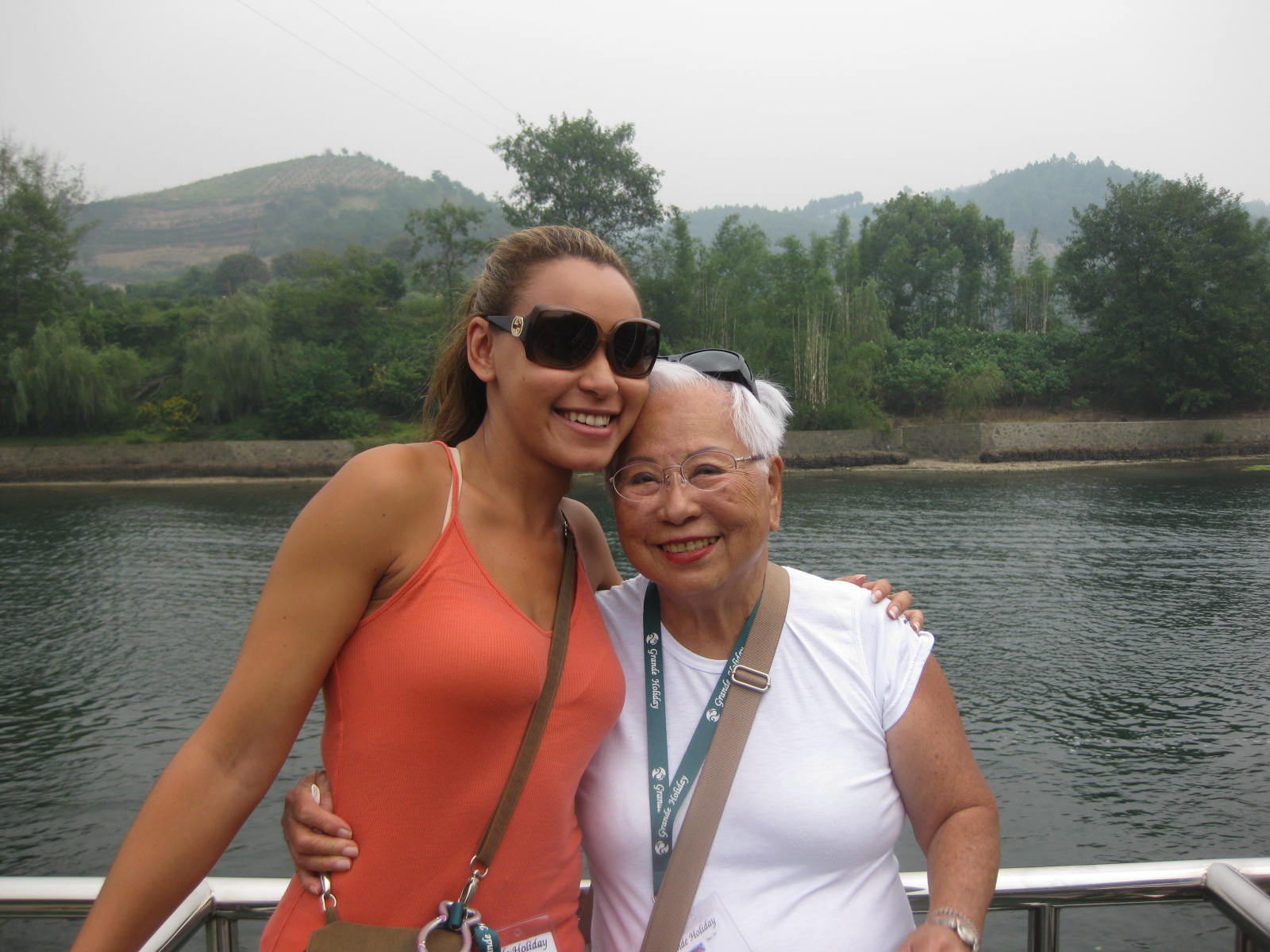
We boarded a large, flat-bottomed boat to float down the Li River in an all day excursion. I went immediately topside, rocking dockside in a confined space would never do.
The staff asked for our orders of turtle or fish soup. Orders would be phoned to a fisherman who would meet us downstream and deliver the fresh catch.
I stopped to photograph the bottle of snake wine. That too, would be served later. A favorite of Chinese men (natch), they swear snake wine makes them virile “like Superman.” Of course it does. I wonder how much they drink before that fantasy seems real? I, quite honestly, have never considered that particular anatomic appendage of the Man of Steel, which, now that I am, seems a little... intimidating. But I digress, as I am wont to do when men wear spandex. Oops! Secrets out!
The river Li bent and swayed and with each turn we floated into another startling scene made famous by Chinese ink and wash paintings. Small trails disappeared quickly into the deep, broad-leafed jungle. Tin roofs sometimes peaked over banana fronds and phoenix tail bamboo. Water buffalo swam the shallows and lumbered onto rocky shores. A junk pulled alongside to deliver fish and turtle. In a National Geographic moment, a Chinese fishermen poled his bamboo raft, his kormoran waterbird perched, ready to dive. 
I spent the day topside visiting with whomever joined me: a large group of Germans in hi-tech fabrics, Tevas, and zip-off, convertible, hiking pants, a bunch of east-coasters, and Jimmy from Los Angeles, who planned to race home for his (internment) Camp Reunion. 
Jiuma Hua Shan (Nine Horse Fresco Hill) came into view and they herded all passengers to roof and rails. The mythological Monkey King brought his horses from heaven to drink in the Li River. It so happened that an artist saw the horses and wanted to draw them. Frightened and skittish, the horses ran into the cliff, never to reemerge. Variegated in yellow and white, dark and light, the horses assume a variety of poses: some run, some lie, others play on the mountainside as they have for centuries.
Chinese legend says that if a person can point out all the nine horses, he or she will win the next Imperial Examination. Urban legend says Mao and his Generals floated the river Li one day and came upon Jiuma Hua Shan.
“How many horses do you see?” Mao asked.
“Only eight, Mr. Chairman,” his infinitely wise general responded.
Not surprisingly, it is reported that both Premier Zhou Enlai and President Bill Clinton identified all nine equine etchings.

Lael spoke with a Seattle doctor over lunch. She attended a six-month rotation in China to update her holistic/herbalist skills. She said the leading causes of death in China were lung and liver cancer.
“That’s odd,” I said.
China has not been environmentally conscientious. They dump anything and everything into their rivers and oceans. ... And now, even their government is wondering if their practices are poisoning the people.
Knowing the water in China is bad, we brought hiker water filters and drank only bottled or filtered / boiled water.

Derek climbed to the upper deck and pulled a Chinese 20 Yuan (like a $20 bill) from his wallet.
“It’s coming up,” he said holding the bill against the riverscape. ... and so it did.
Methinks one of the old Bond movies used this area as backdrop - but I can’t quite remember and am unwilling to hunt it down.
We docked in a tiny town grown up around the pier of disembarking tourists. Dusty store fronts spilled out onto dirt streets. Vendors called, “Lady, lady, you like? Come look lady, nice one!”
“Look out for pickpocket and one-day old antique,” our guides warned before we fanned out through the bazaar.

Walking back from dinner we saw full, bull elephant tusks, beautifully carved.
“I thought this was illegal?” I exclaimed aghast.
It IS illegal, everywhere but China. China did not sign onto the world embargo of ivory importation. So if you shoot it, they will buy it... and illegal poaching and annihilation of dwindling elephant herds continue across the African plain. A crime punishable by death is fueled by Chinese yuan. ... A tragedy of global consequence and proportion.
I want to call them environmental morons but you know the adage: when one points a finger, three fingers point back.