Sunday, February 21, 2016

This is Political

This is Political

“The best thing that ever happened to the Democratic Party is Donald Trump,” one of my friends guffawed last fall. Everyone laughed; they are not laughing now.

After South Carolina’s primary, Timothy Stanley wrote, Who does Donald Trump have to insult to lose a primary? Jesus? Stanley is a conservative, historian and columnist for Britain's Daily Telegraph. He says time is running out for conservatives to come up with a strategy to defeat a man at odds with their philosophy.

I am both interested and repulsed by politics. I am interested in the process of change and particularly keen on health policy. Like many, I am repulsed by partisan politics, the status quo, the old crony (seemingly wealthy, white) society and the new Jim Crow. I want our Congress(wo)men to negotiate and compromise, to run our country with transparency and justice for all. I doubt I’m alone.
To that end, I have watched every debate and every town-hall meeting of both Republicans and Democrats. I’ve talked to my friends and sought editorials and opinions from news agencies.

Following the New Hampshire GOP primary, Huffington Post writer Ariel Edwards-Levy attacked voters and Trump. “Donald Trump is a serial liar, rampant xenophobe, racist, misogynist, birther and bully who has repeatedly pledged to ban all Muslims — 1.6 billion members of an entire religion — from entering the U.S.”
After Trump’s win in South Carolina, the Huffington Post declared in big bold letters:                     
THE PARTY’S OVER 
GOP’s Moderate Wing Officially Dead…

While I am no Trumppet, clearly the Post is attached to an outcome and not the best at reporting with neutrality. 

CNN took a different tact, researching the border wall "Mexico will pay for.” Its a fascinating 2.5-minute exposé worth watching. They estimate construction costs of $10,560,000,000 or just over 10.5 BILLION dollars with construction time of four years. WHO is footing that bill?
Watch it here: http://www.cnn.com/2016/02/17/politics/donald-trump-mexico-wall/index.html

In my search for perspective, by far the most helpful article I stumbled upon was by Retired Lt. Gen. Mark Hurtling, former Commander of US Army Europe and 7th Army. In his article, Judging our Candidates as Leaders, he says candidates should be carefully evaluated on character, presence and intellect.
He points first to character; do they have the right stuff? Do they understand others; would they apply moral principles in serving our citizens? “The key question one should ask: Do we as a nation trust this leader to do the right thing, for all people, in the toughest of situations?”
Second, he turns to presence, “confidence, not arrogance. Presence generates a positive perception from supporters. More important, it garners support and generates respect -- not fear -- from foes and sworn enemies.”
Lastly, he points to intellect, defined as a profound understanding of critical issues. “Great presidents, continuously faced with complex national and global challenges, need to be able to build strong teams to assist them in generating sound strategies, and thus require phenomenal interpersonal skills.”
He closes with this, “As a nation, we have just a few short months to determine who will be our 45th president, so I'm hoping others join me in evaluating that leader with the most potential in these three critical areas.

His analysis has given me another tool in evaluating candidates; one I find valuable and one I wanted to share. I hope you too find it useful. When I look out across the globe filled with civil wars, public beheadings and stonings, coups, executions and the like - I know that the American experiment in democracy, while still in its infancy is neither to be dismissed nor diminished. Despite our foibles, there are reasons people seeking freedom flock to our shores and borders.

Take not your responsibility to be an informed voter lightly. People are literally dying for the privilege and duty.

Friday, December 11, 2015

2015 - Its a Wrap!

2015 - Its a Wrap!

Double-click to enlarge photos, X right-upper-corner to close.
Cancun
   As 2015 ends, I hope this holiday season finds you in good health and spirits. That is always my hope and wish for you. Often victimized by our circumstance, we easily fall into despair when ego or body experiences discomfort or dis-ease. In recent years, I have focused on vitality at every age and any stage. I realize that my body is the aging vehicle that carries me through this life. On my ever changing canvas, finding brilliant sunsets, shooting stars and glorious sunrises that herald the day is more intentional than circumstantial. I have turned my focus there and my recap of 2015 exemplifies that intention.

BD girls: Mom (L) and Milly (R)
Sibs: Sandra, Cornelia, David
Mom and twin Milly celebrated their 90th birthdays in April. We had a party in Honolulu that was good fun.

Also in April, I started a new job at Kaiser South Sacramento - a pilot program to bring Nurse Practitioners (NPs) back into primary care medicine. Over the last two years, the Affordable Care Act (ACA) brought 14 million uninsured US citizens into the ranks of the insured. (2015 enrollment figures are not yet released but I’m sure we can add another few million.) Every healthcare system is struggling with the influx of new members and is forced to re-think their care delivery models. Kaiser Permanente (KP) is no different. 
Long the largest, local employer of NPs, they slowed and stopped hiring NPs in the Sacramento metro area more than a decade ago. And while KP was gloved and scrubbed to deliver the brand-spanking-new ACA-baby in Washington DC, they seemingly did little to prepare for the primary care onslaught. While other systems hired and trained NPs ahead of the delivery - I guess KP thought they could hire enough docs. Beeeg mistake.
A circuitous route to: I am one of six NPs hired in a 1-year pilot to train NPs in primary care. I see the walk-ins (so all those years in the Emergency Dept. are more than helpful), manage all the blood pressure medication adjustments [our medical assistants check about 40 hypertensive (high blood pressure) patients each day], and help cover appointments, phone calls and emails of vacationing docs.
I’ve had to immerse myself in the books again - to bone-up on joint assessments, procedures, rashes and common ailments. I continue to do some insulin adjustment for my docs - after five-years in Diabetes Management I am skilled, I have more time and I enjoy it. They find it tremendously helpful. Dats da goal baby! The people, of course, make it worthwhile; I love the people. So it follows that I love my job but then… Have I ever held a job I didn’t love?
My goal is to say, “Yes!” as much as possible. “Yes, I can help you. Yes, I can do that. Yes, add them to my schedule.” I have to be more flexible than ever - its good training for aging - a time that seemingly brings inflexibility to many facets of life.
While our doctors love the help, the numbers must show that we positively impact patient care. If we succeed, our program will spread throughout the northern California region and several HUNDRED NP jobs will open within the Kaiser system. I am keenly interested in that. I can’t tell you how many NPs I know still working as RNs in the Kaiser system - awaiting NP positions. I saw this pilot program as a way to impact something bigger, much bigger.  … fingers crossed.

I own a Kamaka ukulele - one I begged for and received on my 10th birthday. (Yes, Jake Shimabukuro plays a Kamaka.) Two years ago, it returned home to the Kamaka factory in Kaka’ako for a well baby check. I began taking ukulele lessons this year. I walked into my first lesson carrying my battered case.
“Is your ukulele as old as the case?” someone asked.
“Yep.” I opened my case and people gasped. Kamaka ukuleles are feather light and cost a cool $1000 dollars now. They call my Kamaka vintage. I wonder what that says about me?
“You better buy a new case,” they advised.
Some of you may remember that I was actually offered a music scholarship to the University of Hawaii. I’ve always thought of music as my gift. I love music and practicing was never a chore. So I’ve really thrown myself into my ukulele lessons -  much to my enjoyment. It nurtures the kāhoaka (spirit) in me that is anchored to my heart/home in the middle of the sea.

As you know, California is in the midst of a multi-year drought, nine years by my reckoning, interrupted by the storms of 2011. If you’re reeeally interested, go to my blog at:  http://lorinzmuze.blogspot.com/2015/05/water-is-new-oil.html for the first in a three-part series on the drought. 
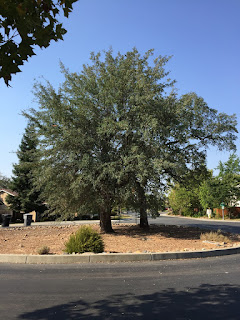
Oaks of our cul-de-sac
Oak trees, notoriously adverse to summer watering, began dropping yellowed leaves and showering the ground with Hail Mary acorns in May - as if it was fall. All our trees are stressed after multiple years of drought and dry winters. I wondered about watering oaks and searched online. I found a study conducted by the University of CA in a nearby regional park. Their conclusions: Under periods of prolonged drought, supplemental irrigation of established oak trees may prevent their decline and death … if irrigation water is applied well away from the tree root crown area but within the tree rooting zone, even frequent summer water application may not be detrimental to established oak trees. 
So I began watering the Blue Oaks out front in the study’s very prescribed manner and under the cover of darkness. After several months and only when they clearly seemed improved, I contacted the city arborist, confessed by oaky sins, and we formulated a plan for keeping the oaks around my home alive and thriving.
“They should be watering the oaks,” my neighbors protested, “Not you.”
“I agree but clearly, they’re not going to. And you must admit, if those oaks die, our cul-de-sac will look very, very different.” Uh… like crap - but I didn’t say that. Hence, I stopped watering my lawn and diverted my water to oaks.
LET'S DO THIS! Watering greenbelt oaks.
The greenbelt behind me is heavily studded in oaks - some that were severely stressed. After more research online, I found a formula for how and how much water. Here, each bucket has twelve 1/4 inch holes punched through the bottom - they deliver water slowly so it seeps in versus runs off. Five 5-gallon buckets  = 25 gallons. Its a lengthy process; my goal was to gimp them through the summer - and so I did. The rains have started again and I think the oaks are safe for now.

Yosemite Conservancy work group
In early August, I went to Yosemite for a week of volunteer work through membership in the Yosemite Conservancy. OMG - what a blast!!! AND-and-AND - we had a vegan cook from Italy!!! I ask you - could LB be any happier? Nay, nay! Camping in Yosemite during the summer with an Italian (certified dietician) chef preparing vegetarian and vegan meals for me? Heaven! We worked in the two, little known sequoia groves just inside the northern park entrance. 
The Mariposa Grove is currently closed for a two year restoration project. I would normally avoid projects on the Yosemite valley floor, much preferring the highlands. But I’m hoping to work in the Mariposa Grove next year. Can you imagine working amongst the giant sequoias of the Mariposa Grove while its closed to the public? Heaven with whip cream and a cherry!
I met fantastic, like-minded people. I met people who volunteer year after year and those who arrive in their motorhomes and volunteer all summer. Can you see my little gears turning? Retirement is but five years and two months away - but who’s counting?

Two close friends have suffered catastrophic illness this year. It makes me appreciate my own good health and the abilities/capacities of my body. It has also provided an opportunity for spiritual and emotional growth. I understand, in a new and profound way, that life is too short to be stingy with my love and approval. For the full story, visit my blog at:

I recently traveled an hour south to see Sandhill Cranes during their winter migration. Some of their habitat is clearly rice paddies flooded to support the Pacific Flyway migration. Their calls and coos are captivating and part of my “nature that nurtures” life strategy. 
As I said at the top, I have focused my energies toward heartstring strummers. They are: meaningful work, key relationships, daily exercise, writing and music. No-matchy? - No calendary. It makes for a life that is simple, aligned with core values and imparts a tremendous sense of peace and prosperity.

What’s on tap for 2016?
Niece Lael will shortly birth a baby girl. I plan to visit my new, grand niece in Los Angeles.
I will turn 60 and plan to party.
Friends John, Bill and I hiked in the Swiss Alps last year and plan to hike in the Dolomites (Italian Alps). 
Mom will turn 91 and I will reliably return to Honolulu.
I will fill the rest of 2016 with meaningful work, key relationships, daily exercise, writing and music. What about you? I would love to hear.

I’ll leave you with this last verse from a Country Western song  - where typically the dog and wife are on the lamb, he laments the loss of his best friend - the dog, the corn needs picken’, and the beer is chillen' on his ex’s cold heart. However in this verse, Lee Brice seemed to get it right:
Be a best friend, tell the truth
And overuse "I love you"
Go to work, do your best
Don't outsmart your common sense
Never let your prayin' knees get lazy
And love like crazy.

Prefer Ram Das? Tell the truth and love everyone.

Mele Kalikimaka é Hau’oli Makahiki Hou! 
Me ka manao hoihoi I ka mau a mau loa aku (with love infinitely) ~ Lorin


Sunday, November 15, 2015

In Thanksgiving

Click once to enlarge pictures. X at top, right corner to close.

I’ve been researching for a blog on guns: gun violence in America, gun control and the Second Amendment. Convoluted doesn't even being to describe… and the research is time consuming. Mere discussion seems to ignite tempers. So as Thanksgiving nears, I thought a turn toward the genteel was in order.

I’ll start with the tale of two men and who they are for me. (Both have granted permission for this posting.)

Aw comon' Eddie, just PRETEND you love me!
Eddie Joe was a surgical resident and Army Captain in the large teaching program at Tripler Army Medical Center (TAMC). Our paths collided during my first days in the Army Nurse Corp. I stood tall (well, relatively speaking), straight and starched in a long, white dress with deep pockets and gusseted sleeves, white cap, white hose, white shoes - seemingly straight from the photos of WWII Army nursing. Eddie wore the drab brown that all uniformed services seem to employ. My Lieutenant’s rank collar bars were highly polished. His? Um… not so much. Eddie is from Arkansas, he speaks in the slow, soft drawl of the south. 
“Lets go change a dressing,” he said, “I’ll show you where the supplies are and how to get it done.” We quickly fell into a friendship that endures to this day. After Honolulu, Eddie was stationed at MAMC (Madigan) near Seattle. I landed in Anchorage, AK and finagled my reserve duty at MAMC. 
   Their girls were in grade school and I remember the back of one bathroom door covered in ribbons and bows and elastic bands and things that sparkled. “How do you want to wear your hair today?” Trish asked before braiding (with or without ribbons braided through) or pony-tailing or head-banding or beret-ing, fulfilling any number of requests. Me sporting my pixie-cut? Me fascinated.
Military obligations fulfilled, they settled in Nashville and I in Sacramento. Over the years, I’ve dropped in whenever my travels crossed the country. You wanna know southern hospitality? Eddie and Trish wrote the book, opening their home and hearts to me.

Some years ago, Eddie was forced into an early retirement by Parkinson’s disease (PD). “I could feel it in my hands,” he said answering my queries.
Learning of his plight, I vowed to visit frequently and regularly. In June 2014 he was stooped and shuffling; his exercise program somewhat erratic. I gently scolded, reminding him that walking is key to maintaining mobility for people with PD.
In September 2015, he was remarkably improved, so much so that I stopped mid-sentence to inquire. We walked daily for 60-90 minutes and joked about finding me a home in Nashville. Eddie is tall with long legs; I could barely keep up.
We reminisced over large bowls of popcorn. “Besides my family and a couple childhood friends, I think Eddie is my longest friend,” I asserted. “We’ve been friends since I was twenty-three. What is so curious to me is that you never know who will be your friends for life. I never expected that it would be you two and I’m so thankful. Thankful that you let me tag along and watch your girls grow - and share in your lives.”
Eddie fell in mid-October, breaking a hip. It has since been surgically repaired and now physical therapy and rehab continues from home. And I wonder what friendship and support looks like from 2300 miles away.

Michael - post transplant
Michael is a doctor at Kaiser. We became friends during Landmark’s Advance Course. Our work locations and schedules did not allow for hallway run-ins so our friendship was built slowly and deliberately through coordinated lunch breaks on the hospital campus, an occasional beer and joining his family to hike a 30-mile section of the John Muir Trail.
Some years ago Michael was diagnosed with sarcoidosis, an autoimmune disease that scars his lungs. After a long remission, it flared again - only to march inexorably toward his demise. Watching his decline up-close-and-personal has been sad and disturbing. He stopped surfing then hiking, stopped skiing then cycling. Much to my utter dismay, he gave away his backpacking gear. He lost weight, his color ashened, his energy waned and life ultimately became circumscribed by the tethering of a 100-foot oxygen tube. Secretly, I loathed his doctors and accused them of negligence for not doing more - as if there was more to do.

Early in 2015 he was evaluated for lung transplantation and in June, was hospitalized until death or transplantation. Most people awaiting transplant die, I thought, because Americans are generally adverse to organ donation. And I was not incorrect in that thought, statistics overwhelmingly favor death over transplantation. Most people die awaiting transplantation - not Michael.
Like mana from heaven, a pair of lungs arrived in a cooler and he underwent double lung transplantation. Friends and family breathed a collective, albeit premature, sigh of relief. His recovery continues to be complicated and protracted… and life will never be the same.

When I examine my friendships with these men, I ask myself, What does it mean to be a good friend now? By necessity, the nature of our relationships has changed and here is what I noticed.
For the immediate post-operative period, Michael was sequestered in a home near Stanford to facilitate multiple visits to the transplant and rehab teams each week. Los Altos is easily a 6-hour roundtrip from Sacramento. Friends and family streamed to Los Altos on the weekends in love and care. And after a 3-hour drive, none want to take their leave after just a few minutes; right?
Avoiding the weekend treks meant I didn’t visit as often. There’s the rub. How do I show my love and care without adding to their to-do list? How can I ensure my visits are not burdensome? 
I called to check-in. Sometimes Michael cancelled my scheduled visits. In my upset, my conversations with myself turned “young.” Well how come they got to visit and I didn’t? When is my turn? I noticed that I angled for my-fair-share as if he were a commodity at auction. I’m not proud of these inner conversations but it IS helpful to notice them. Noticing prevents me from pressuring an ailing friend to assuage my fears.
I confessed these juvenile conversations to Michael. “We have rules and agreements about how our relationships work. By necessity, you are breaking all the rules and everyone has to adapt. I notice that my inner conversations about your rule breaking are sometimes very young. Like I’ll think, Well how come they got to visit and I didn’t? I’m sure I’m not alone in this. And I notice that I still want my-fair-share-of-Dr.-Michael-GM-thank-you-very-much!”
“Oh my God,” he said, “Thank you for saying that. I’m sure you’re right; that you are not alone in this.” 
“I’m positive I am not alone. In putting my attention toward what would be helpful,” I continued, “You get to tell me what that would be. You get to say; not me - and I get to deal with it. But I have to tell you, it takes something to be in a conversation beyond What’s-in-it-for-me?”

Wisdom Course instructor Joan Bordow says, “When you get really straight with how much your life is all about you - something else is possible beyond your small, selfish, little life.” Whoa!

So for most of 2015 I have planted myself in generosity and a conversation bigger than myself, looking for what could be supportive and what might be helpful, asking for input and fulfilling upon requests.
Saturday, I drove to Berkeley to take ex-mother-in-law Sarah out for her 85th birthday. She loves sports cars, so I retrieved her in one. She loves cut flowers, so I brought a vase filled with them. We dined at Chez Panisse, a swanky Berkeley fixture that is known to be one of the finest eating establishments in all of northern California. Chez Panisse tops her list. Not how I would choose to spend my birthday but… its not about me. Sarah said it was her best birthday ever. Mission accomplished.

“I’m lucky that I can be generous with my money, my time, and my attention,” I told Michael. “I can blame that on you. You are teaching me to move in the world with graciousness and grace. Sad that my friends must suffer catastrophic illness for me to shift my focus… nonetheless I am ever grateful.”

It makes me wonder about all the people I shut out, all the people I ignore and pass over. In looking there - my attention is drawn to those we collectively and justifiably exclude - the homeless are one such group. 
A few years ago, I was in San Francisco for a long weekend. San Francisco has so many homeless and they are everywhere: holding signs on street corners and straddling intersections, lurking in doorways, laying along walkways, loitering near ATMs, sleeping in parks, lingering near public bathrooms, like e-v-e-r-y-w-h-e-r-e.
Before embarking to the city, I stopped in my bank and withdrew fifty one-dollar bills. As a practice in generosity, I decided to give $1 to every beggar until my cache was exhausted. In the gloom of that early Sunday morning, I found a sizable roll of cash in a crosswalk. It was more money than I had gifted.
Now I keep an unobtrusive pencil case in each car, stuffed with $1 bills. (Mahalo Shea GM for the conversation that inspired this.) Fireman were passing-the-boot at Costco over the weekend; I had money for them. A man held a sign at a freeway off-ramp; I gave him a dollar. Its not much but its something, and it allows me to engage in a way that is comfortable for me. I acknowledge their humanity and they are no longer invisible to me. My sonar seeks and pings on them now. Its not much - its a start.

We never know who will touch us in ways that change our lives. I would have never put money on Eddie or Michael - and yet, each man has touched me deeply and altered my path.

As Thanksgiving approaches, I am reflective and thankful for their touch. I am thankful for the ways my life opened with their input, friendship and love. I am thankful they allowed me to tag along and watch their families grow. I’ve been moved by sharing in their wins and losses, their struggles and disappointments with disease. Each has left an indelible print on my heart and opened me to my Mother, my family, to Sarah, to friends and coworkers, to fellow yogis, the homeless on the street and to you. I opened to you - and you opened me more.

A heart broken open that spills forth in love is a beautiful thing. Thank you all for cracking this hard coconut open. In Love and Thanksgiving ~ lb

Will you allow your heart to be broken open?
Oluolu ka hoaloha’loha ana = Happy Thanksgiving 


Saturday, August 22, 2015

Amendment to LBz Drought Dilemmas

Click once to enlarge pictures. X at top, right corner to close.
After writing my last blog - which included a bit about the Blue Oaks in the cul-de-sac out front - I saw an opening for action. I contacted the woman in charge of Municipal Landscape Services. We had communicated several years ago about the oaks when she, the city arborist and I, met in their shade. They advised we move all the cobble from the base of the trees to the “edge of the planter.” Biggest damn planter I’ve ever seen. They planned to fill the planter with wood chips - which mimics a more natural environ for oaks and helps retain root water for the mycorrhiza fungi network. Yep, look it up. The NPS Rangers in Yosemite even sing/teach a song about mycorrhiza fungi! The market downturn forced our project off the budget. Nonetheless, we organized a neighborhood project and in a few hours had all the cobble pushed to the curbing.

Last week, I reached out again. I began by sending the UC study that watered drought-stressed oaks, informing her that I regularly watered our oaks and that they looked better. I asked her to have the arborist render an opinion. He examined our oaks, concurred with my assessment, recommended a watering schedule and that the city deliver the prescribed 4-6 inches of “duff” (wood chips) into the “planter.” Yay; we are back on their project list!

4 pyres in this photo
I also let our Municipal Landscape lady know that their were pyres of deadwood out behind my house (ready for a prescribed burn) and asked if they could be removed. She had many questions about the pyres and seemed miffed. “We typically prefer to manage and perform the brush clearance ourselves so that we can coordinate it during our fuel modification work.” Well I wish you would!

“The greenbelt behind my home is studded with oaks,” I responded. “I'll bet there are 20-30 oaks directly behind my property. They drop branches. For about the last three years, I have dragged said branches out from under their parent tree and gathered them into piles away from all trees. That way, if we have yet another grass fire (two since I’ve lived here), the accumulated deadwood beneath the oaks would not present a fuel load that could actually threaten them. Or that was my hope. Burning trees will threaten my home. I consider this work part of maintaining a defensible space.”
She softened, “…we also realize folks are doing their part to protect their property too,” and sent a ground crew manager to assess the pyres. They will pick up the deadwood in the next 2-weeks, chip it, and dump it into our cul-de-sac planter. Yippeeeeeee!

Awesome; eh?

So I have a bunch of work to do outside before the city comes to pick up all the deadwood in the greenbelt behind my house. I want to get every good-sized log/branch into those piles.
The neighborhood kids play in the “cul-de-sac planter” and have since moved a bit of the cobble under the oaks again - enough to prompt an arborist comment.  So I’ll be kicking those to the curb. Well - not really kicking - but you get the idea.

To that end, I sent out at Courtie update (I live on a court) informing everyone of the developments. “Once again - we need to get all the rocks to the edge of the “planter.” I'm going to work on that tomorrow. So my request is that if your children play with rocks in the circle, please have them replace their rocks back to the edges.”

One friend recently described me as “pepper and cinnamon” -  it has given me pause.
I sent an amendment this morning: “Let me amend this - I sound like a rock nazi. After the wood chips are dumped - it will be an awesome playground. 
I am just trying to comply with their request about rocks being out of the middle and pushed to the edges until the wood chips arrive.
Thanks. Sorry if I sound like a rock nazi.”
My neighbors laughed and expressed appreciation when we all met under the oaks to toss rocks. 

Sometimes I feel like this eccentric, meddling crone. And if I didn’t own a cat who hates all creatures - I’d own four more. So I’d be this eccentric, meddling crone with five cats. Uh-huh? Aren’t you glad you’re not a Courtie?
Do feel free and join me if you have any inclination to throw rocks or stack kindling.

Saturday, August 1, 2015

LBz Drought Dilemmas

Click once to enlarge pictures. X at top, right corner to close.

The drought is ever present in California and presses upon my mind at every turn. My last blog provided historical factoids about California’s water. This entry will address my personal responses to the pressures of water - or the lack thereof.

Last year, Californians were asked to vote on Proposition1, a 7.12 billion dollar bond for California’s water system. A “tunneling project to secure delivery of fresh water from the State's abundant north to its thirsty south and Central Valley agricultural industry.” (The abundant north balked knowing that SoCal has been more aggressive in water storage, currently has more water than we and seems to suffer fewer restrictions.) But that is an entirely different issue. 
  
The Bay Delta Conservation Plan proposed boring a parallel set of 37-mile-long x 33ft i.d. tunnels (60km x 10m) directly under the Delta. They are sized to deliver 9,000ft3 to 15,000ft3 of water per second and would feed water from the Sacramento River in north delta, to a set of massive Federal and State-owned pumping facilities in the south delta. There water is lifted into the delivery canals of the State Water Project and the Central Valley Project. Study data is available at The Bay Delta Conservation Plan website.
Nearly $17,000,000 was donated toward the Prop1 cause while a paltry $98,000 worked for its defeat. Understand that California’s water system is archaic and crumbling. Our water rights system is arcane and unjust.  The Sacramento-San Joaquin River Delta is part of the largest estuary on the West Coast and ground-zero for California’s water wars. It is a vitally important ecosystem and the hub of California's water supply system, providing water for more than 25 million Californians living between the Bay Area and San Diego (or 2/3 of the state’s population) and irrigates some 3 million farmland acres in the San Joaquin Valley. The drought has brought everything water from simmer to boil.
“We can't just cross our fingers, hoping for the best in the Delta,” Governor Brown said. “Fish populations are at an all-time low. Bold action is imperative.” 
I agreed but felt completely unqualified to vote on the fate of the Delta. We knew southern Californians would vote for Prop1 and they outnumber northerners by many. My question was - should I vote for it? 
Delta denizens were adamantly opposed but I had no confidence they could see beyond local biases and a not-in-my-backyard mentality. A small feeder fish called the Delta smelt surfaced in discussions.
I studied the pros and cons of the initiative and talked to two in-the-know. One woman worked on the public information piece for the Governor’s office. She explained it quite simply. The pumps in south Delta are so strong they reverse the flow of the San Joaquin River and obviously, can suck fish into the system. In times of low water, they can’t be run. In times of water excess - when pumps could be run - fish are nearby and prohibit pump use. At those times, the proposed tunnel intakes positioned in north Delta would allow water  excesses to be syphoned off without endangering fish and damaging the Delta ecosystem.
I spoke with a federal biologist working on the Delta smelt. “Why should we care about the Delta smelt?” I asked. 
“Because its the bottom of the food chain,” she said, “And if it goes extinct, it will alter all life and health of the Delta. I’m not allowed to have an opinion but if I did, I’d vote no.”

Protecting the smelt became the rallying cry of those opposed. Both the Nature Conservancy and the Natural Resources Defense Council (NRDC), conservation organizations to whom I regularly and generously donate, supported Prop1. I cast an equivocal vote for Prop1: to “authorize $7.12 billion in general obligation bonds for state water supply infrastructure projects, such as public water system improvements, surface and groundwater storage, drinking water protection, water recycling and advanced water treatment technology, water supply management and conveyance, wastewater treatment, drought relief, emergency water supplies, and ecosystem and watershed protection and restoration.” It won with a resounding 67% of the vote.
I thought I voted for tunnels… but according to the NRDC, Prop1 “does not advance the State’s $25 billion flawed Bay Delta Conservation Plan, the proposal to build two massive tunnels under the Delta and divert unsustainable amounts of water.” 
You get my angst in California voting? Its hard, really hard to cast an intelligent vote around here despite studying the issues more than most.

Watch this 3:38 minute Delta Flow animation at https://youtu.be/1lblKcVclHA. It is highly informative albeit likely biased. Nonetheless, the tidal fluctuations and the need to mitigate salt water incursions are made clear.
Salt water incursion into the Delta is problematic. If you did not stop to watch the video above - do so now. As I write, a temporary, 800-foot dam is being constructed in the Delta to prevent the salty Pacific from creeping inland and contaminating drinking water. This strategy was utilized effectively during the drought of 1976-77. The dam will be removed in November (when we hope/pray El Niño brings rain). The entire project will cost tax payers a cool $28-mil. How will this help? It will allow California’s northern reservoirs to release less water for flushing the Delta to prevent salt water incursion.
Outflow from Folsom Lake was recently increased to help flush the Delta, compensating for decreased outflow by Lake Shasta - whose waters are being diverted to protect the local salmon run. Folsom Lake is the source of water in my house and water conservation is key. 
They’ve asked us to let our “lawns go gold” and use the water for trees. If I wash my car, I pull it up on my lawn. I also capture some of my gray water for plant irrigation. The City of Folsom is replacing median strip landscaping with wood chips and shutting off irrigation. Their plan for watering city trees is insufficient however, and many have died over the last year.

California’s oaks (I believe these are blue oaks - Quercus douglasi), notoriously adverse to summer watering, are dropping yellowed leaves and showering the ground with Hail Mary acorns. All our trees are stressed after multiple years of drought and dry winters. 
I wondered about watering the oaks and hunted online. I found a study conducted by the University of CA. They followed 165 oaks in a regional park near Stockton from 1978 - 1992, (all non-drought years and immediately following the drought of 76-77). Some oaks were watered; some were not. By 1992, 73% of non-irrigated trees were in serious decline or dead. An additional 24 trees were selected  for drip irrigation. After five weeks, 11 of 12 (92%) irrigated trees had new growth, while only 2 (17%) of the non-irrigated trees showed similar growth. After one year, all irrigated trees continued to thrive while their non-irrigated cohort declined.
Their conclusions: Under periods of prolonged drought, supplemental irrigation of established oak trees may prevent their decline and death. If irrigation water is applied well away from the tree root crown area but within the tree rooting zone, even frequent summer water application may not be detrimental to established oak trees. 
So now I water the oaks of my cul-de-sac circle and yard in a careful, prescribed manner and under the cover of darkness.

Meanwhile, at Folsom Lake, the U.S. Bureau of Reclamation is building a barge with multiple pumps  capable of drawing water from a nearly-depleted lake should water levels fall below the permanent intake pumps. 
I consider this drastic and something to consider when one opts to water a lawn. Don’t wait for the city to do their part or your neighbor or the people in Granite Bay with acre lawns. We can all do something and I can let my lawn go dormant and use the water to keep our oaks alive.

Meantime, WalMart bottles water from the Sacramento Municipal Water Supply at 99 cents for every 748 gallons and sells it for 88 cents per gallon. (And they say California has an inhospitable business climate?) Do the math.
The reasons to dislike this multi-billion dollar corporation whose workforce is decidedly part-time to avoid providing benefits and paying a living wage, thereby encouraging them to subsist on public assistance… well, for me, that’s just enough reason to boycott their enterprise outright. Socially aware Starbucks has moved its Ethos water bottling operation out-of-state.

While I would like to demonize Walmart (and did), they present a dilemma in much the same way that almond trees do. Recent local radio ads tout, “An almond tree is not unique in its water needs.”
The sustainable almond growers and Almond Board report that 6,500 almond growers farm 760,000 acres and grow nearly 100% of US almonds and 80% of the world’s almonds. Almonds add more than 100,000 jobs, $11 billion to the state’s economy and are California’s largest export. I water my sycamore to provide house shade and it provides NO income though undoubted contributes to energy cost savings. If an almond tree consumes approximately the same in water and provides the state with jobs and income, it doesn’t seem wise to shut that spigot off.
https://www.youtube.com/watch?v=9PxAmC0fp1Q

So how then do we ask Walmart to move its water bottling operation out-of-state? Nestles and Arrowhead also bottle water in California. And what about locally-owned Alhambra?
What will I do if the dregs of Folsom Lake tastes nasty? Several friends in Carmichael have switched to bottled water for that very reason, their usual municipal water sources are depleted and the current mix is distasteful. The water table is dropping and some neighborhoods near Fresno no longer have  running water. Water is trucked in by the municipality and public showers have been opened. Can you imagine? What if that was mi casa or su casa? It very well could be!

One climate model predicts a fifty-year drought and that in just two decades, there will be no skiing in California. Squaw Valley (1960 Winter Olympic site) and adjacent Alpine Meadows ski resorts must have missed that memo as they made an April announcement a to link both parks with a high-speed gondola.
I went skiing at Squaw last winter. It was rocky; my hiking boots would have been more useful and appropriate. It was a scary and disconcerting sight.
I camped in Sequoia National Park (NP) in March. The General’s Hwy linking Sequoia to King’s Canyon NP, typically closed for snow, was open all winter. Same for Tioga Pass, the east-west mountain pass across Yosemite - open all winter. Virtually NO snow was visible from the Yosemite Valley floor as I gazed across its expanse in February. And while all of that is most unsettling, it does nudge me into rethinking park access and “off-season” backpacking.

Climate models also predict a 2015 El Niño winter. Historically, a strong El Niño brings powerful storms and lots of rain to the West Coast and Southwest. Good news; right? 
“The great myth is that El Niño will be the great drought buster,” says Bill Patzert, climatologist at NASA's Jet Propulsion Lab in Pasadena and one of the world's foremost experts on El Niño. He explains that typically dry SoCal’s infrastructure is built to move excess water quickly seaward. NorCal’s water infrastructure is built to capture snowmelt. El Niño winters are wet and warm leaving little snowpack. Rainwater capture will occur only when El Niño rains over a reservoir and its tributaries. Rainfall in the foothills directly replenish now depleted aquifers but don’t look to El Niño as savior.

I wonder about property values (think retirement fund) and what living in a drought blighted area might be like. Do I even move forward with terracing my back hill for planting if irrigation could be prohibited or prohibitive?

Several idioms seem sure: change is inevitable, resistance is futile  and attachment is the source of suffering.
The Buddha saw that people's ignorance of the nature of change was the cause of suffering. We desire to hold on to what we value, and we suffer when life's inevitable process of change separates us from those things. Liberation comes, he taught, when we are able to sever our attachments to the transient things of this world.
A steady shower of yellow-brown leaves flutter earthbound from the oak under whose canopy I write. My fifty-foot sycamore is encircled by a soaker hose. Stone cairns mark the watering sites 10-feet from six Quercus douglasi. My oven timer beeps and I rise to move a small sprinkler from tree to tree - a task that has consumed my morning.

Tomorrow morning I drive to Yosemite for a week of volunteerism with the Yosemite Conservancy. There we are maintaining trails, filling convenience trails and restoring the NP preferred trail in a little-known, high-country sequoia grove. I plan to head for Tuolumne Meadows on Wednesday, my day off.

This is what life looks like when its working and from my corner of the ring.

Be not attached, dwell in the inquiry and have a namasté.