Sunday, December 2, 2012

Asian Chronicles - 5


Xi’an (pronounced Shee-ahn) - Home of the Terra-Cotta Warriors 9/30/2012

Tap on photos once to enlarge and tap X in upper right corner to shrink.

Our wake-up call came at 0600 and bags were collected for an early flight to Xi’an. I tucked my breakfast-in-a-box beneath my arm and boarded our bus which groaned as we pulled away into the darkness. I watched the city lighten from elevated freeways snaking their way through Beijing’s cement canyonlands.
The day broke clear and bright. Beijing, infamous for smog so thick it burned and left a disagreeable tang on one’s tongue, once again basked in clear skies lassoed by the God Maui and dragged trans-Pac for his people.

Dawn beget the Moon Festival, a mid-autumnal festival held on the full moon of the fifteenth day and eighth lunar month. While we know China as an industrial powerhouse churning out goods faster than our rapacious appetites can consume; they know themselves as agrarians. The Moon Festival is one that celebrates harvest. Notice its proximity to the equinox, a time of nearly worldwide thanksgiving.
“The full moon is round,” Angela said, “Round is a symbol of heaven, perfection, and family. The Moon Festival is a national holiday and a time to return home.” 
Moon Cake is a flakey pastry filled with sweetened black beans and lotus blossom seeds eaten in remembrance - to celebrate the sweetness of life and family. This year, the full moon on the fifteenth day of the eighth lunar month fell on September 30th. 
October 1st is China’s National Day. Equivalent to July 4th, it is the day Chairman Mao stood at the Tiananmen Gate of the Forbidden City in 1949 and declared the founding of the People’s Republic of China. It is the first day of a national holi-week. That the two holidays fell conveniently together, creating eight consecutive days without work, was fortuitous. The government lifted all road tolls and the Chinese mobilized.  
There is great internal demand by the Chinese to tour their own country, for it has only been allowed in the last decade. Why am I in China at this time, competing with them to see their antiquities? I became suspect of a tour company who would schedule my 14-day tour during an 8-day national holiday.

“Yes, time flies. Our three days together almost over,” Angela bid us farewell. “You are a very lucky group: no fake money, no pick-pockets, even the weather,” she pointed outside the bus, “Blue skies. You saw many things in Beijing,” she said before summarizing our trip. “I hope you return to Beijing again. How will we know one another from Green Bus? What’s our code word?”
“Ding-ding hou!” we chorused before erupting in laughter. 
“Yes, twenty or thirty years later we will know Green Bus from ding-ding hou,” she laughed. We hugged Angela and boarded our two-hour flight to Xi’an. 

In-flight we discussed our personal want for more museums, artifact, antiquities and less shopping.
Derek said, “If we do that, half the people sit outside; they don’t want. The government makes us go to pearl factory, to jade factory because so many people get rip-off buying fakes. They complain and the government can say - look, we gave you a chance to buy the real one.” I heard a low growl from a dark recess - Monkey curling a lip to bare his teeth. (Ask Dr. Google about Monkey and Monkey Mind.)

The local guide palmed our green flag and microphone. “Nē hoú,” his deliciously deep voice resonated through the bus.
“Nē hoú,” we echoed.
“Welcome to Xi’an. I am called Peter.” Peter is a 40-ish scholar working on his PhD in Chinese History - purrrfect!  He is tall, six-foot or so with a longish crew cut standing straight as bristles. Wire-rimmed glasses perched on a puggish nose over buggish eyes. I wondered about his thyroid function and scoured his anterior neck with my eyes, wanting to palpate the gland and instruct, “Swallow.” 
“Nē hoú má?” (How are you?) Peter asked.
“Ding-ding hou!” we chorused again to laughter he could not comprehend.
“Oh, that good?” His brows rose, he smiled broadly, his words more statement than question. “So you know how to say good and var good. What if you are not so good? Do you know ma-ma-hu-hu?” He waggled a splayed hand at us, “So-so?” 
Our heads shook no.
“Ma means horse. Hu is tiger.” His intonation was precise and deliberate. “Ma-ma-hu-hu is horse-horse-tiger-tiger, or so-so.” He waggled his hand again. Love it! “Can you say ma-ma-hu-hu?
“Ma-ma-hu-hu,” we echoed.
“Var good,” Peter smiled, “How do you say thank you?”
“Xièxie (pronounced sheh-sheh),” we said without hesitation.
“Var good,” Peter said, “How about no thank you?”
“Bullshit,” Collin said laughing.
“Bùxuè(pronounced boo-sheh),” Peter corrected, laughing, shaking a finger at him. “They know bullshit. Bùxuè is no thank you. If you want something stronger you say bùyào (boo-yow). That means 'NO! I REALLY don’t want.'”

Xi’an is one of China’s ancient cities dating back to 2700 BCE. “Confucius was from Xi’an,” Peter said. “Chinese Buddhism start here. Seventy-six Empros ruled Zhong Guo from Xi’an. Zhong Guo means Middle Country; it is the ancient name for China. Xi’an was the capitol city for 1500 years.” He pointed to several green hills dotting the landscape between the airport and city. “Those are toom,” Toom? “Crypt of Chinese Empro.” Ah, tombs of the Emperors.
Eleven mound tombs with 200-300 chambers apiece surround Xi’an. Legend says Emperor Qin (China’s first Emperor) was buried in an elaborate tomb, between two rivers of quicksilver, surrounded by an army. It was thought to be mythos until 1974, when a farmer digging a well uncovered a clay soldier. He thought he found ghosts of the “element generals”: earth, wood, metal, fire, and water.
One by one, an army of thousands emerged from the soil: infantry, archers, cavalry, charioteers, horses, acrobats, dancers, singers, bookkeepers, flagman, etc. They would become known as the Terra-Cotta Army, putting Xi’an on the map, and catapulting tourism to its top industry.
The farmer was compensated approximately 10 USD, a generosity because land and air are owned by the government. Under different circumstances, he might bask in the lap of luxury as his farm generates an enviable income for China. Rather, he signs books in the gift shop, apparently an embittered old man.
“Twenty-one hundred years ago Xi’an was invaded by Ghenghis and Kubla Khan. So there are many Mongols in Xi’an. Many Muslims came over Silk Road so Xi’an is var multi-culture,” Peter continued. “We have many Muslims and a mosque. You will see women with veil. We have tolerance for many people. My family came here during Culture Revolution, to run away. Some of my family were imprisoned. I have no love for Chairman Mao.” I was surprised by his candor.
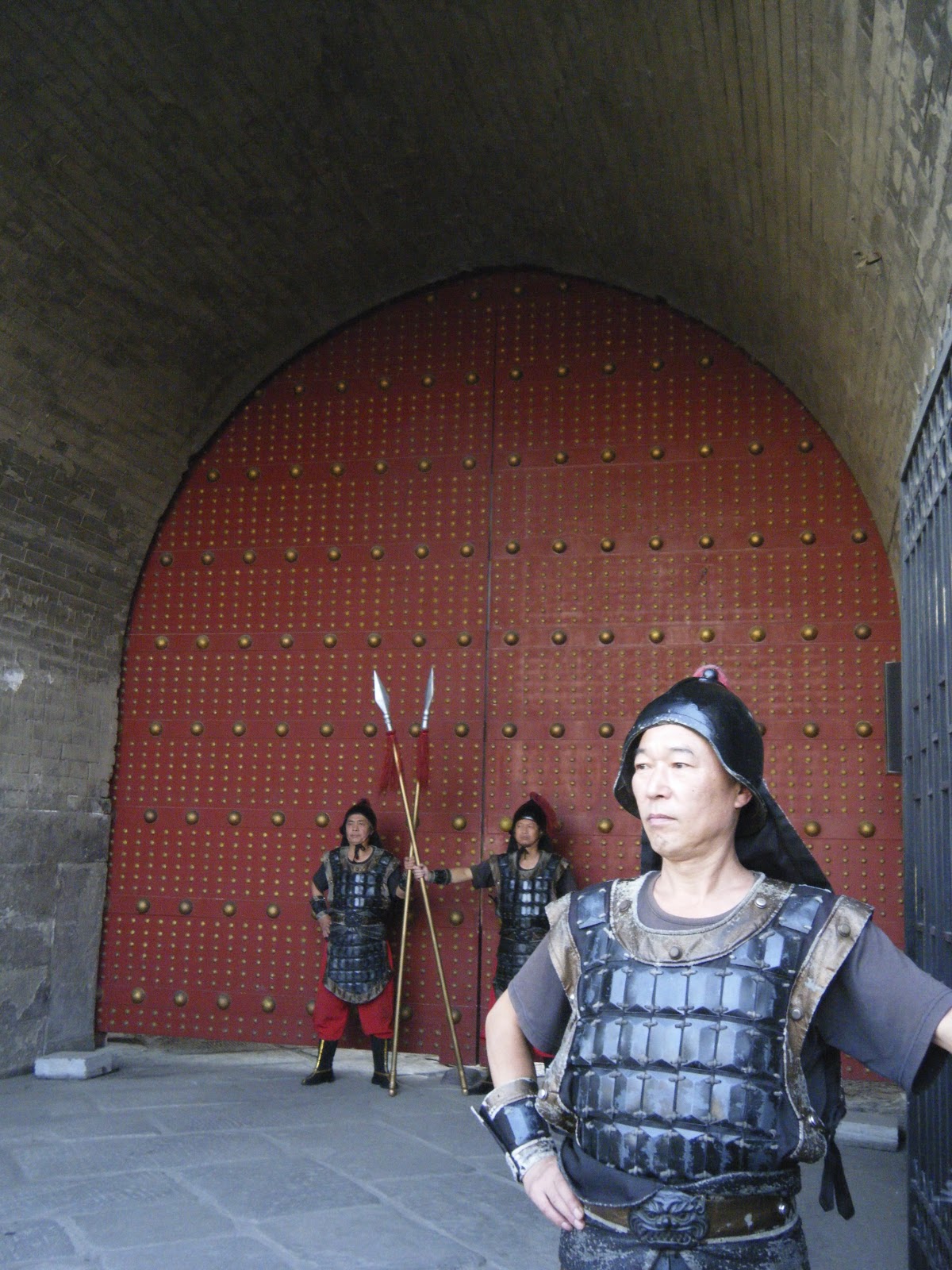
We drove immediately to the Xi’an City Wall - one of a very few intact city wall fortifications remaining in all of China. Unlike some crude rubble sections of the Great Wall, Xi’an’s wall is of ashlar construction, probably filled with crude rock (and bodies) and veneered in finely masoned rock brick with thin, mortared joints. Scaling this wall would be difficult. We clustered inside the moat at an exterior gate; sheer walls towered sixty feet overhead. Clearly, approaching enemies were easy pickens’ for archers perched above.
There we watched a “gate opening ceremony” with dancers, acrobats, and a fellow that tossed a large vase into the sky to catch and juggle it with shoulders or legs or head. The narrator, a young woman in costume, spoke English phonetically. Her initial proclamation was nearly over before I realized she was speaking English. We encountered this memorized, phonetical English in several prepared speeches - their words mispronounced and mis-intoned. It was more difficult to understand than you can imagine. 
Inside, we climbed a long, steep stairwell to the top of the wall. A guard tower housed a small museum with old uniforms - raw silk with plates or disks of metal and leather attached as armor. They were both utilitarian and artful.
Marathons are run atop the wall - three times round its eight-mile square. Stairs are outfitted with metal ramps and they rent bicycles. Had we more time, I would have loved to pedal its circumference. 
We attended a Tang Dynasty show and were served seventeen different dumplings for dinner. Dumplings shaped like koi, encased fish. Snout shaped dumplings contained pork. Rooster head dumplings held chicken. They were creative in their presentation both at table and on stage.
The Chinese version of a geisha playing a koto sat on stage and hammered at a guzheng. She was joined and the quartet played the guzheng, an er-hu: a boxy, stringed violin of sorts, a suona: a nasal, reed oboe and a pipa - a plucked mandolin. I was reminded of the thin, reedy music my Popo played on her transistor radio.
“S’cuse me, ham dumpling” our server hollered before plunking the platter onto the lazy-susan.
“Did she say ham?” Collin asked after tasting it. “I think she meant to say Spam.” How fortuitous! Hawaiians consume more Spam than the rest of the world. How could our hosts have known? The theater was dark, my eyelids heavy. We fell into bed that night - exhausted.

Terra-Cotta Army and Wild Goose Pagoda 10/1/2012

“Nē hoú. How you lie brehfus?” Peter asked. “Var good? Today we see the terra-cotta soldier of First Empro Qin (pronounced Chin), Q-I-N,” Peter said as our bus left the hotel. “This is the first day of one-week holiday; we see soldier first, before many crowds. Then we have lunch. In north China we grow winter wheat and make noodoo, no rice.” he shook his head. “I eat noodoo every day,” he said, rubbing his belly. “I love so much. Today I take you to noodoo house.”
I love noodles so much myself. Sometimes I sign-off with “toodles noodles” in deference to my love for noodles. I am liking this character Peter var much. We speak noodooz!

We stood outside the gate, tickets in hand when Peter’s voice came through my earbud. “Sticky rice, sticky rice,” he said, making gathering motions with his arms. “When I say sticky-rice, we stick close together; okay?” We nodded. Already the crowds thickened. 
“Sticky-rice,” he instructed while we were counted, passing through the secured entrance where bags were scanned airport-style. We queued for electric trolleys and rode into the Terra-Cotta Army Museum. 
Four excavation “pits” are housed beneath large hangars.  Seven thousand figures have been unearthed. They are full-size and each is different. The theory is that I carved your face while you carved mine. Most faces are Chinese: small, narrow, with flat cheekbones and small nose. Some faces are Mongol: wide with high cheekbones and broad foreheads. The conquered, the captured, the  enslaved, they theorize.
Collin-need I say more?
The Army’s silk clothing and wooden weapons have long decayed but the soldiers, the soldiers are clay and they have endured. Each soldier was painted but when they are unearthed and exposed to air, the paint oxidizes and quickly disappears. Because of oxidation, digging has slowed and some areas have been reburied.
Niece Lael & me
Pit 1 contains the infantry. Pit 2 contains archers, their top knots askew to enable rapid retrieval of arrows from their quiver. Pit 3 contains guards and chariots. Two bronze chariots have been found. They are built to 1/3 scale and are believed to be two of eighty-one. One general, standing seven-foot, a full foot taller than the rest, has been disinterred. 
Obviously, the Terra-Cotta Army Museum is a UNESCO site of world cultural legacy. The presence of underground artifacts inhibits building and digging in Xi’an.

Guide Peter
Pit 1 was an enormous hangar. We strolled along its edge and peered into the dirt. At the far end, the “hospital” mended the fragmented warriors.
“Aloha,” Peter’s voice interrupted my thoughts. “Green bus, I’m here.” Okay, I’m HERE; where are you? Our guides actually did this frequently enough to be annoying. “Aloha - Green Bus, I’m here,” is not a particularly helpful piece of information. I need to know where here is i.e. “Green Bus, I am outside Pit 1 between two buildings, near the bathrooms.” This would be far more useful and was precisely where I found Peter gathering the group for a lua-break (lua = Hawaiian for bathroom) before entering Pit 2.
We descended approximately twenty-feet below grade, into a dimly lit, underground Pit 3 to view the chariots. The crowds were ten-deep and I waited, consistently pushing forward until I reached their encasement. Green Bus had long passed when I finally snapped my pictures and raced after them.
Our last stop was a theater in the round playing a documentary recounting the tale: the well, the discovery, the excavation, the confiscation, the collection, the wealth. It emptied into the gift shop where the hapless farmer works seven days each week, signing books. He allows photos when a book is purchased. His photo was captured via shoot-from-the-hip iPhone (not mine).

Our group surged into another Museum gift shop, flowing over their sales floor and up the stairwell to the  Noodle House. Two noodle chefs were at work. A young, tall and lean man twirled and twirled noodles like a jump rope in a process that thins and elongates. When it stretched sufficiently, he cut a section and began again, twirling and twirling, the rope of noodles hitting his floured table with a loud thwack at every rotation. He worked next to a large, boiling vat where the noodles cooked before they were scooped, with a wire ladle, into bowls. His noodles were mein: long, thin, spaghetti-like noodles. 
An older, stout fellow worked with a lump of noodle dough from which he whittled thick, short sections. He stood away from his boiling vat and his whittlings jumped into the pot. He made fahn noodles: broad and thick like sagnarelli - a flat, ribbon cut pasta. I wondered if their physical  likeness to their noodles was more than coincidental. 
The noodle sauces were Szechuan-style, spicy and thick with black beans. The buffet contained many vegetables and a childhood favorite - boiled peanuts. It was easily the best meal I ate in all of China and I was longing for something besides onions and bell peppers. I echoed Peter’s sentiment, “I love so much.”
Emperor Qin’s mausoleum is the only one that has not been plundered, pillaged or excavated. Apparently the quicksilver legend is true. They conducted extensive ground penetrating sonar and have identified his tomb 150 feet below grade. A sarcophagus sits on marble floors in a large room with the bones of his wives - who were entombed alive. Of the two rivers... they obtained core samples using penetrating probes, the area is highly contaminated with mercury. It will be many, many years before his tomb is disturbed.
Emperor Qin diverted substantial manpower to his soldiers and tomb, and China's the fields lay fallow and his young country starved.

We paused at the nearby “reproduction factory” where you too, for a mere 6000 USD, can have a life-sized warrior made in your likeness.

Leaving the warriors behind, we boarded our bus for the Wild Goose Pagoda (Dayan Ta) Park. “You will like var much,” Peter said, beginning to tell its tales.
Built in 652 CE, the Wild Goose Pagoda was part of the Da Ci’en Si Buddhist Monastery until Mao, in his effort to cleanse the nation of God, sent the Red Guard to execute monks and nuns. Some were thrown from the Pagoda which stands at 64 meters (210 feet). 
“Hello?” Peter’s phone interrupted his tale. His face took on a somber expression. “Yes, I sink so. Yes.” He looked up at us. “That was our company telling us to be var careful. A bus crash today in Beijing. They have thirteen German tourists, six died. We have sher-fu, var good driver, masterful. He will be careful.”

The monastery was beautiful with cobbled walks, old pines, lush undergrowth, ancient pillars, and a temple bell. The Pagoda leans, its crumbling rock, chinks, and frailties hidden in the glow of late light. It was originally erected to house 1,335 volumes of Buddhist scripture - which were destroyed by fire in 1968 on Mao’s orders. One does wonder what sources Mao’s continued reverence; doesn’t one?
I sought a small, jade Buddha, a request from my buddy Wade. I thought it appropriate to purchase a Buddha within monastery walls, and so I did.
We strolled through a curious garden of marble steps and pillars. What the heck? The steps are for horse mounting and dismounting, the pillars for tying one off. We left the monastery as daylight faded.

“Tonight we eat hot-pot. You know hot-pot?” We gave Peter a puzzled look, shaking our heads no. “Hot-pot is shabu-shabu.” 
“Oh-h-h,” we chorused. 
“I don’t know shabu-shabu,” Peter continued, “But Hawaii people tell me hot-pot is shabu-shabu and I am sinking dis is so.”
We sat at round tables and each had a small brazier and pot filled with broth. A separate table displayed various condiments. I rounded the table, gathering greens, mushrooms, shoots, and seasonings for by hot-pot. This is more like it! Within minutes I had blanched vegetables over noodles. YUM!
“This is a better way to eat; yeah?” Collin said. “You eat less coz you get full while you’re cooking.” 
“There is some physiologic evidence for that,” I said. “It let’s your brain catch up with your belly. It lets the signal for satiety get there.” Its why Weight Watcher’s advises drinking 8oz. of water 30-minutes before meals. Its why we tell people to chew 30-times before swallowing. Its why we advise putting your fork down between mouthfuls. It slows the meal and allows transit time for the chemical signal from belly to brain to suppress the drive to eat. For some, this signal travels quickly; for others, not so fast and they eat and eat and eat. Hot-pot is definitely a good food strategy for the arsenal.

“Set your bags out tonight,” Peter said as we rode toward our hotel. “Tomorrow we have var early flight. We pick up your bags tonight. But remember to keep clothes for tomorrow.” He told the tale of John from Utah who packed all his clothes and slept naked. John was missing at breakfast and queuing for the bus. Peter went to his room. 
“John, John.”  In his retelling, Peter knocked at the air in front of his face. “John, are you asleep?” John wasn’t asleep - he was nude! They wrapped him in a tablecloth and intercepted his luggage at the airport before his flight. “Don’t do that,” Peter poked his finger at us while we laughed and laughed.

I later reflected upon these Chinese antiquities, so old yet not tumbling and crumbling as the ruins of Europe.
“Do you think they were better masons,” a friend asked.
“No, I think they had harder rock.”


Saturday, November 24, 2012

Asian Chronicles - 4


China 4 - Beijing 3      9/29/2012

Tap the photos once to enlarge.

At a time just slightly later than the previous morning, our tour group descended upon the breakfast buffet like swarming locusts. Green and red lanyards holding name-tags rounded necks at nearly every table. We greeted one another while queuing for multi-national cuisine. I ate Asian (This was my third trip to Asia; I NEVER eat Western in Asia.) and pushed back before feeling full.
I’d watched an inflight documentary, Monk Beopjeong’s Chair, aboard Korean Air. Buddhist monk Beopjeong is credited for the proliferation of Buddhism after translating many texts into Korean. Additionally, he penned fifteen books and his royalties were estimated in the millions - though he practiced a life of no possession(s). His millions funded many university tuitions and other causes he deemed worthy. 
The documentary showed a young man entering the monastic, ascetic life. He stood on a scale, was weighed, and admonished to keep a stable weight throughout his life. He did so and film footage before his death in 2010 showed an elderly, trim, and fit man. He said, “Push back from the table before you are full.” I decided to push back before I was full during this trip through China. Little did I know that outside circumstances would aid my quest.
I believe Confucius said something similar though it evades my googling. 

The Irish have an old recipe for longevity:
Leave the table hungry.
Leave the bed sleepy.
Leave the table thirsty.

Inelegant albeit insightful, as it were. Despite our lives of American excess - I know this sentiment to be true.
“Its not about longevity,” my friends and family argue, “Its about quality.”
“Uh-huh, and your point is?” While not insurmountable, the mind-body connection is inseparable. Few possess Stephen Hawkins-ish intellect to overcome physical devastation. Rather, we succumb. Its all about squatty-pottys and tai-chi folks - I’m telling ya.

“Nē hoú,” Angela said once we were settled aboard the green bus.
“Nē hoú,” we responded.
“Very good,” Angela said. “How was your breakfast?”
My mind snapped to attention. She didn’t just set us up for this; did she? Yes indeedy!
“Ding-ding hoú,” we chorused followed by raucous laughter.
Angela laughed, immediately realizing her mistake and our propensity to answer every question possible - even those vaguely plausible - with ding-ding hoú.

Our bus growled through the cement canyon-lands of Beijing’s business district, around seracs of rock, sand, and steel in all  its forms. Floral displays along the roadside and medians were abundant as Beijing readied for its national holiday. 
City Moat
We crossed a river with steep walls - the city moat. Moat? Ancient Beijing was designed in concentric squares. The innermost contained the Forbidden City, home to the Emperor and Imperial family, his concubines and servants. The second wall protected the Imperial City (with the Forbidden City at its center) that was accessed through only six gates. The third wall encircled the Forbidden City, the Imperial City, and the Inner City. The moat, a water filled channel cut deep and wide, surrounded all inside an impenetrable fortress. Peasants farmed the lands of the outer city.
Inner City Wall Guard Tower
Because of these fortifications, the city whose name (Beiping) meant North-Peace, was indeed peaceful within. Unscathed by battle, the Imperial City endured until foolish Emperor Hongwu ordered it demolished in 1369 CE (AD) and moved the capital city south to Nanjing. Emperor Hongwu’s fourth son usurped the throne in 1399 CE (AD) to rebuild and rename Beiping. Beijing literally translates to North Capital, a name literally reflecting its past.
Mao ordered the demolition of remaining city walls. Some areas were planted as parks like The Imperial City Wall Garden, a long swath of greenery following the footprint of the old wall.  Few Guard Towers remain along the moat, monoliths to an ancient past.

Our destination was the Temple of Heaven and Angela began with its history and stories. Built in 1420 CE (AD) during the Ming Dynasty, the Emperor (thought to be the Son of Heaven) would make sacrificial offerings to the Gods and receive divine guidance in the Temple of Heaven. 
Like all cultures, many current holidays are based on agrarian celebrations for planting and harvest. We visited the Temple of Heaven on the eve of the Moon Festival - aka the mid-autumn festival of thanks for good harvest. 
Similarly, Chinese New Year is the first day of the first lunar month and spring festival - a time to plant. The winter solstice is the time to rest and give thank for past and future harvests. But I digress - as you know I am wont to do.

PAUSE IN THINK: A footnote regarding BCE/CE versus BC/AD. 
The Gregorian calendar is the most commonly used calendar in the world today. It was introduced by Pope Gregory XIII in 1582 CE to reform the calendar used by the Church and resolve, among other things, the drift we accommodate with Leap Year, an inconsistency that, over time, dragged the spring equinox and thereby Easter, earlier and earlier in the year. One could not, after all, have the resurrection occurring at Christmas.
There is much written of the incorporation of pagan/harvest celebrations into Christian holidays but that is a different discussion for another day. 
The BC/AD notation is based on the birth of Christ. BC= before Christ. AD = Anno Domini = in the year of our Lord Jesus Christ. The Gregorian calendar is clearly Christian while most of the world is not.
The BCE (Before Current Era) / CE (Current Era) notation can be traced to European Christians as early as 1615 and is neutral or sensitive to non-Christians because it does not explicitly make use of Christ and Domini (Lord), which are used in the BC/AD notation. It is gaining popularity of usage and I use it here in deference to Asia, a predominantly non-Christian country. End Pause in Think.
Me, Mom, Sis Gina, Niece Lael
The Emperor came to the Temple grounds to practice The Rite of Worshipping Heaven, which began in the 26th century BCE. (In my mind this date is suspect as written word in China dates back to by 1300 BCE”. But I digress yet again.) The Emperor would fast from food and other earthly pleasures before presenting himself for worship. The Rite was tightly prescribed beginning first with animal sacrifice, divine music and dance, the burning and burying of sacrificial animal(s), incense burning, jade and wine offerings, and prayer.

An arial view of the site shows a walled complex with a “Heaven Gate” at each of the four cardinal directions. The north wall is convex and semi-circular - a symbol of heaven. To the south, the Hall of Prayer for Good Harvest (Qiniandian) is surrounded by a square wall - a symbol of earth. This design reflects ancient Chinese thought that heaven is high and round; earth is low and square.
Inside the Hall of Prayer for Good Harvest, twenty-eight posts support a circular roof and three layers of eaves. Four posts along the inner circle represent the four seasons. Twelve posts along the middle circle represent the twelve months. The twelve posts along the outer circle represent twelve shichen. (A shichen is a unit of time in ancient China. One shichen equaled two hours so one 24-hour day was comprised of twelve shichens). 
Mural between stairs
The Imperial Vault of Heaven (Huangqiongyu) echoes the design of the Hall of Prayer for Good Harvest on smaller scale. The entire complex is built upon a base of marble, often carved marble. The stairwells were of particular interest to me. Stairs bordered intricately carved murals (now fenced off). The back-story is that the Emperor traveled by palanquin. His bearers climbed the stairs and as his chair straddled them, he passed over beautifully carved, marble murals.
The Temple of Heaven is a UNESCO (United Nations Educational, Scientific and Cultural Organization) World Heritage site and like many dynastic remnants - is a park belonging to the people. People entertained themselves throughout the park grounds with tai-chi and dance and mahjong. Near the entrance, a harmonica band played an enthusiastic rendition of a song for Chairman Mao, quite reminiscent of a polka.
Carved, marble bannisters and stairwells, small, carved roof tiles, ornamental mythical animals adorning roof corners, and intricately designed and artfully painted fretwork all point to the army of craftsman at the Emperor’s disposal. Restoring and maintaining these artifacts in a modern economy is more challenging.

The bathroom was our first that provided central sinks and toilet paper dispensers. Both men and women collected toilet paper from a central dispenser then went in opposite directions into male and female toilets. All returned to the central area for hand-washing. It was a bit disorienting at first, to see both males and females enter and exit through a single door. 

We left the Temple of Heaven after viewing only one of three major on-site features.  Covering 674 acres, one would require several hours to circumambulate the oasis where the densely packed business jungle of Beijing breathes a great sigh. 
Our bus was destined for the Chinese Herb Center aka Beijing Zhong Yan Wan Kang Hospital of Traditional Chinese Medicine. The Li’ang Tse Wellness Health Care Center had been the exclusive pharmacy of the Imperial Family for over 300 years. They practiced a 3000 year-old brand of traditional, Chinese, herbal medicine.
We sat in a large room while Dr. Fu, an older Chinese man wearing a white coat, lectured on yin, yang, and chi (energy). He trained in the west, he said, before returning home to practice medicine in China.
“Chinese people prefer natural herbs instead of chemicals. Meridian lines are invisible channels of energy. Herbs and acupuncture unblock our meridians to enhance the flow of chi.” 
“If you have eye problems, a Chinese doctor will treat your leevah (liver). If you have ear problems, a Chinese doctor will treat your kidney to unblock the meridians.”
“Chinese doctors don’t do any tests,” he continued. “They do a physical exam. They feel your pulse, examine your eyes, tongue, hands, fingernails. Therefore Chinese patients want to see a doctor with gray hair or no hair.” We chuckled at this. Dr. Wu’s dark hair was appropriately thin on top.
“Natural medicines have minimal side effect and are better than chemicals and surgery. Herbal medicines are more effective for senile conditions,” he said, “The conditions of aging.” As aging is the leading cause of death, he suddenly had my attention.
“Food and medicine come from the same plant. Western medicine has many chemicals, lots of side effect. Chinese medicine uses mineral-rich herbs to replace the deficiencies of our diet.”  

“Let food be thy medicine and medicine be thy food,” Hippocrates said. Hippocrates was a Greek physician in 460-370 BCE and the father of western medicine. That Western and Chinese medicine are rooted in food and herbs and sprouted during the same era can likely be traced to the domestication of horses and subsequent trade of knowledge and goods along the east-west axis of the Eurasian plain - but that too is a different discussion for another day.

“It is common for Chinese doctors to prescribe western medicines plus herbs. Herbs are living medicines and they deserve a place in your Primary Care.” Dr. Fu wrapped it up and brought it home for his little army of helpers. “We recommend that you take these herbs in addition to your current medications. Yes, you can reorder over the internet.”
“We will give you a free consultation and recommendation.” Of course you will. They flooded into the room in their starched white coats and sat down, reaching for wrists, putting their fingers on the pulse of the front-rowers.  
I casually leaned forward, released the clasp on my medic-alert anklet, and slipped it into my pocket. I am the physical picture of health and would give up nothing. Could they detect renal insufficiency through an abbreviated physical exam and a runner’s pulse. Highly unlikely. Call me skeptical.

Vinyl began spinning in my brain to an old Steely Dan tune:
Are you with me Doctor Wu?
Are you really just a shadow
Of the man that I once knew?

Are you crazy are you high?
Or just an ordinary guy;
Have you done all you can do?
Are you with me Doctor,
Can you hear me Doctor ,
Are you with me Doctor Wu?  ...er... Fu.

Dr. Ma sank into the couch next to my mother. I scribbled furiously in my journal and he glanced over uncomfortably.
“How old are you?” She answered as he reached for her wrist.
“Please stick out our tongue.”
“Blood pressure okay?”
“Blood sugar high?”
“You have diabetes?”
“How is your cholesterol?”
“Any pain?”
“I think you okay. You have extended belly. You need this one,” he circled B1 on the brochure, “To mobilize your metabolism to lose weight.”

B1. Jie Du Yang Gan Fang (Detoxify and Nourish the Liver)
Main ingredients: Indigo naturalis, Amerbiae, Olibanum, Pieoniae rubra, Artemisiae scopariae, Curcumae, Bupleurum, Lysimachia, Istaidis, Salvia Miltiorrhiza, rhizome Cyperi.
Functions: Clear away  the internal heat and toxin, relieves the liver, invigorates the spleen, and resolves blood stasis.
Indications: The medicine cures various kinds of acute or chronic hepatitis, liver cirrhosis, fatty liver, and gall stones ... eliminates fat, removes speckles and wrinkles, reduces body weight and improves one's looks.
Dosage: Twice a day, 4 capsules each time, after meals.

He also recommended: #2 San Cai Jiang Tang Wan (Blood Sugar Reducing Bolus) - a cure for obesity and diabetes; and #5 Tong Luo  Huo Xue Wan (Main & collateral channel cleansing and blood activating bolus) - A cure for bone spurs, herniated lumbar disc, meniscus injury, sciatica, and all kinds of joint pains, swelling, numbness, limit mobility due to sprains and strains ... Parkinsonism, varicosity, etc.
You try all three for three months. Nine-hundred dollars please.

He turned to my brother-in-law Michael and recited his litany of questions.
“How is your sleep?”
“How is your sexual performance?” 
Overhearing many such health interviews, I noticed they asked men about sexual performance and women about their regularity of flow - as if a woman’s sexual health is determined solely by menses. Women are deemed sexually sound if their flow is regular. After all, their only function is to bear and rear children. But of course! Is there more? Grrrrr...
“Your abdomen is extended,” Dr. Ma touched Michael’s belly. “You need increased metabolism to lose weight.” He circled B1. on the brochure.

Twenty-one distinct herbal preparations were thusly described in their tri-fold pamphlet. Dr. Ma recommended a full course - a three-month trial. Each bottled herb cost 100 USD. A full course of any prescribed herb cost 300 USD. He recommended two-three herbs per person. 

They bypassed the young and the thin. I never did get my free consultation. But in this methinks, they are wise. Statistically, they know trim people have little disease. For their sales force, we are generally speaking, slim pickens’.
“I consider that elder-abuse,” my niece, a medical-legal defense attorney said after watching one couple shell out $2000. “They target the elderly.”
There is no silver bullet, no magic mushroom, no panacean herb.

Old Chinese proverb says: He that takes medicine and neglects diet, wastes the skills of the physician.
Later, my nephew Collin did a hella-raucous rendition. 
“Come heah” (here), he said, reaching for my wrist and pulse. 
“Let me feeo (feel) yo pulse. Stick out yo tongue. You have gray hayah (hair). You ode (old).”
“Can you heah (hear) me? If you no can heah, Chinese doctah look at yo kidney, not yo eah (ear). Sumpteen wong wi yo kidney. You anemic.” 
“Can you see? If you no can see, Chinese doctah look at yo leevah (liver). Sumpteen wong wi yo leevah.” 
“How yo blood preshah (pressure)? Cholesterah (cholesterol)? Seh-show pehfomance (sexual performance)? You all F’d up. We have herb fo you." 
Oh my gawd! We laughed till we cried.

We gathered for lunch at round tables seating eight to ten people. Complimentary beverages were always the same: hot tea, Coke, Sprite, and Chinese beer. We usually drank beer and other tables typically donated beer to our cause. 
Ever wonder why Chinese restaurants are filled with round tables? A circle is the symbol for family, wholeness, and perfection. Our table covering was vinyl flooring cut into a perfect and whole circle. Food was placed on the lazy-susan in the middle. 
We had been instructed to bring our own chopsticks and eating utensils. I brought collapsible chopsticks and nesting fork, spoon, and knife of indestructible plastic. Some restaurants provided hot tea or water for washing the tableware again. 
My lunch consisted of, not surprisingly, rice, onions, bell peppers, and watermelon. The food in northern China was dull and uninspired. People complained that it had no flavor. They served a bland soup at each meal that looked and tasted like whitish water.  It had no flavor, no vegetables, no hint of broth, zip, zero, nada. Collin teased that they had boiled their socks and served Dirty Socks Soup.
Our guide Derek explained. The white soup is the water in which the noodles are boiled. Northern China is cold, their crops are few. They grow wheat and eat noodles. Impoverished peoples discard little. This traditional, flavorless, white soup is indicative of their past, of poverty, a throw-back to stone soup.

“I would have preferred to stay at the Temple of Heaven,” I told Derek. “Than spend 90-minutes with the herbalist.”
“No can,” he said. “The government makes us take you.” Plausible - but probable?

Our afternoon would be spent traversing Tiananmen Square (T-Square) and the Forbidden City (F-City). The two complexes are adjacent to one another and a through-trip entails 3.5 miles of walking. Mom hired a wheelchair with a “pusher”.
“Tiananmen Square is the largest city square in the world,” Angela said into our ear-buds. Of course it is, I thought. Wikipedia however, reports it is the third largest behind Merdeka Square in Jakarta and Praça dos Girassóis in Brazil. Nonetheless, it covers 440 square meters or 109 acres. Its big! It is bordered at its northern edge by the Tiananmen Gate into the Forbidden City - built in 1415.
Angela
A raised, textured footpath ran along its edge. “This is for the blind,” Angela pointed. It was a little hard on the feet and definitely not for the unsteady but one could walk beside it, tapping it with a cane. 
T-Square was littered with people. Fantastical floribunda adorned the Square just one-day ahead of the national holiday. The national flag snapped sharply. Angela explained the symbolism of the Chinese flag. “The large star represents the Communist Party. The four smaller stars represent Chinese people from all walks of life under the leadership of the Communist party.” The young soldiers standing with the national flag are not unlike our Marines at the Tomb of the Unknown Soldier. All are handsome, of similar stature, and highly trained for the great honor of guarding the flag.

We watched a toddler toddle, his legs spread wide for balance, the split and contents in his padded, crotchless pants, very visible.
Chinese people begin toilet training as early as one-month and most babies are trained by six-months. By the time children can walk, they know to squat down in their open-crotch pants whenever they feel the urge. How do they do it? It starts with a stay-at-home Mom or Grandmother, a baby that is constantly held, and learning subtle cues. Babies learn to signal and mothers respond, holding them over a toilet or sink. Yes - a public sink - where one might wash one's hands. To say that we were aghast is putting it mildly.

The Great Hall of the People, where China’s new leadership was revealed just weeks ago and Memorial Hall, where the body of Mao is interned, are along T-Square. The line past his crypt, even now - 36 years after his passing - is hours long. His picture hangs prominently over the Tiananmen Gate, the very location where, in 1949, he declared the founding of the People’s Republic of China.
Mention T-Square to a Chinese and they think of Mao and 1949. Mention T-Square to a Westerner and we think of a courageous man, a line of tanks, and 1989. “The Incident”, burned into the minds of the western world, is referenced only in hushed tonal Chinese. When Google was available in China, The Incident was not a searchable item.

Tiananmen Gate
We traversed T-Square and entered the Forbidden City (F-City). If you have never seen the movie The Last Emperor, do so. It was filmed in the F-City and recounts the fall of the last dynasty of China just 101 years ago.
“Notice that the buildings are red. Red is for good fortune, happiness, and to ward off evil spirits,” Angela said. “Brides wear red. Yellow tiled roofs are for the Emperor only. Outside you see gray roof tiles. The ancient city was gray with bright colors only in the Forbidden City.”
The F-City includes over 3000 structures and four gates - one at each of the cardinal directions - natch. The ground level surface is made of stone brick - FIFTEEN layers deep to prevent invasion by tunneling. The inner and highest court contains living quarters and The Hall of Supreme Harmony, where a sandalwood throne served twenty-four emperors. 
The Palace of Heavenly Purity was the emperor’s bedroom. Conversely, the Hall of Earthly Tranquility was the Empresses’ bedroom. Of course he would find earthly tranquility in the Empresses’ bedroom. But Chinese language is very literal and he had many concubines. We wondered about a Great Hall of Heavenly Liaisons - or something more graphic.
Large brass pots, big enough to boil several, large, European men at once, were incense urns. Sure they were. Within the F-City, Dragon statues have five toes. Only the Emperor’s dragons have five toes - don’t you know. The F-City was refreshed and refurbished for the Olympics and it shows, its colors vibrant in the waning afternoon light.
In ancient times, nothing towered over the F-City. Now Beijing’s tallest building, its World Trade Center, rises to 88 stories nearby.
The mountain behind the F-City (and similarly at the Summer Palace) was built from its diggings and fulfills the feng shui requirement of a mountain (hill) to the north. That these mountains do not landslide during great storms is beyond me and a testament to their engineering.

Street vendors swooped upon us at the back gate, peddling Red Army hats. I have a visceral reaction to buying and wearing a Red Army hat and realized that is likely due to the propaganda of my native land. Chinese youth sport them proudly. There is a reason Mao continues to be revered in China. We did not live under his autocracy but neither did we endure the injustices of dynastic rule.

We dined on Peking Duck that night and because there were three birthdays, there were three cakes with fantastical fireworks for candles. That the frosting did not melt  nor the candles take flight and orbit was sheerly by design. We wanted them, (Of course we did; we’re Chinese) then remembered we could not get them into the country. Rats & Tigers!
They sent us to our rooms with a small moon cake in hand. The Moon Festival and full-moon rose with the morrow and so began an eight-day national holiday. We would fly to Xi’an, the home of the terra-cotta soldiers.