Sunday, November 11, 2012

Asian Chronicles-3


Aboard the bus, Angela filled our commute to lunch with stories of jade - its meaning and significance.
Jade (technically jadeite) is believed to be a gift from Buddha. The current sources of jade are Burma and the Hunan Province of China. Jadite re-crystalizes in response to body heat and over time its color deepens and the stone clears. Translucency is highly valued.

“The 2008 Olympic medals were backed with white jade,” she said, holding both thumbs and forefingers up to form a circle.
     “The jade bangle,” she stopped abruptly, “You know jade bangle? Jade bracelet is in pieces, it might be two pieces that open or many pieces. A jade bangle is one piece, carved from one stone. A bangle is like a wedding ring,” she continued, “A symbol of love. An heirloom bangle, given to a young bride, is believed to pass down happiness and fertility. It is worn on the left, closer to the heart,” she said, touching her chest. “The heart is locked, it will not wander, and the blessed fruition of the bangle flows from left to right.

“You will see many small, jade carvings of the Chinese Zodiac.” Angela held a pinched thumb and forefinger before her face, then spread them an inch apart. “This is for the baby to wear, to protect the baby.” Ahhh - at birth, Popo gave most of her grandchildren a beautiful piece of jade.
“You will see many jade carvings of the HAPPY Buddha" she smiled. "Rub his BIG belly for happiness,” Angela said, rubbing her contrastingly flat tummy in a circular motion. “Stroke his LONG earlobes for long life,” she pulled at one ear. “Rub his head for knowledge and wisdom,” she patted her head.

We had lunch in a banquet hall above the Jade Factory. Two jade carvers worked near the entrance while forty salespeople loitered on the sales floor, waiting like bees in a hive - to swarm. One carver worked to the whine of a Dremel-like tool while his cigarette, propped at the edge of his table, sent a thread of white smoke spiraling up. No eye, ear, or lung protection required. My brother-in-law Michael leaned-in and whispered, “Bet that’s not OSHA approved.” Bet not!
“Western toilets,” someone announced as I trailed the queue to the bathroom.

Of the eight-courses served for lunch, six were meat with or without vegetables. I picked out onions and bell peppers to eat with my rice before our dessert of watermelon. The only vegetarian courses served were rice and watermelon. I was sure the menu was heavily weighted with meat as Americans are known primarily as carnivores.
A month earlier, I’d alerted our tour guide Derek of my vegetarian preference.
“I think you will be pleased with the diet,” his email said. “Please try it and if you require special arrangements, we can accommodate you.”
I spoke with Derek after lunch. “I can make do but if our meals are going to have mostly meat dishes; can you get them to bring out the vegetables a little earlier?”
“Yes, I will take care of that for you,” he said.

The Jade Factory was the first of many showrooms that seemed unavoidable on this tour. We watched several demonstrations, one showing progressive steps in carving seven-layered, concentric, jade balls.
“Hold up the jade to the light. You can see vein. Plastic, no vein.” The saleswoman rotated a hand in the air. “No vein. See? Scratch it with metal or stone, no scratch.” She raked a pair of scissors over the bangle. “Plastic, scratch. Jade, no scratch. Jade heavy.” She passed the bangle out into the crowd. “Plastic light.”

I was shopping specifically for white jade, stud earrings, mounted like a single pearl. “No white jade,” they said. Olympic medals could NOT have depleted their stores! Harumph.
I own four jade bangles (and need another like a hole in the head, my Mother would say) but they are always of interest. I perused their showcases with my calculator in hand (a sure buying sign.) It was my first opportunity to convert Chinese yuan (CNY) to USD (US dollars) = 6.26:1. Making the calculation, I thought I could fare better in Honolulu’s Chinatown should Spirit so move me. 
There were three caucasians in our tour group. E-v-e-r-y-one else was some-part Asian. We Asians love our jade and gold and know its worth. As a whole, we judged their jade ding-ding over-priced by double or more so little silver changed hands.

Back aboard the bus - we headed into the Changping District and the Juyongguan section of the Great Wall - some 60 km (~37 miles) from Beijing. The terrain became hilly with tightly terraced flanks. Sections of The Great Wall came into view and when our bus came to a stop, several miles of The Wall could be seen slithering like a great, white serpent through green hills. 
Parts of The Great Wall are dated to 500 BCE. Remember, there were seven separate countries building protective walls. China’s First Emperor Qin began connecting these walls to protect his young country from northern Mongols, barbarians, marauders, and nomadic tribes living in yurts. There is evidence of fortifications in Juyongguan Pass as early as 770 BCE.
One million peasants worked on The Wall. Ninety percent of them died on The Wall and it became their grave. The Wall has been revised and rebuilt over and over and over again, as evidenced in rock patches and different rock layers.

Cloud Platform
The Juyongguan section through Juyongguan Pass was constructed during the Ming Dynasty and completed in 1368. It consists of watchtowers, gate towers, and the Cloud Platform made of white marble - which once supported three pagodas followed by a Buddhist Tai’an Temple. Just the Platform remains, adorned in relief carvings of Buddhist figures and sutra scriptures carved in six languages.
The Great Wall’s height varies and on cross-section is trapezoidal, wider at the base than top. Its width measures a mere meter where The Wall perches precariously, wedged into steep terrain. Our summit, the thirteenth tower, was 1600 steps - one way. We had two-hours to scale The Wall to the thirteenth tower and return.

The bus dropped us at the bathrooms.
“Are they all squattys?” And after a brief pause, “Oh my God, they’re all squattys.”
“You’re lucky you’re skinny,” she said.
“No, not skinny,” I said as a matter of fact, “I'm lucky because I'm flexible. What’s important here is flexibility.”
“Oh yeah; yeah?”

We started up The Wall straightway. The first few sections were very steep with uneven rises and inconsistent stair depths. Some steps rose as much as 18-inches or so, while others rose only six inches, making it difficult to settle into a rhythm. The steps are worn into a trough adjacent to the handrail, the high use zone.
A thin Chinese man and his wife moved slowly up the wall. I passed them and they returned the favor when I rested. I walked with him for a bit and learned they were from Taipei. I guessed his age to be late 70’s though he possessed the timeless Asian visage; he spoke excellent English. She stopped near the tenth tower but he continued on, slow and steady.
“You’re amazing!” We high-fived as he descended and I approached the thirteenth tower.
“You’re amazing,” Mr. Taipei said smiling.

Inside the thirteenth watchtower, I scaled a steep chimney-like stairwell to reach the sunny roof with cut-outs for archers. Down-climbing this thing is gonna be a bugger, I thought. Okay, I admit I didn’t think bugger, I thought that other B-word. And it was; I descended it facing forward, like a ladder.
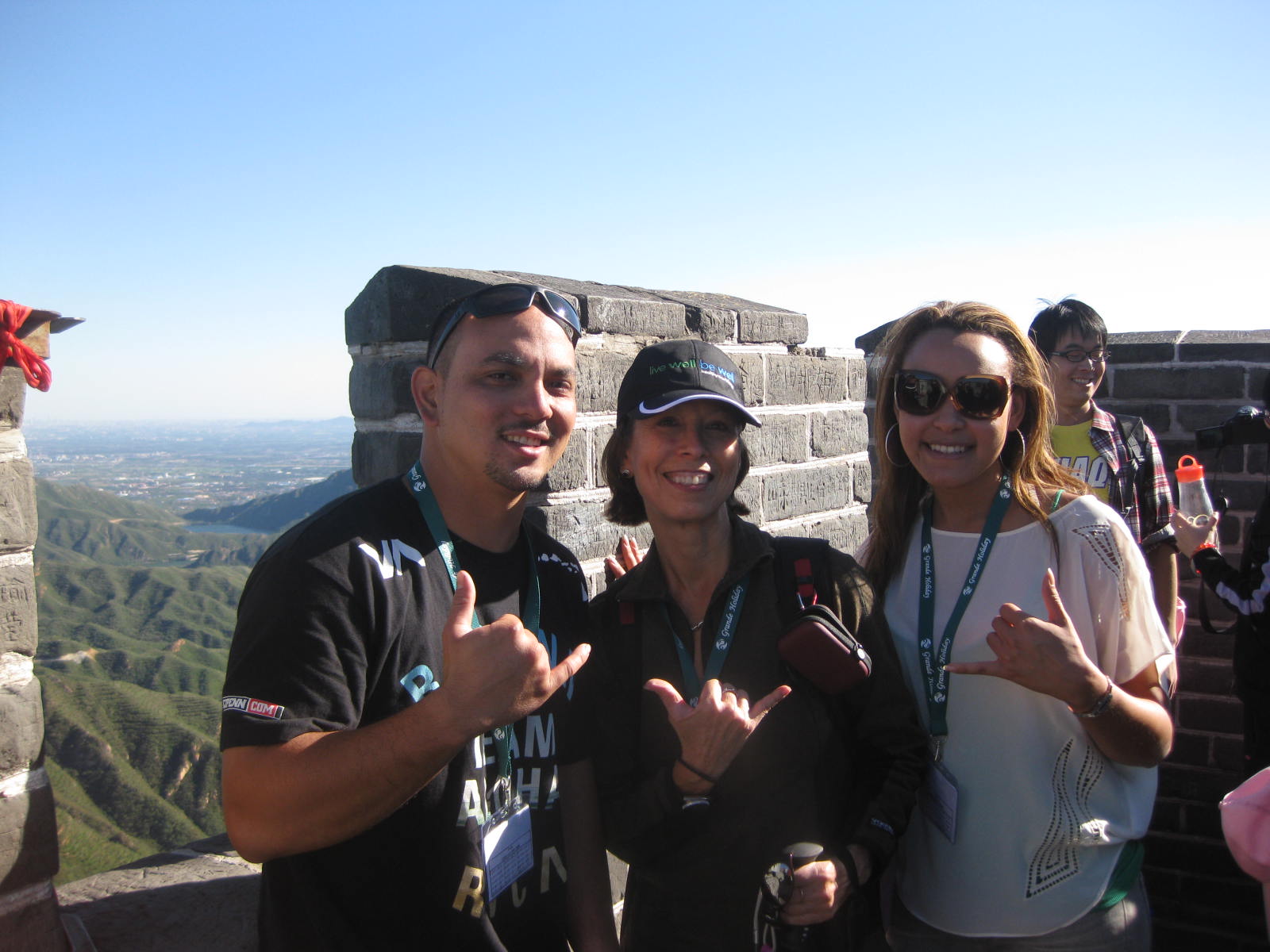
Nephew Collin, Lorin, Niece Lael
We summited in forty-five minutes so we lingered, taking photos and striking the famous, Hawaiian, shaka pose, as Hawaiians are wont to do - repeatedly - throughout China.

Gusts of cool wind carried “outhouse” stench along the stone staircase. Without water to rinse or “flush” these stainless steel squattys were particularly fragrant and visually repulsive. Need I say more? I tried holding my breath but ... you know, that doesn’t work for long.
The small village at the base is a quaint reproduction. There you can buy coffee, sodas, snacks, and take pictures with costumed Chinese warriors. The sun dropped behind the thirteenth tower and the village turned monochrome, drab, gray occasionally punctuated by a red door.
We paused at a large site map to locate ourselves.
You Are Here & Here & Here!
“Look!” Collin bust into laughter. “Every place says You are here! You are here,” he poked at the map, “You are here," he touched it again, "You are here, you are here,” he cackled. “How the hell are you supposed to find yourself?” We burst into laughter and snapped photos, adding it to our travelogue.

Our bus lurched forward. “How many of you made it to the top?” Angela asked once everyone was counted and seated. Seven hands rose to the applause our fellow travelers. 
Angela smiled broadly, “Chairman Mao said you are not a hero until you have conquered the Great Wall.”
I thought it curious that she spoke of Chairman Mao almost as if he were still ruling with the iron fist historically proven to be no better than the Imperialists against whom he railed.

“What are the locks on the wall?” I asked. Chains with engraved locks festooned sections of the wall.
“Chinese people (I noticed that Angela seldom used the word "people" without a qualifier. She said Chinese people or Hawaii people or people from the United States. But I digress.) “Chinese people might engrave their names on a lock. Then they lock it on the chain and throw the key over The Wall. So their love is locked and it will stay strong and last a long time, like The Great Wall.”

“They have squandered an opportunity to showcase their antiquities here,” my sister Gina said quietly. “Can you imagine how many people visit this section of the wall? They’ve built a freeway to it!” She reached for her sunglasses absently and propped them on her head. “They could have a museum; they could showcase other antiquities and entice us to partake - but they don’t. Instead they have this cheap, kitschy, cheesy stuff. They need a good consultant to help them maximize their opportunity in a...” she paused, looking for the right word, “In a tasteful way.” 
Yep, and they need someone who speaks English as a FIRST language to translate their signage. For example: Up your seat for landing versus return your seat to its upright position for landing. Up your seat? Com’on, surely they can do better! Up yer seat too - Bucko!

I pointed to the tightly terraced hills as the road descended in switchbacks on its way to Beijing. Not crops? Angela explained the hills were terraced and planted in pine, cypress and poplars to stabilize erosion.

Angela began to explain China’s 1979 One Child Policy and its current status. 
“Ethnic minorities, like the Manchurians, Tibetans, Mongols, and farmers can have a second child if the first one is a girl. My mother is Manchurian and my father is Han. Children have their father’s lineage so I am considered Han. Most Chinese are Han but we can pay a penalty, an extra tax, and have more children.” 
She said her parents were loyalists. Her words were careful and never disparaging of “Chairman Mao” though he has been dead 36 years and his Cultural Revolution is blamed for 40-70 million deaths, imprisonment and torture of the intelligentsia, and damaging the historical culture and society of China.

We passed a vacant amusement park. “Wonderland,” Angela pointed. A bankrupt Singaporean, investment company abandoned the project prior to completion. It stood yielding to the elements, construction cloth flapping, scaffolding falling, bright primary-colored walls fading, like a child without a raincoat in a storm - waiting.

Our bus stopped at a pullout along a busy street and beneath the IBM building.
“See the dragon?” Angela pointed to the building’s crown. 
Oh my God! No wonder buildings take on these weird shapes in Asia. (For a picture of the ancient Dragon rune IBM reproduced, return to Asian Chronicles-2 and scroll to the seventh picture.) Dragon heads echoed from the tops of columns, stamps in walls, caps on stairwells, and ornaments under eaves.

We crossed the pedestrian overpass to an overlook of the Olympic Village. Low-angled sunlight seeped through cracks between buildings and the air grew chilly.
“Bird’s nest is the symbol of great fortune,” Angela informed. “It was designed by a Swiss firm.”
We stayed just long enough to snap a few pictures before dinner.

Dinner, like lunch, was eight-courses and all meat until the tofu dish arrived just before dessert. I picked out onions, bell peppers, eggplant, and more onions to eat with my rice. Rice, onions, peppers, eggplant, tofu, and watermelon. Weight gain will not be an issue.
     My nephew Colin is a quick-study and comedian. “Let me guess what we’re having for dessert... um... watermelon!” And so it was.
Our day had been full. We returned to our hotel at 7:30 pm and, still fatigued with jet-lag, were quickly asleep.

Saturday, October 27, 2012

Asian Chronicles-2


China 2 Beijing - 9/28/2012

“The restaurant opens at six o'clock,” Derek said before sending us to our rooms. “Some of you will be up at four - so you can come to the restaurant at six.” Mom and I arrived at 0545. The wait staff kindly seated us and served coffee while they finished assembling the breakfast buffet.

“I wanted you kids to be captivated by China like I was,” she said. “When I first came to China and saw all this; I've never been more proud to be Chinese.” 
Mom was a teenager when WWII fractured a flawless Hawaiian sky and descended like swarming wasps upon a quiet, Sunday morning. They watched Zeros dive-bomb Pearl Harbor from the roof of the family home near Chinatown. After that, ostracism of all Orientals became ubiquitous and unavoidable. Mom moved to Florida for a tour of duty with my Dad and the US Navy, where their inter-racial marriage was not recognized. 
Mom has felt the sting of racial bias seldom experienced by Caucasians. Arriving in China for the first time imbued her with a sense of ethnic pride, a these are my people sense of belonging. Raised in a large, Chinese family with traditions of a Cantonese-speaking Popo (grandmother), I understand this well. I too feel the Chinese are my people, though they might disagree.

Breakfast was the wonderful, international buffet commonly found in better hotels across Asia. Its menu included Chinese: congee (rice porridge) flavored with pork, pi dan (fermented duck egg), chicken, or plain; dim sum, fried rice, seasonal fruit (predominantly dragon, cantaloupe, and watermelon), and tea-boiled eggs. Japanese: sashimi, nori-maki (rice with veggies and/or fish rolled in seaweed), miso soup, pickled vegetables. Noodle chef for making Asian soups. American: egg/omelet chef, bacon, cereal, milk, pastries, pancakes, waffles. European: bangers, roasted tomatoes, pastries, croissants, crusty bread, preserved meats and cheeses.

The tour book read: Beijing is the nation’s political, economic, cultural, and educational center as well as China’s most important center for international trade and communications. ...Beijing is one of six ancient cities in China.

We gathered in the lobby and were sorted by lanyard color into the red (lanyard) bus or green (lanyard) bus. It then became clear, red lanyards were on the extended tour floating the Yangste River. 
Our tour of Beijing began on the green bus with local guide Angela - a 30-ish sylph with a deprecating, ingratiating way. “Ne hou?” she said over a microphone. “That means good morning or hello. Can you say ne (knee) hou (how)?” 
Ne hou,” we chorused.

Chinese language now refers to Mandarin but China includes over 50 recognized Chinese minorities, most with their own language. There are eleven major Chinese languages and each has multiple dialects and sub-dialects. 
When the last dynasty toppled in 1911, there was no national language and in many ways, China remained as fractured as before Emperor Qin (the First Emperor, pronounced Chin) conquered six neighboring countries and unified them in 221 BCE. In 1913, the intelligentsia and new government proclaimed the Beijing Guanhua (Mandarin) dialect the national standard and language. Controversy erupted as Mandarin is filled with words from assimilated northern peoples and is considered impure Chinese. The argument for Cantonese was that it is closely related to classical Chinese, more pure. Nonetheless, Mandarin was spoken more broadly for it served as the lingua franca for centuries and with it, it was thought the entire nation could be unified linguistically within 100-years. In actuality, one century later, schools continue to instruct using local languages and Mandarin is studied as the universal language, like a foreign language.
Mandarin uses four tones; Cantonese uses six. Tones lend the sing-song quality to the languages. Change the intonation; change the word. 
This tonemap helps visualize the four pitches of Mandarin. To correctly pronounce ne hou, the word ne (knee) is level, or the first tone. The word hou (how?) employs the 2nd tone, intoned up as if asking a question. NÄ“ hoú.

Ne hou,” Angela repeated. “Good, very good. You are quick learners. How do you say I'm good?”
Hou,” I said with others. Her eyes widened and mouth gaped in surprise. “Oh you Hawaii people are very smart,” her voice warmed with her smile. “Hou is good. If you want to say its very good you say ding hou. If you want to say something is extremely good, you say ding-ding hou.” Someone giggled at the back of the bus. Ding-ding has a different meaning in the islands; not extremely good, ding-ding means penis.

“So how was your breakfast this morning?” Angela paused then responded to someone nearby, “Ding hou? Oh, ding-ding hou!” She was baited by another. She beamed and was visibly pleased with the report that breakfast was ding-ding hou but her look of puzzlement grew with our laughter. “What? Tell me,” she pleaded. 
I watched her listen intently to an explanation at the front of the bus. Angela gasped and covered her mouth, “Oh you people are nasty!” A roar of laughter filled the bus and ding-ding hou became our categoric response until Peter taught us ma-ma-hoo-hoo in Xi'an - but that is a different story for another day.

Our bus crawled onto a freeway - that at 9am - was bumper-to-bumper. “How many people do you think live in Beijing?” Angela asked. We hollered out numbers. “Oh, that's too much,” she scolded with a feigned scowl. “Nineteen million,” she corrected. “They say 15-million is perfect but we have 19-million so travel into Beijing is restricted. You cannot move to Beijing without a job.”

A BMW sedan nearly grazed us as it squeezed in and passengers on the right cried out. “Don't look,” Angela instructed, covering her eyes. “That's why we call our bus drivers sher-fu. You know sher-fu?” Yes we did, we are from Hawaii and we are Donnie Chen fans. We know sher-fu means master, most commonly - kung-fu master. 
That bus drivers are called sher-fu is two-fold: first, they are masterful drivers negotiating large buses through treacherous traffic tangles. (While Beijing's freeways might have four delineated and painted lanes, actual traffic lanes may number six or seven!) In Xi'an, Peter explained that Chinese drivers are inexperienced and drive as the spirit moves them. Yikes! Secondly, many - including our driver - labor away from home for six months or more, so like a kung-fu master before battle - if they are faithful, they are celibate. They earn the title sher-fu.

“We have many joint-ventures with foreign companies in China now,” Angela continued. “That BMW was made here in China. We have Buick, Hundai, and VW.”
“Beijing is like your Washington DC. You are going to Shanghai later? That is our financial center, like your New York City.” 

H2O Cube
Olympic Torch
“What's that?” Angela pointed to a structure on her left. “Yes, the Bird-nest. Did you watch the Olympics in Beijing? Very good. The Bird-nest holds 90,000 people and is the largest stadium in the world.” Of course it is, I thought. 
“What's that next to it? Yes, the Water Cube, the aquatic center for all the water events.” We looked at a silver, cuboidal building covered in fluffy, convex squares. “The skin of the Water Cube is plastic. The outside coating? Plastic. Your Michael Phelps swam there. Did you watch him swim? Yes, he is ding hou.”
“Ding-ding hou!” we insisted, causing Angela’s color to rise with a chuckle.
“Your hotel, The Trader's? It was built for the 2008 Olympics. It is on the east side of Concentric Road.” Beijing has many concentric roads that encircle the city in concentric rings. The concentrics are bisected by connectors, roads to ease Beijing's 24-hour flow of newly minted cars piloted by Spirit.

Angela filled our drive with the facts, figures, customs, and history of Beijing.
You might remember Peking? When Mandarin was adopted as the national language, many names were officially changed to their Mandarin equivalents - and Peking became Beijing.
Beijing is located on a plain surrounded by the Yan Mountains. The Yans create a bowl that cradles smog until its scrubbed clean by wind or rain. It had stormed the previous day; the sky was sunny and bright. 
“You Hawaii people brought Hawaii weather with you,” Angela exclaimed.  And so it was for the entire sixteen days - bright, warm days arose with the sunny people of Hawaii such that every local guide commented on the wonderful state of the weather.

We drove to the Emperor's Summer Palace http://en.wikipedia.org/wiki/Summer_Palace and as we neared, Angela began with its tales. "The Summer Palace Yíhé Yuán, the Gardens of Nurtured Harmony, was built during the Quing Dynasty, 250 years ago. Its two dominant features, Kunming Lake and Longevity Hill, are manmade. Kunming Lake is the world's largest man-made lake (Of course it is, I thought again), covering 2.2 square kilometers." 
     Like all of China's antiquities, the lake was manmade, handmade, hand dug by calloused hands and sweated brow of Chinese peasants. The soil excavations were used to build Longevity Hill. Its purpose - to provide relief from inclement summers within the Forbidden City. Both Palaces were occupied until the Qing (pronounced Ching) Dynasty was overthrown by Sun Yat Sen's democratic government in 1911. 
The Empress Dowager or Dragon Lady was its most infamous occupant. She was the last to rebuild the Summer Palace in 1902. She siphoned millions for the restoration from the Navy just six-years before the First Sino-Japanese War - which China lost. Talk about David and Goliath! 
The Palace is a garden and like all Chinese gardens, strives for the harmony of four essential elements: water (yin), rock (yang), flora, and architecture. In December 1998, UNESCO included the Summer Palace on its World Heritage List. It declared the Summer Palace “a masterpiece of Chinese landscape garden design.” 

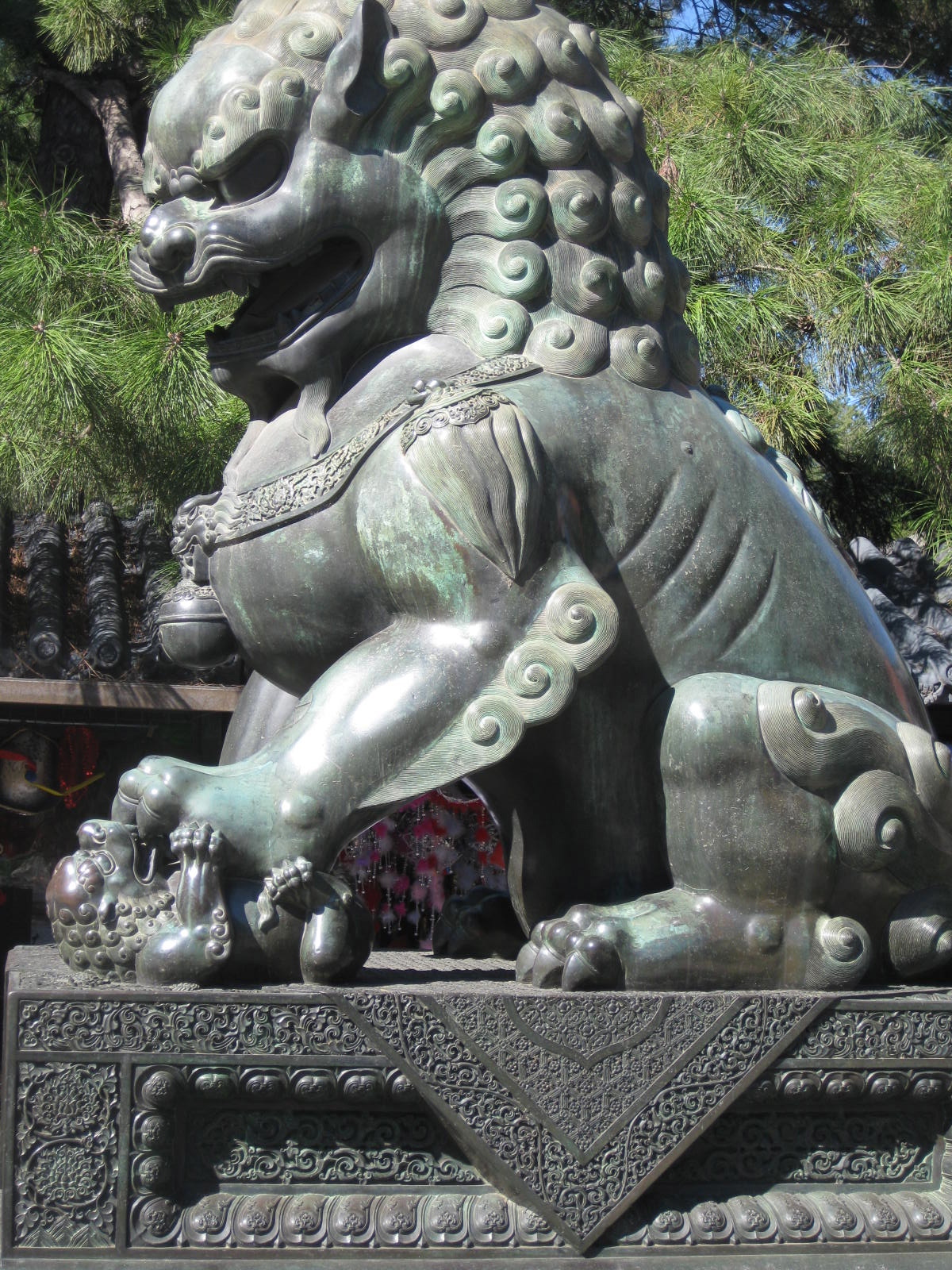
Angela & Yang Fu Dog
We disembarked and Angela unfurled a light green flag atop a meter-long, collapsible rod, like an old pointer used prior to the advent of laser pointers. We would follow this green flag throughout China for it would be passed like a baton, from one local tour guide to the next. 
“Turn on your receiver,” she instructed. In addition to name tags on green lanyards, we also wore small receivers that hung from a blue, synthetic cord. We donned earphones and heard Angela clearly. “Alohaaa - green bus; follow me.”

Yin Fu Dog w/cub
The entrance gate is guarded by two enormous Fu Dogs. Fu Dogs are paired lions - one female, one male - representing both Yin and Yang. They seem identical in every way, one foot propped atop a ball. But under Yin's foot, that ball is a cub rounded playfully on its back. I have seen Fu Dogs my entire life, looked at thousands of them, and have never seen that cub! You know, we look without seeing.
Ancient symbol for Dragon
The most ancient symbol for Dragon, dating back 2000 years, is C-shaped with a dorsal scale and was sculpted in green flowers. The dragon is yang to the phoenix yin. Typically, he is a four-footed, scaled, and wingless serpent and the symbol of power, strength, and good luck. Just two days before the Moon Festival, a national holiday, the city was bedecked, bejeweled, and bedazzled in flowers and this floral symbol of Dragon was our first example of hundreds to come. I have seen this symbol many times with unknowing eyes; now I know.

Raised thresholds keep evil spirits out; their height denotes rank and stature as do the ornamental roof corners. The Palace entrance thresholds were approximately 12-inches high and spanned three doorways.  In ancient times, the central door was for the Emperor only. That tradition was upheld for decades following the collapse of the Qing Dynasty but no longer. A group of school children in matching uniforms entered the Palace willy-nilly; I carefully stepped over the Emperor's threshold with mindfulness to its station in history. 
The Palace grounds are dotted with bronze statues of mythical creatures and imported rocks from sacred lakes. The worlds largest man-made lake is home to a floating lotus garden and the Marble Boat (Qing Yan Fang - Boat of Purity and Ease). 
Pavilion ceiling
We traversed sections of the Long Corridor barely stopping to appreciate its grandeur. The Long Corridor was commissioned in 1750 by Emperor Qianlong so his mother could stroll through the gardens year round.  It is 728 meters or 2,388 feet or 0.45 miles long. Log crossbeams divide it into 273 sections and four octagonal pavilions. Its wood members are richly adorned with 14,000 paintings depicting scenes of classical Chinese literature, folk tales, historical and legendary figures, famous buildings and landscapes, flora and fauna. Long Corridor is the longest painted corridor in the world. Of course it is, I thought yet again.

“Five-star toilets,” Angela sold them like a barker at a carnival. Step right up folks, gichyer five-star western toilets that are clean and comfortable. We got toilet paper, we got seat covers. Git em right here, right now!  Five star means  toilet paper is stocked as are seat covers for western toilets. This location had two western toilets. 
     “Chinese people prefer squatty-pottys,” Angela said, “Because they consider them more hygienic. You’re not sitting on a seat; you’re not touching anything.” Ah, the bulb of understanding was lit. I don’t mind squatty-pottys, in fact, I highly recommend them to maintain limberness and strength - but that’s me.
Do you know the Chinese do not have the rate of falls, hip/femur fractures, and death by subsequent pneumonia of western countries. Wanna know why? Squatty-pottys keep them limber and flexibility is the difference between recovering one’s balance or falling. Squatty-pottys man, I’m telling you, install one for longevity and good health - but I digress as I am wont to do.
Apparently there were a great many western toilets installed preceding the Olympics. Now bathroom doors picture a western toilet if one is installed and many bathrooms have at least one.

“Lady, lady; you lye hat?” The street vendors pounced thick as thieves as we exited the Palace and made our way to the bus. “Ten dollah. Okay, okay, foh you lady? Speshow price jes foh you; fy dollah. You lye? Fy dollah! So cheap lady!”

Saturday, October 20, 2012

Asian Chronicles-1

Getting There 9/26/2012
“How’s preparations for China going?” my friends asked.
    “I have a suitcase parked at the edge of my living room - at which I throw things,” I replied. Two-days before departure, I laid it out in an organized fashion. I would be traveling for 24-days; what did I really need? Passport - check. Camera - check. Wilderness and Travel Medicine handbook - check. Two skorts and long-sleeved shirts - check. Bikini and sarong - check, check. Sling-shot, sock monkey for sister Gina - check. 

I set my out of office response: Traipsing through China, hanging in Hong Kong, munching in Macau. Ne hou ma? Email communication is best. A hui hou kakou! and boarded Hawaiian Air for Honolulu. There I joined my family and our tour group.

Early the next morning, I donned the forest-green, "Grande Holiday" lanyard holding my name-tag. At 10am people congregated along the wall at Korean Air’s check-in counter. Decibels grew steadily with the crowd. 
Lael, Mom, Gina, Michael, Collin
Mom had signed on with a small tour of twenty - perfect - but Air and Sea Travel had tossed our tour into a larger one. Some lanyards were green, others red; I knew not why. The group grew to eighty. Many were elderly and I felt some relief for my niece and nephew upon spotting a few twenty-somethings wearing name-tags. Most travelers had lunched in Chinatown on September first - for a tour debriefing. There I presume, they met our guide Derek. 


Derek is a slight man of Chinese descent. He wore a striped pull-over, faded jeans, and Keen sandals. Mostly Derek lives in hotels and out of suitcases. His wife and children however, live in Beijing while he straddles the dateline. His English is heavily accented in a way that is both familiar and homey.
Derek gathered us round, "They change the plane; I like this one better, it's bigger. We have ten rows. The seats are arranged two and four and two. Yup? Alright? Two, four, and two,” his fingers, extended overhead, reconfigured themselves from two, to four, to two.  “So married couples can sit together - two; easy. And one can have the window and one can have the aisle and you can switch so no one is trapped. Okay? Alright? And if you are in the middle four, you can go out on the right or on the left." His hand waved, gesturing right, then left. "Okay? Alright?"

I was reminded of a friend who passed his camera to an oncoming hiker for picture-taking. "You look through the little hole here," he said stating the obvious, "And you push the  little button there." That my eyes weren't captured rolled to the welkin was pure luck.

Derek continued, "The alcohol on board is free. You can have red wine or white wine. They will show it to you and you can tell them. Please enjoy but DO NOT GET DRUNK," he giggled, softening his caveat. Yup, okay, alright Derek.
My nephew Collin, a big, Hawaiian kid, mimicked, "If you in da middle, you can exit right oh lef. Alright? Okay?" We giggled our way to security.

We flew a newer, Korean Airlines airbus A330 with individual eight-inch LCD screens and USB ports for charging. We would travel 9.5 hours and 4,549 miles, crossing the dateline into a Korean evening nineteen hours ahead of Hawaiian-time. I watched several movies, made preliminary journal notes, and cracked the cover on a new and highly recommended book, The Corrections by Jonathan Franzen.

    In preparation, I loaded my iPod Shuffle with favorite instrumentals - classic and modern - purely for escape and relaxation. I downloaded three audio-books into my iPad and iPhone. I however, still gravitate to paper and The Corrections was no exception. So when I say crack the cover, I do mean it.
    The Corrections is a best seller, winner of the National Book Award, and Pulitzer Prize finalist. It was also a recent finalist for NPR's top 100 by American novelists. It is a must read for those who are or have aging parents. Did I get everyone? Within its pages I felt revealed and known and expressed and celebrated and devastated and illuminated and transformed.

    Many hours later, we processed through Incheon International Airport in Seoul, Korea to catch our connecting flight to Beijing. It was 11pm Hawaiian time. Incheon was clean and spacious, its surfaces gleamed, its air - fresh. These features hardly impressed me at the time but would assume new shimmer and shine upon my return.
    Our China Airlines carrier was lackluster after the Korean airbus, sans individual LCD screens and USB ports. Domestic carriers, even in the states, have few amenities. We landed in Beijing at 6pm local time and 3am Hawaiian time. Darkness fell as we collected luggage and cleared customs.
    The barricade outside Receiving was lined with eager greeters including, not surprisingly, Starbucks. Our bus awaited two-blocks away, across a densely packed street that rose in resentful and incessant blaring at the mere notion of stopping to let 80 people cross. We negotiated uneven and unlit sidewalks, shiny with rain, and waited in the bus while the lost were found.

    My head spun and circled on approach for landing on a Beijing pillow at approximately 9pm local time,  6am Hawaiian time - after a full 25-hours of wakefulness. I was tired but with the jittery alertness that comes with sleep deprivation and a body driven by will and necessity.

Tuesday, August 21, 2012

Welcome to Neurology


I sent a text to a small audience: Got z call! I’m top o z list and I accepted! So z factor that most affects a start date is z re-credentialing pkg. Mahalo!!! U may un-pretzel now! (keepg all appendages crossed). More soon!!! Xoxo   ~L

Amid the yippees, yee-haws, and congratulatory texts, one stood out at the end of the day: SUPER NEWS!!!! Congratulations and welcome to Neurology. Welcome to Neurology... they can’t take it back now; can they?

After a six-year hiatus, I would soon return to Kaiser Permanente (KP) as a Nurse Practitioner (NP). I held my breath and spoke not a word. Beyond that core group of friends, I shared the news with no one. I waited in disbelief, bracing for the call rescinding the offer with sincerest apologies for their error. When a week had passed without retraction, I told my Mom and called my manager.
“This has been a great place for me to land,” I said. “It expanded me and in doing so, it expanded the NP team at Mercy General, where we now manage the diabetes of all post-op open-hearts.” The ripple effect through my life is seldom so clear. “But it is one of my heart’s greatest desires to work as a nurse practitioner for Kaiser.
“I understand,” she said, “Were I in your shoes, I’d do the same. You have been an asset to this department and we will miss you.” Ditto.

Six years ago, my job with Kaiser's Hospital Based Service (the internist group that cares for hospitalized patients) was mortally wounded by line-item veto during a budget battle. I found employment as a staff RN in the ED (Emergency Dept.) overnight. A year later, I moved into diabetes management where I have flourished in an expanded-RN position. But an expanded-RN role is far from an NP role.
Saturdays at the General, I round independently, write orders, confer with other clinicians, and sometimes call for specialist consultations. Mondays at KP, my orders require approval and a doctor’s signature. The weekly demotion is acute, the loss of status - sometimes humiliating.

In a recent conversation, a physician said, “Your diabetes work is inspired, and authentic, and transparent. You’ve found expression there, and joy, and it enlivens you. It’s kind of a sweet spot.” 
“Yes,” I nodded.
“I am wondering how you reconcile this sweet spot as you look about for something else in your want to work as a nurse practitioner.”
“Well, you know,” I started slowly, “There is growing where I'm planted AND I am not my circumstance. The quality of my life will not be determined by my circumstance... and sometimes it is.”
“So you have a commitment to growing where you’re planted?” 
“Yeah, I guess,” I cast a long, backward look through my memory. “It’s always kinda been that way. Growing where I’m planted is certainly one way I live and I am intrinsically happy; I make lemonade. There is also recognizing when I am planted in fallow ground. My life is not a spectator sport. If I can’t play ball, if I can’t put down roots to nurture me, I’ll take my ball elsewhere.”
Diabetes Management had been anything but fallow ground.

If I knew then what I know now... I turned my nose up at two jobs in 2005-2006. One job involved migraines. Migraines? Does that have anything to do with the heart? 
Pause in think: When my favorite cardiovascular surgeon is particularly playful, he will respond to my questions saying, “Wait a minute, does this have anything to do with anything between the zenith of the aortic arch and diaphragm? Hmm? Then why are you asking me?” At which time we bust a gut. Thus my tangential, rhetorical question regarding migraines. But I digress.
The other job involved caring for Kaiser patients in skilled nursing facilities - the smells of which make me wretch, while managing monthly blood work held little appeal to daily, even hourly labs.

But if I knew then what I know now... that the KP tide would turn from NPs and I was in for a six year drought through which I would work split days-off to keep a particular skill-set alive. 
“I’m proud of you, at your persistence and creativity in the face of disappointment,” my friend said.
Yes, I’ve made lemonade and enticed many into drinking the Kool-Aid. Its been fun, rewarding, expanding, all that... and underneath it all has been my deep and sometimes despairing disappointment in not working for KP as an NP.

So its back to from expert to novice yet again for me. This is what I noticed... fear.
Fear that my friends Jack and Rochelle (neurologists both) will find out that I’m not very smart, and not all that teachable, and stubborn, and argumentative, and that all my work in diabetes was flukey and coincidental. Basically, I fear they will find out I’m a fake.
“Oh,” Blake said, “You’re suffering from the Imposteur Syndrome.”
“Impostor Syndrome; what’s that?”
“The Imposteur Syndrome,” he explained, “Usually felt by someone who has taken on something big and it’s working. They feel a little out of their league, hence a fake. And they are usually playing a bigger game.”
“Yep, that’d be me, z imposteur.”

Self-censoring internal dialogue - we all have it and it flares, fanned by circumstance. They’ll find out I’m a fake is some version of I’m not good enough - a primordial conversation for human being along with: There’s something wrong, I don’t belong, and I’m on my own. 
When these conversations run hidden in the background like elevator music... ever leave an elevator humming the song that played within? It’s so subtle. When self-censoring, internal dialogue plays in the background without our awareness (Landmark calls this undistinguished), and our actions and decisions are based upon disempowering beliefs about ourselves and others... life can be reflexive and knee-jerk.

In a recent training THE take-home message for me was this: A key aspect of integrity is knowing how I occur for myself.
How I occur for myself is like a brown pair of shoes at a black-tie affair, like an imposteur, a fake. How that manifests is that I withhold and keep secrets because if I told you of the fourteen patients who have weaned themselves from insulin and countless others who have lost weight and take a fraction of their previous medications, you might look deeper and finding that some have backslid - deem me a charlatan.

On a conscious, rational level, I know that inspiring and motivating people into new action is no different from that which supports them once change is made. However, my workflow does not include both. I am paid to do one and work in the other steals time from that for which I am paid. So I move people to take action but once they achieve the goal, I work elsewhere. 
And truly - if I didn’t have this justification, this human being would likely find another. My Landmark training helps me distinguish that the entire conversation is in service of: I feel like a brown pair of shoes at a black-tie affair. When I can see that, when it is distinguished, I can set my concerns for hiding, faking, and looking good aside to share my excitement in life with others.

It takes enormous courage to try out new ways of being in the face of fear and by choosing to do so, we become less reflexive and more author of our own experience. Choosing requires courage - and courage leads to the ontological discussions of being
Ultimately, there IS no reconciliation with where I am and what I want. Sometimes, rarely, I have been resigned that I might never work for KP as an NP. Nonetheless, I show up and play. The venue may change but my heart is not tied to the venue. My heart is tied to being: who I get to be and how I get to play. 
As it turns out - my new playground is spelled NEUROLOGY.

Those who know me well, know this as my creed, BaconiOS, if you will:
A person who is a master in the art of living makes little distinction between their work and their play, their labor and their leisure, their mind and their body, their education and their recreation, their love and their religion. They hardly know which is which, they simply pursue their vision of excellence and grace, whatever they do, leaving others to decide whether they are working or playing. To them they are always doing both. ~ Lawrence Pearsall Jacks

I must be re-credentialed at KP. The background checks should fly as I am a KP employee and currently working as an NP (thus possess a DEA number, furnishing license, etc.) Ultimately, the credentialing process allows me to write orders, prescriptions, and bill for my work. It is a two-three month paper-chase. I now await arrival of the tome, a two-inch-thick packet from Human Resources.
Realistically, I expect to land in Neurology (fingers crossed) in November.

Mahalo for your support through these many years. 
Play on and I’ll keep ya posted!

Tuesday, August 7, 2012

Mating in Captivity ~ Unlocking Erotic Intelligence


Love never dies a natural death. It dies because we don’t know 
how to replenish its source. - Anaïs Nin 

I have just read a riveting page turner, Mating in Captivity - Unlocking Erotic Intelligence. Written by couples and family therapist Esther Perel, I’d say its underlying question is (in the words of Dan Fogelberg), How do we make love stay? 

“Monogamy easily slides downward into celibacy,” Perel asserts, and relational celibacy is seldom, mutually acceptable. Perel examines long-term relationships beneath an uncommon lens, dissects common pitfalls, and builds bridges back to love, sex, and eros where sex and eroticism are not equivalents. 
Many marriages simmer in resignation, enduring versus endearing. Entrenched behaviors and disempowering forms of communication create callous combatants versus convivial compadres. “I’m often amazed at how couples can be up on the minute details of each other’s lives, but haven’t had a meaningful conversation in years.”

Over time, we build barriers in lieu of bridges and our relational dance floor becomes  increasingly cordoned by the taboo. We point to our boundaries, training others to avoid  the out-of-bounds. We don’t address drunkeness or acerbity that reopen festering wounds. We waltz around sensitive topics and the elephant in the room. 
Bridge-building occurs in dialogue - dialoguing through the minefield of fantasy and fear - getting nakeder than naked.

What Perel lacks is access to ontology - the nature of being and relational technology that allows partners to see the impact of their being-ness and behavior on the other, the ability to step outside oneself and become what Eckhart Tolle labeled the watcher.  Without that, partners can stay very, very stuck, entrenched in the rightness of positions and perspectives. You wanna be right or you wanna be happy? So while I agree with bridge-building, from a Landmark perspective, her methods lack trusses and bolts. 
Nonetheless, it is a powerful book and in its reading I gained appreciation for the difficulties of relationship and the capacities, or lack thereof, of its constituents.

“Your friends, don’t understand how you could let your life devolve to a state where you have no partner and aren’t interested in one,” she said.
“We were put here to be in relationship,” he said. “What about you Lorin; when are you going to be in relationship?”
“When I meet someone who inspires me to it,” I defended.

I defend myself weekly and weakly against the onslaught asserting that I should be dating or in partnership or seeking partnership.
I hear their concern and... I have gobs of relationships. If there is one thing growing-up in a large, extended, Asian family teaches - it is to be in relationship. But that is not what my friends point to and against which I defend.
To some degree, I agree with them. Should you have told me that seven years later I would have no real appetite for an intimate, romantic relationship, I would have disagreed. Nonetheless, there it is. I have no explanation other than I have no heart for it. And that, my friends, cannot be conjured ... so I defend. 

Dating to placate my friends or to meet some mythical deadline seems pure folly. I am not lonely or lacking. I am whole without a man. It is what it is.

“I’m a happening guy, I’m cool, I read,” one gentleman asserted while lamenting he lacked “Yummy Man” status. And he is cool ... but he lacks tools and is unwilling to acquire them. Pouting and defending one’s unwillingness to have conversations for workability and alignment is certainly one way ...

“You don’t have a TV?” he looked surprised. “You mean we can’t have a TV in our bedroom? That’s a deal-breaker.” Whew! Was my sigh of relief audible?

“My wife can’t have conversations like that. She can’t hear them and she can’t be with them.”
“C’mon!” my voice rose, “You can’t set things up? Frame them and have conversations for alignment and workability?”
“No,” his head shook. “No,” he reiterated more forcefully when I my jaw gaped and eyes popped. “And pointing out where communication doesn’t work is perceived as nagging. There’s all the make wrong and ... baggage,” he gave me a pained, pinched look.
“That SUCKS Cameron.”
“Uh-huh,” he nodded with an expression that unequivocally said, Yeah, so what?

If life is indeed created in language, then I seek someone who can language an intention to create and recreate love on-goingly, one who can generate conversations for workability and stay with them through breakdown to breakthrough.

Why is it okay with you to be treated that way?
Such a question can look like a nudge toward the door rather than the mine shaft it is. Mine shafts are for mining. They are dark and scary - to which we can bring light and discover treasure. My friend Paki would say, “There IS cheese down that tunnel.”

We know one another through language - and language can be sorely limiting. That limitation gives rise to music, poetry, and prose... the arts. Nonetheless, language is what we have and our reticence with our “outside voice” is very often the cause of our suffering: our unwillingness to have difficult conversations, to express how things are for us, to create alignment, and jointly forge new paths. We weren’t trained in this and there are painfully few examples that it works. 

Perel points to deliberate, parental orchestration of our children’s lives and the channeling of eros from partner into children. The birth of the first child often leaves parents (particularly fathers) surviving in an emotional desert. “I do believe that sex matters for you and your partner. How did it come to be that, on the extensive list of things your children need, parents who have sex isn’t one of them?”
Take home message? Orchestrate for ourselves, for and despite our children.

The cornerstone to the entire structure of marriage is a promise to love, honor, and cherish. Loving with our hearts, our souls, and our bodies. I assert the real work of marriage is an intention to restore and re-presence love on-goingly - with our hearts, our souls, and our bodies. We lose sight of this, we don’t speak it into existence, we don’t point to its starts and stops and pull for it  in the moment it wanders. Often, we do not row together but drift, oars up.
Further our focus on till death do us part is flawed and stigma prevails, albeit dissipating, in divorce. We have our eye on the wrong ball. If we had our eye on love, honor, and cherish - till death do us part would be a forgone conclusion. How do we do that; keep our eye on love, honor, and cherish?

When is pointing to love’s starts and stops like nagging? When one feels at fault. Its all in the delivery; is it not? We can hear anything if we are not made wrong. I think the cornerstone is an intention bigger than marriage itself, bigger than staying together till death do us part or the habit of it or inertia or fear or to preserve public persona and looking good or for the kids or because its the right thing to do or from a commitment to it or a bigger commitment to honor one’s word. 
Consider a marital commitment as old news unless that commitment gives rise to an intention to nurture the nature of its constituents. What? Nurture the nature of its constituents? What would that look like? It would look like knowing and providing that which makes your partner feel loved, honored, and cherished without regard for oneself.  What is today’s intention for my beloved? A relationship from a commitment might look very different from a relationship rooted in a commitment that inspires created and re-created intention.

Some years ago, a bleader (blog reader) said, “You’re not in relationship; you don’t know.” I let that silence me for many months. ...I was married longer than most. Without the distractions of children, I had years to cogitate and ruminate. When I expound on marriages of resignation and unwilling partners - I know from whence I came and daresay, it lends a particular perspective.
Writing brings my life and thoughts into focus. I often write when I am troubled or seeking clarity. Writing helps distill my seemingly random and disconnected thoughts into something orderly and meaningful. T’was the case here. I feel like a big chunk dropped into place. ... I can see the barrier and the opening.

I am primarily unattached to whether couples stay together. I am committed that they find peace, joy, and love versus suffering and struggle. More than love, what people seek in relationship is to be heard, known, and accepted for who they truly are.
This year, I am being trained by Landmark to “listen.” My hope is that people find themselves in my listening and discover the soft landing and sweet spot where who they are can unfold and express. That’s good relationship material in anyone’s book!

Mahalo for your bleadership, ongoing dialogue, and email threads - stirring the reduction of blog. 

Thursday, June 14, 2012

Remembering Father on Father’s Day


Father’s Day quickly approaches and I find myself unexpectedly tearful. Dad died last July 13th; this Father’s Day is my first without a father. And... I am unexpectedly tearful. 
I’m not sad Dad died; Alzheimer’s ensured no remnant of him remained. I am deeply mournful of his last years, watching all of him trickle away.
His moments of anguish were mine, those shocking moments when he knew.
“I know my brain doesn’t work good anymore,” he said, tears trickling down his cheeks. “Help me,” he pleaded. I held him and loved him, it’s what there is to do when Alzheimer’s comes calling. Moments like that were islands in the stream of belligerence, arguments, combat, and confusion. He was more vacant with each trip home, his words more spare, his expression more wooden.
“What DO you think of Dad?” I asked during one of his more lucid moments.
“Nothing,” he said with a wide-eyed look of astonishment, “Absolutely nothing.”
In some ways, I think it was easier when he no longer knew, once his thoughts quiesced.
In looking beyond his undoing, there is much to celebrate in my father. He was a man of his time, hardworking and dutiful. A child of The Depression, he knew hunger, and poverty, and resourcefulness. He vowed he would never be that hungry again, that hunger would be a stranger to his home and children. Dad made good on his word. Our garments were home-sewn; we didn’t have much but we had a “Roof over our heads and food on the table.
Viewing the gestalt of his life, he did well. He fulfilled his evolutionary duty raising and fledging offspring. He climbed the socioeconomic rungs from poverty and provided for his family even in death. Dad was successful by any measure.
In viewing him as a soul seeking expression and fulfillment in the world, I fear he fared poorly. Undoubtedly, full self-expression was not on his radar - but if it had been - what would it have been? Dad loved his family and he loved to sing. He loved Rogers & Hammerstein musicals and the outdoors: hiking, skin diving, scuba diving, and fishing. I don’t remember him doing much of what he loved. In fact, I know very little about what he loved or how, when, and IF it found expression. Typical of his time, Dad was stilted in his expressions of love. He seemed bound by duty and suppression, trapped in roles, and for that, I grieve.
Concerning men at large as a seemingly separate species and alien unto myself, I can be critical of their obsession with sports and its trivia. And of their fascination with cars, guns, and gadgets. Contrarily, Dad did not seem to have passions. Was I oblivious or was there no space or will for his passions to bloom? I fear his passions trickled away decades before his mind.

Men step or misstep into this role that occupies their thoughts, time, will, effort, attention, and intention. Fatherhood subsumes their lives. We seldom see our fathers sans the Father-Filter. But if we did, if we viewed them as souls seeking expression and fulfillment in the world - what fertile ground could we till for them?
Father’s Day is a day set aside to ensure we acknowledge and remember fathers. I am remembering mine and acknowledging the many fathers that grace my life. 
On this Father’s Day - learn the passions of one father you love  
and nurture his expression in the world.
Happy Father’s Day to all fathers past, present, and future. 
Fulfilled fathers:  
may we know them, 
may we nurture them, 
may we be them, 
may we raise them.